
Wi-Fi 7 and Wi-Fi 8
What Wi-Fi 7 brought, why Wi-Fi 8 aims for reliability rather than speed, and why the 6 GHz band is contested across Asia-Pacific.
- 802.11be
- 802.11bn
- MLO
- 6 GHz
- UHR
Most broadband traffic travels its last few metres over Wi-Fi. A fibre connection can deliver gigabits to the door, but what users experience depends on the access point, the walls, the neighbours, and the spectrum available. Wi-Fi 7 raised the ceiling with wider channels and links that use several bands at once. Wi-Fi 8, now being standardised, keeps the same peak speed and focuses instead on making connections consistent. Meanwhile, regulators across Asia-Pacific are deciding how much of the 6 GHz band Wi-Fi will get.
Generations
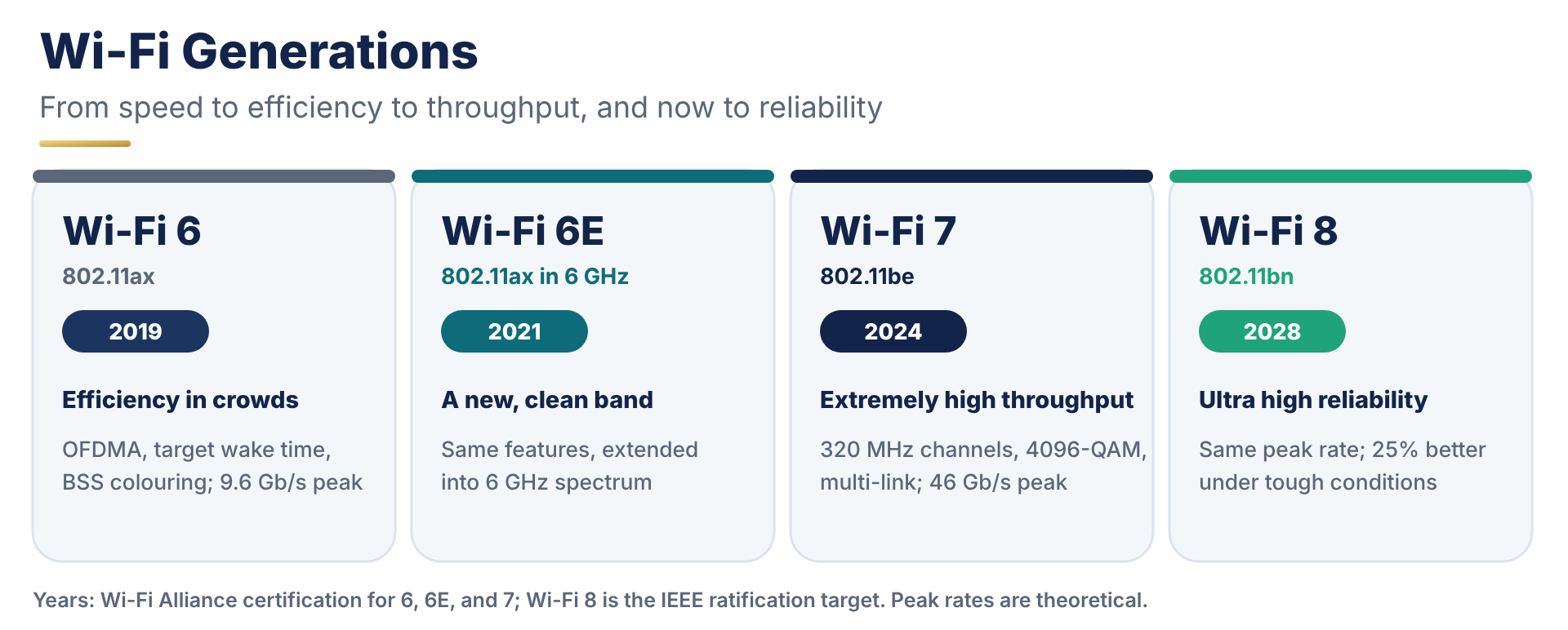
The IEEE writes the 802.11 standards and the Wi-Fi Alliance certifies products and gives them generation numbers. Certification often starts before the IEEE standard is formally published: the Wi-Fi Alliance launched Wi-Fi 7 certification in January 2024, while IEEE 802.11be was published in 2025.
Wi-Fi 7
| Feature | What It Does |
|---|---|
| 320 MHz channels | Doubles the widest channel of Wi-Fi 6, available in the 6 GHz band |
| 4096-QAM | Packs 12 bits into each symbol for clean, short-range links |
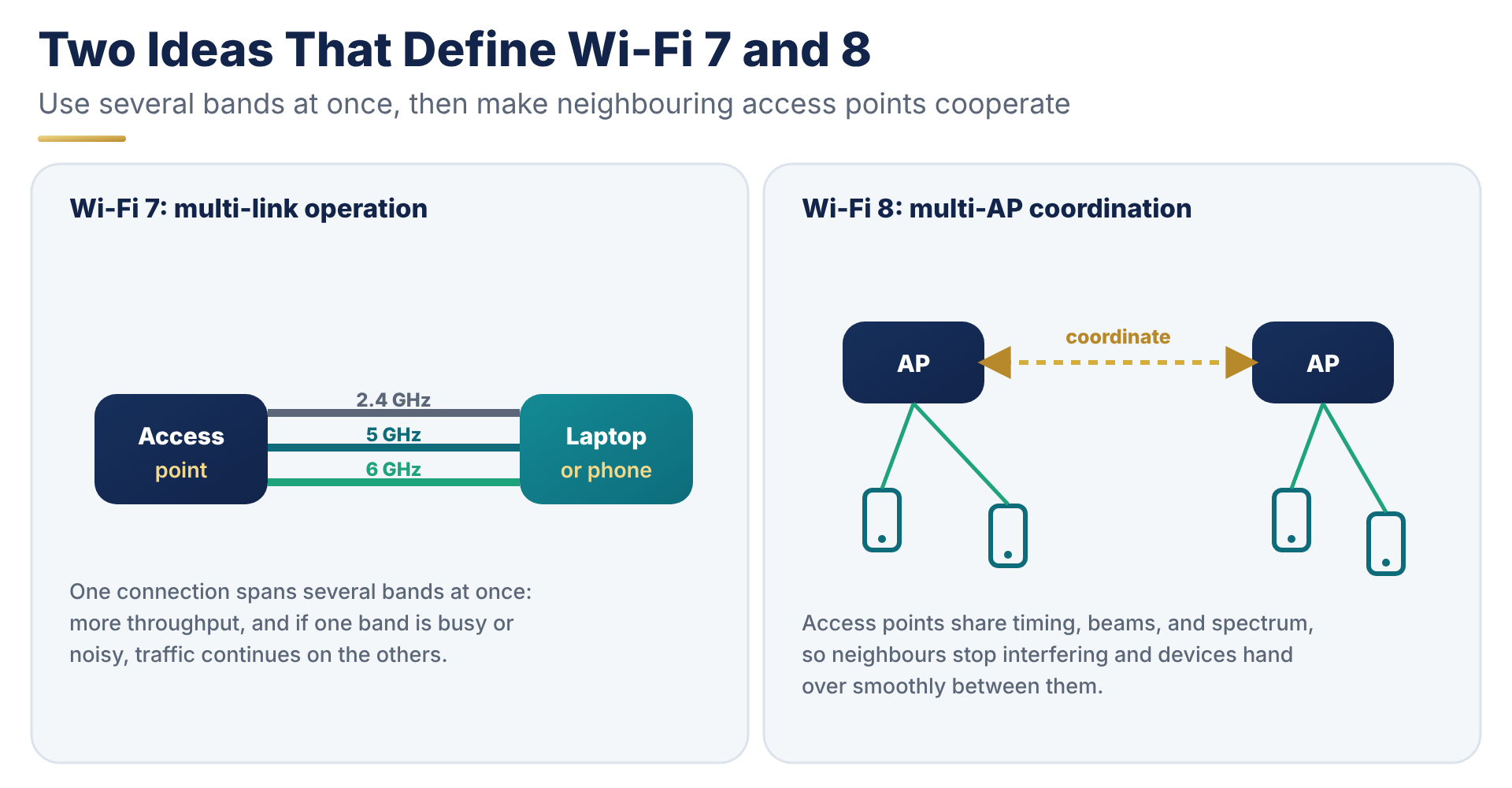
| Multi-link operation (MLO) | One connection uses 2.4, 5, and 6 GHz together for speed and robustness |
| Preamble puncturing | Uses a wide channel even when part of it is busy |
Adoption has been fast. The Wi-Fi Alliance, citing IDC, estimated that about 583 million Wi-Fi 7 devices would ship in 2025, and enterprises are adopting it faster than previous generations. But many homes still run older routers: in the third quarter of 2026, 80% of Wi-Fi 6-capable smartphones in Indonesia and 73% in India were connected to Wi-Fi 5 or older home networks.
Wi-Fi 8
Wi-Fi 8, IEEE 802.11bn, is the first generation that does not raise peak speed. Its project name is Ultra High Reliability (UHR). The goal is that Wi-Fi behaves more like a wire: steady throughput, low latency, and few dropped packets, even at the edge of coverage or in crowded buildings.
- Multi-AP coordination. Neighbouring access points coordinate their timing, beams, and spatial reuse so they stop interfering with each other.
- Better performance in poor conditions. Targets include about 25% more throughput under weak or noisy signal conditions, and lower worst-case latency.
- Seamless roaming. Devices move between access points without dropping sessions, important for voice, video, and industrial uses.
- Coexistence. Improvements for sharing antennas and spectrum with Bluetooth and ultra-wideband.
Draft 2.0 went to ballot in August 2026, and IEEE ratification is targeted for September 2028. Chipmakers showed early Wi-Fi 8 silicon at CES 2026, and ABI Research expects almost half of smartphone chipsets shipped in 2030 to support it.
The 6 GHz Question
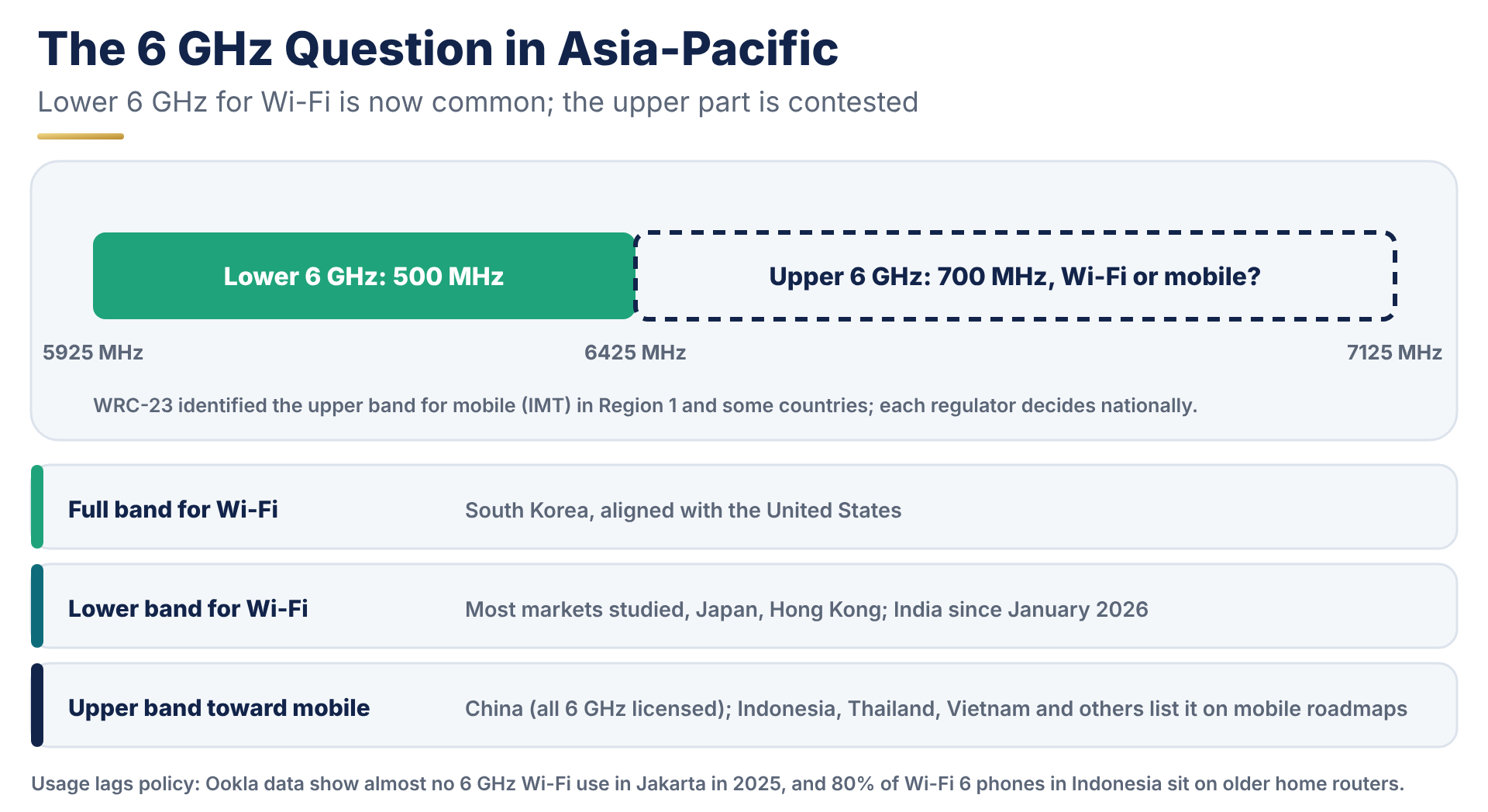
Wi-Fi 6E and 7 depend on the 6 GHz band for wide, clean channels. Most Asia-Pacific markets have opened the lower 500 MHz (5925–6425 MHz) for Wi-Fi; India joined in January 2026 after five years of debate. The upper 700 MHz is contested. Mobile operators want it for 5G and 6G capacity, and the GSMA argues that licensed mobile use brings far greater economic value. The Wi-Fi industry argues that full-band access is needed for 320 MHz channels. South Korea opened the full band to Wi-Fi, China reserved the whole band for licensed use, and countries including Indonesia, Thailand, and Vietnam have placed the upper band on their mobile roadmaps. The policy background is covered on the Spectrum page.
What Comes Next
The near future is Wi-Fi 7 replacing older routers, fibre reaching into rooms as described on the PON page, and Wi-Fi 8 arriving in products from around 2028. The 6 GHz decisions taken in Asia-Pacific over the next few years will shape how much room both Wi-Fi and mobile networks have to grow.
References
- IEEE 802.11be (2025) and 802.11bn draft documents; Wi-Fi Alliance, Wi-Fi CERTIFIED 7, January 2024.
- ABI Research, Wi-Fi 8 market insights, 2025–2026; Tom’s Hardware, TechSpot, and TP-Link white paper on Wi-Fi 8 UHR.
- Le Monde Informatique and Network World on Wi-Fi 7 adoption, citing the Wi-Fi Alliance and IDC.
- GSMA, “6 GHz in APAC” and city data cards, 2025–2026; Business Standard and ABI Research on India’s lower 6 GHz decision.
- Elets eGov on Wi-Fi network quality in India and Indonesia, November 2026; RCR Wireless on global 6 GHz adoption.