
Fixed Wireless Access: Broadband Without the Trench
How 5G delivers home broadband without new cables, where it is growing fastest, and when it makes sense compared with fibre.
- 5G FWA
- CPE
- Mid-band
- India
- Fibre mix
Fixed wireless access delivers home and business broadband over a mobile network. A receiver on the wall or by the window connects to a nearby 5G cell, and a Wi-Fi router shares the connection inside. There is no trench to dig and no cable to pull, so an operator can sign up a customer in days. FWA has become one of the clearest commercial uses of 5G: it took all net broadband additions in the United States from 2022, and in India it has grown to more than 13 million 5G subscribers in about three years. This page explains how it works, where it fits, and its limits.
How It Works
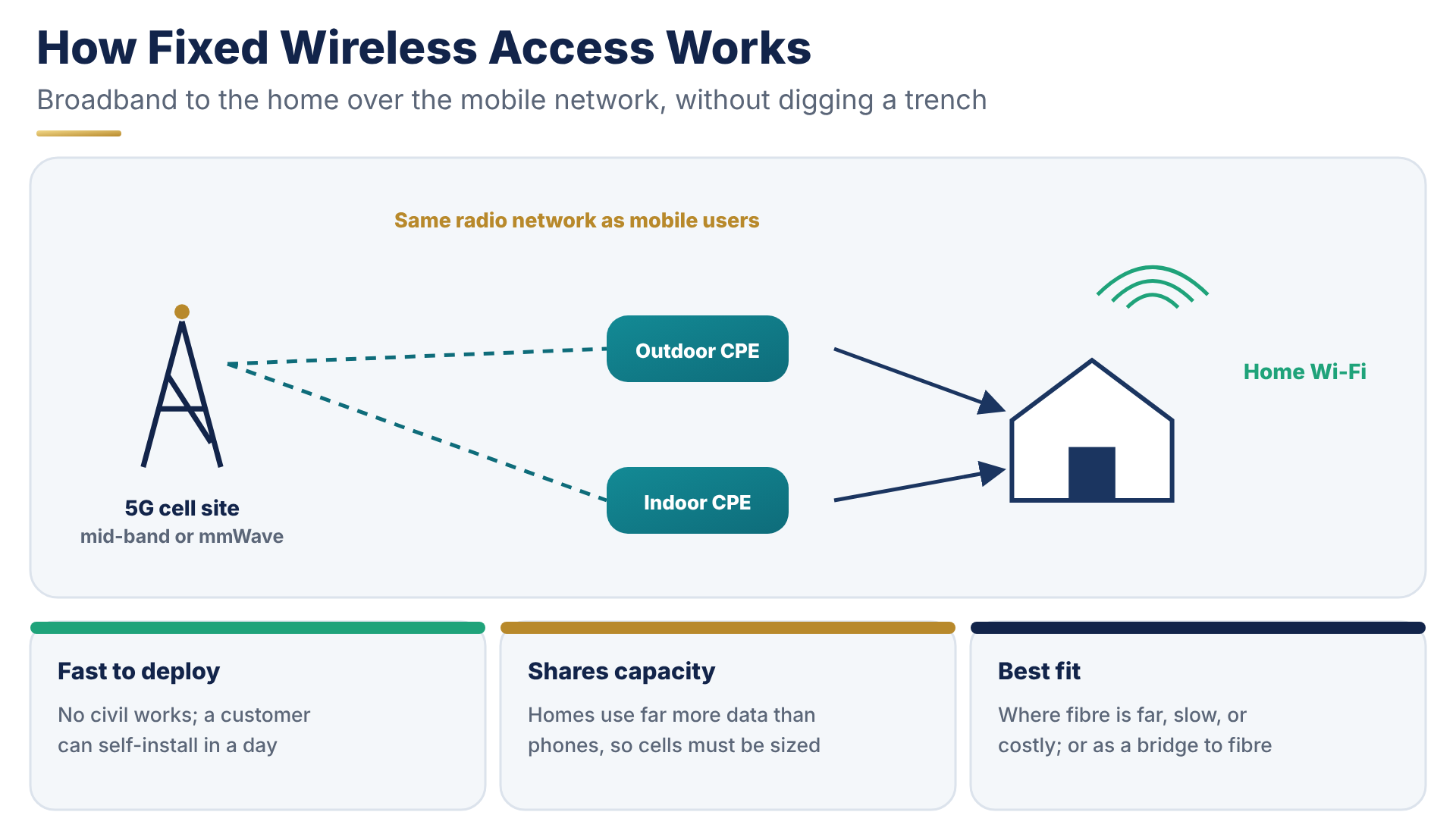
- Spectrum. Mid-band 5G, typically around 3.5 GHz, provides the capacity most FWA needs. Millimetre-wave bands offer more capacity over shorter distances.
- CPE. Outdoor units with directional antennas get much better signal than indoor units, which means more capacity per customer and fewer complaints.
- Capacity planning. A home uses many times more data than a phone. Operators limit how many FWA customers each cell sector can take so mobile users are not squeezed.
- 5G Standalone. Network slicing can give FWA its own guaranteed share of capacity and support business-grade service levels.
Global Picture
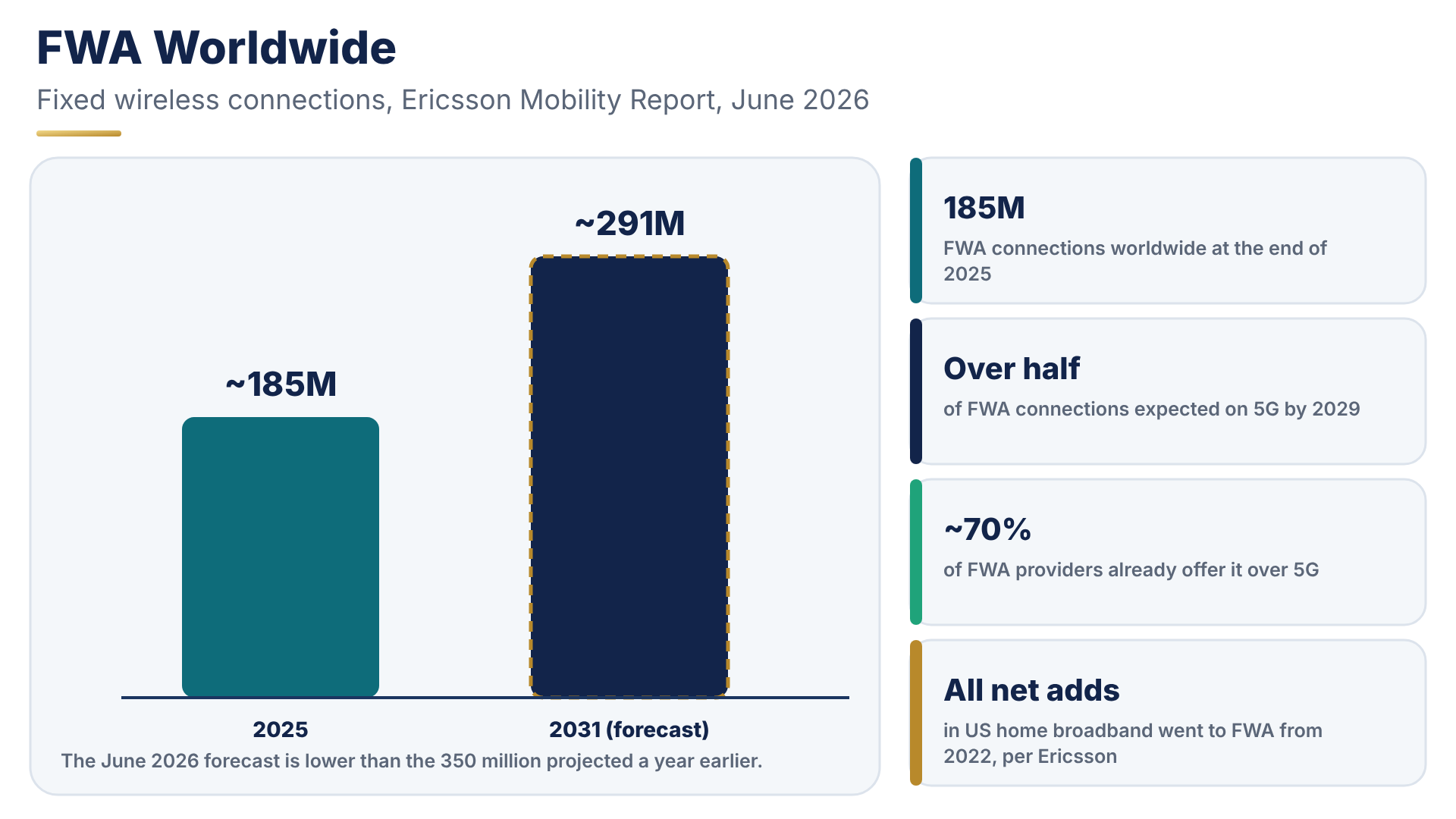
Ericsson counted about 185 million FWA connections worldwide at the end of 2025 and, in June 2026, forecast about 291 million by 2031, lower than the 350 million it projected a year earlier. About 70% of FWA providers now offer the service over 5G, and Ericsson expects 5G to carry more than half of all FWA connections by 2029. Together with fibre, FWA is expected to account for almost all growth in fixed broadband to 2031. Satellite broadband, covered on the LEO page, serves the most remote locations.
Asia-Pacific
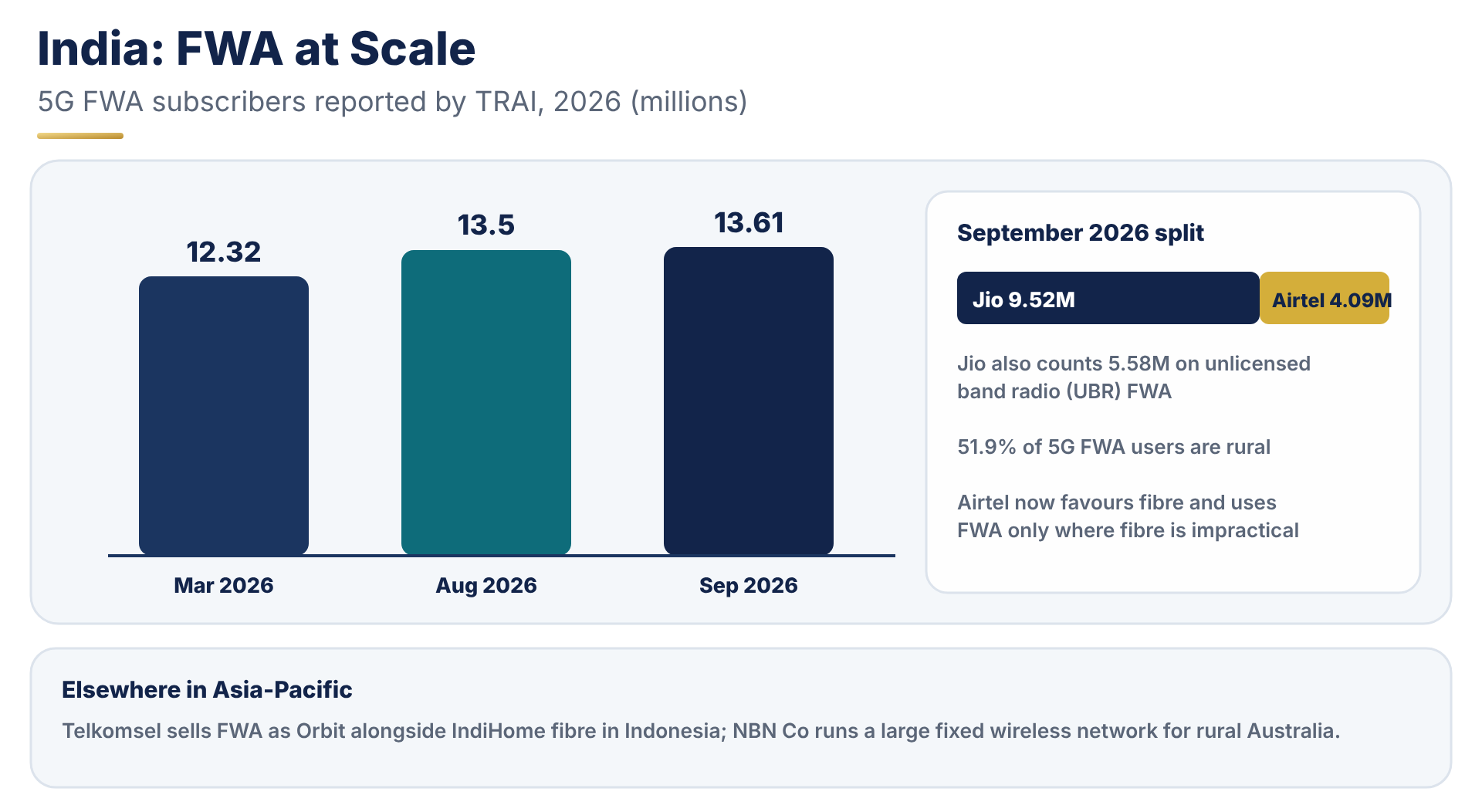
- India had 13.61 million 5G FWA subscribers at the end of September 2026, according to TRAI, of whom almost 52% were rural. Reliance Jio, with its AirFiber brand, held 9.52 million, plus 5.58 million on unlicensed-band radio. Bharti Airtel, with 4.09 million, has shifted its strategy toward fibre and now uses FWA mainly where fibre is impractical, citing profitability and equipment costs.
- Indonesia. Telkomsel sells FWA under the Orbit brand alongside IndiHome fibre. With household fixed broadband penetration near a quarter of homes, FWA can serve areas that fibre has not reached yet.
- Australia. NBN Co has completed a A$750 million upgrade of the fixed wireless network that serves rural and regional customers.
Fibre or FWA?
| Question | Fibre | FWA |
|---|---|---|
| Time to connect | Weeks to months, with civil works | Days, often self-installed |
| Capacity per home | Gigabits, with easy upgrades | Hundreds of megabits, shared per cell |
| Cost profile | High upfront, low running cost, long life | Lower upfront, uses existing sites and spectrum |
| Best fit | Dense areas and long-term demand | Areas fibre has not reached, or as a bridge to fibre |
What Comes Next
FWA will benefit from more mid-band spectrum, 5G Standalone with slicing, cheaper CPE, and the move toward 5G-Advanced and 6G. Its long-term role depends on whether fibre builds catch up. In many emerging markets, FWA is likely to remain a primary broadband technology for years.
References
- Ericsson Mobility Report, November 2025 and June 2026; Ericsson Fixed Wireless Access Handbook, 2026.
- Fierce Network, “Ericsson predicts more FWA, uplink traffic as network demand transforms,” June 2026.
- TRAI subscriber data, March to September 2026, via Communications Today, TelecomTalk, and Opensignal.
- Light Reading, “India’s Airtel shifts broadband strategy away from FWA,” 2026.
- Opensignal, Indonesia Fixed Broadband Experience, October 2026; Converge Digest on NBN Co fixed wireless upgrades.