
Direct-to-Device: Satellites to Ordinary Phones
How a satellite can talk to the phone in your pocket, who is building these networks, how Asia-Pacific is adopting them, and the questions still open.
- Starlink Mobile
- AST SpaceMobile
- Skylo
- Asia-Pacific
- WRC-27
Mobile networks cover most people, but not most of the planet. Oceans, mountains, forests, deserts, and thousands of islands remain beyond the reach of any tower, and when disaster strikes, towers fail. Direct-to-device, or D2D, connects ordinary phones to satellites, so that a phone with no signal can still send a message, call for help, or use an app. Since the first nationwide service went live in New Zealand in December 2024, D2D has become one of the fastest-moving areas in telecommunications, and Asia-Pacific has been at the front of it. The commercial story is told in When the Sky Becomes the Cell Tower; this page focuses on how it works and where it is going.
Two Models
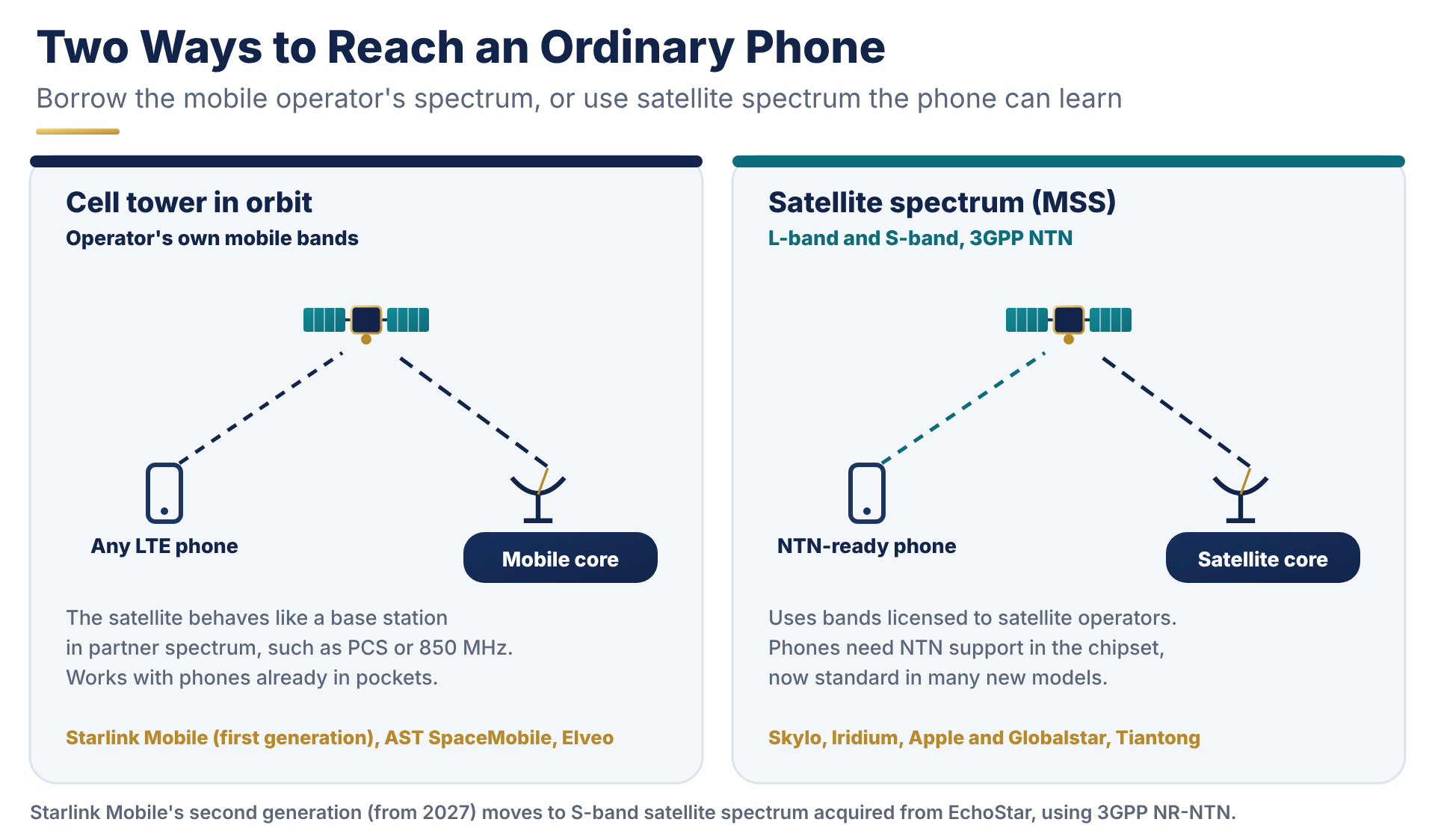
- A cell tower in orbit. The satellite behaves like an LTE base station and transmits in a band licensed to a partner mobile operator, such as T-Mobile’s PCS spectrum or AT&T’s 850 MHz. Any LTE phone can connect without modification. Starlink’s first-generation service and AST SpaceMobile follow this model.
- Satellite spectrum. The satellite uses mobile-satellite bands licensed to the satellite operator, in the L-band or S-band. Phones need support in their chipsets, either proprietary or the 3GPP NTN standard, which is now present in many new models. Skylo, Iridium, Apple with Globalstar, and China Telecom’s Tiantong follow this model.
The models are converging. Starlink’s second-generation system will use S-band satellite spectrum bought from EchoStar and the 3GPP NR-NTN standard, while still working with mobile operators as partners.
The Physics
A phone is a poor satellite terminal. Its antenna is small and points in no particular direction, its transmit power is limited by battery and safety rules, and it is usually held in a hand, in a pocket, or indoors.
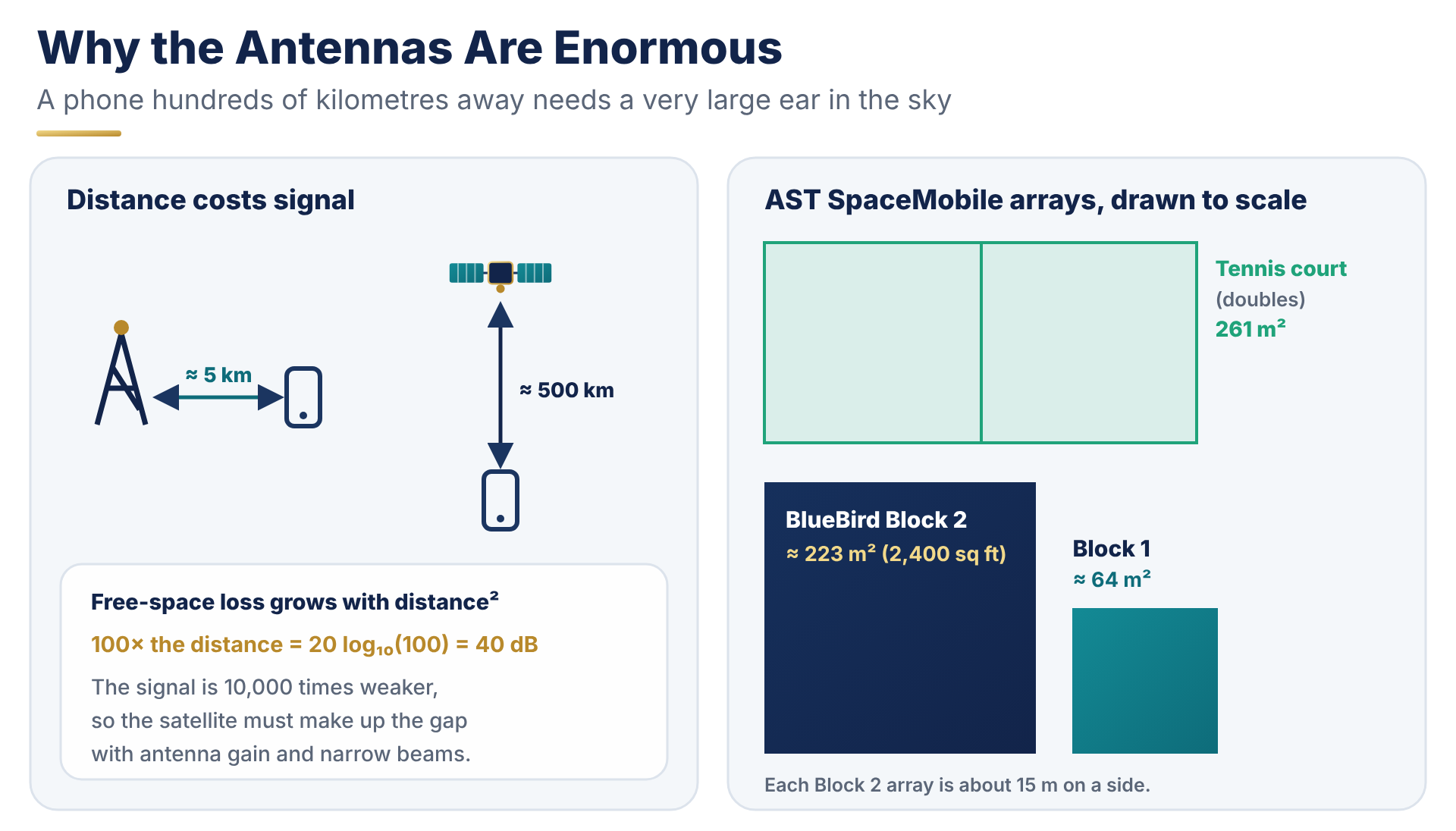
The satellite must therefore do the heavy lifting. Very large phased-array antennas collect the faint uplink from the phone and form narrow, powerful beams for the downlink. AST SpaceMobile’s Block 2 BlueBird satellites unfold arrays of about 223 square metres, almost the size of a tennis court. SpaceX says its second-generation Starlink Mobile satellites will carry arrays five times the size of the first generation, with sixteen times as many beams.
| Limit | Consequence |
|---|---|
| Phone must see the sky | Service works outdoors and near windows, rarely deep inside buildings |
| Large cells | One satellite beam covers a wide area, so capacity is shared among many users |
| Satellites move | Coverage depends on enough satellites overhead; early constellations are thinner near the equator |
| Phone power | First services focus on text and low-rate data; broadband needs bigger satellites |
Players
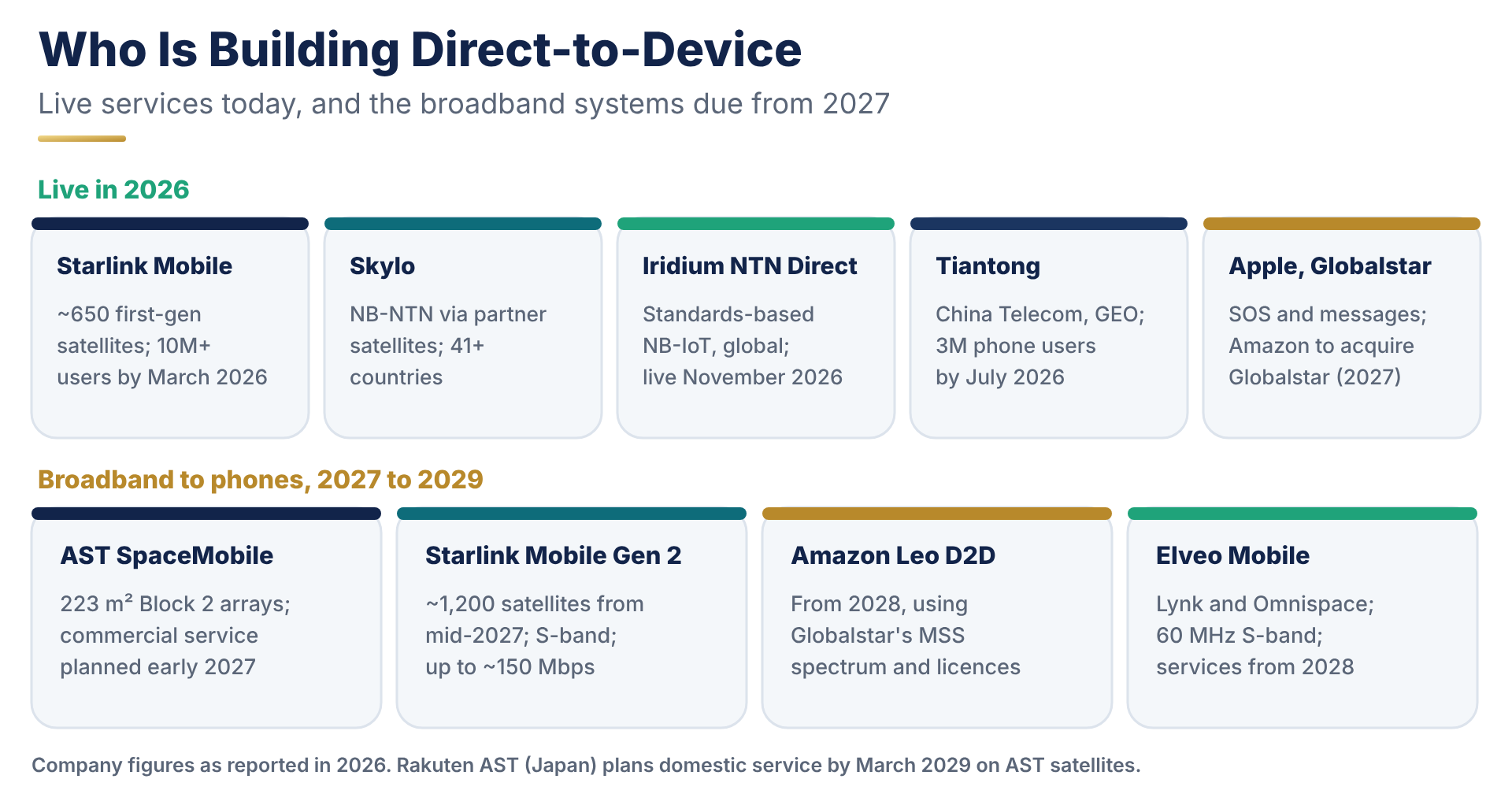
Starlink leads by a wide margin. Its first-generation constellation of about 650 satellites was fully deployed by early 2026, served more than 10 million users, and by mid-2026 had 99 announced operator partnerships. The challengers are betting on capability and spectrum. AST SpaceMobile has more than 50 operator agreements and plans commercial service from early 2027. Amazon agreed to buy Globalstar for about USD 11.6 billion, gaining spectrum licences in more than 120 countries and the contract that powers satellite features on iPhone, with its own D2D system planned from 2028. Lynk and Omnispace merged in August 2026 to form Elveo Mobile, combining small satellites with 60 MHz of S-band spectrum.
Asia-Pacific
Asia-Pacific hosted the world’s first carrier-run nationwide satellite texting service and, eighteen months later, six Starlink-based commercial services across four markets.
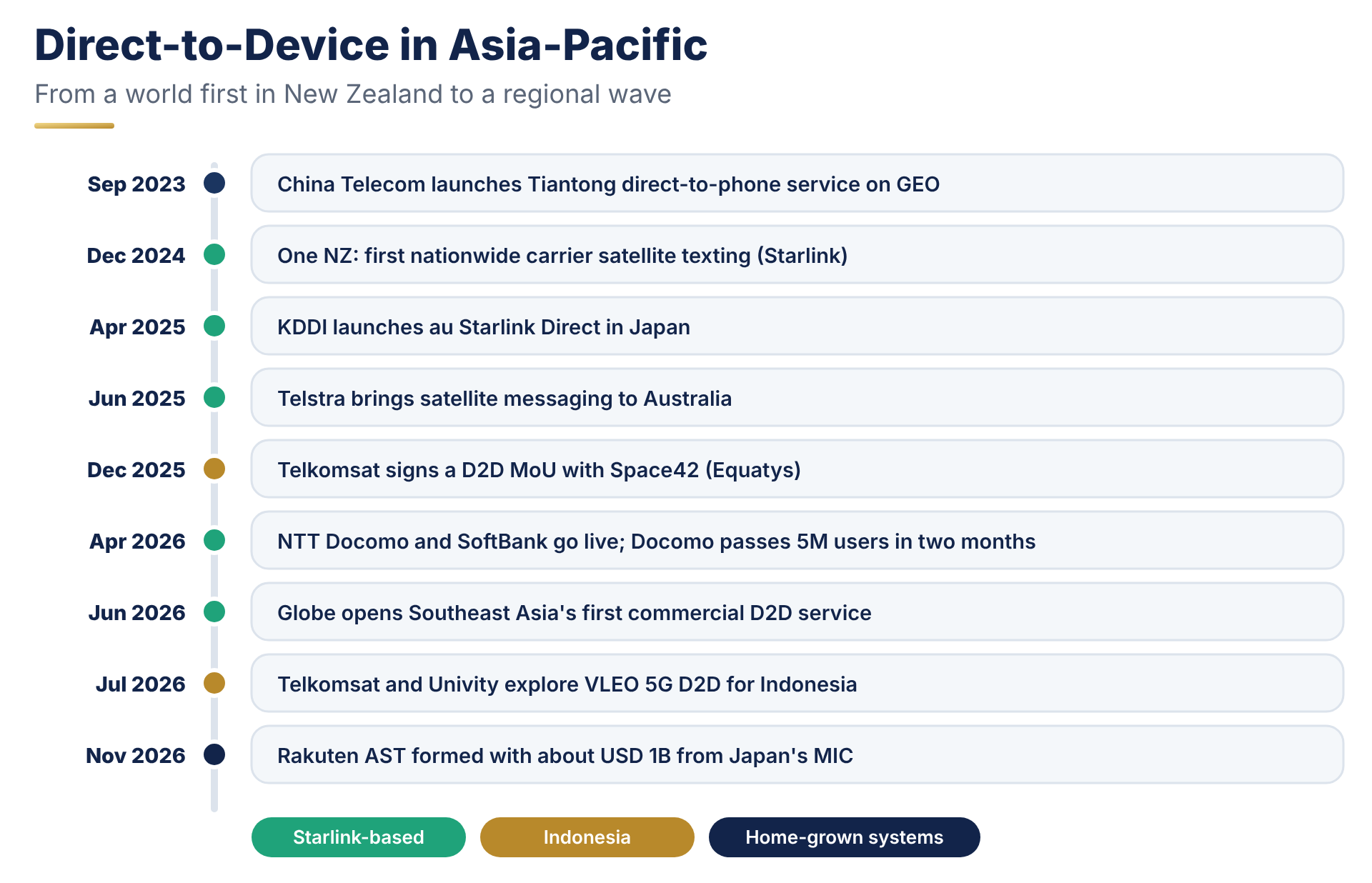
- Japan is the most advanced market. KDDI launched au Starlink Direct in April 2025 and reported about 4 million customers in its first year. NTT Docomo and SoftBank followed in April 2026, and Docomo signed up more than 5 million subscribers in about two months. Japan is also building a domestic alternative: Rakuten AST, formed in November 2026 with about USD 1 billion from the Ministry of Internal Affairs and Communications, plans service on Japanese-flagged AST satellites by March 2029.
- Australia and New Zealand. Ookla found that One NZ’s satellite service reaches about 40% of New Zealand’s landmass beyond terrestrial coverage and extends about 20 km offshore. Telstra includes satellite messaging with postpaid plans.
- The Philippines. Globe launched Southeast Asia’s first commercial D2D service in June 2026, and KDDI customers can roam onto it.
- Indonesia. Telkomsat has signed D2D agreements with Space42 for the Equatys venture in December 2025 and with Univity, which plans very-low-orbit 5G satellites, in July 2026.
- China. China Telecom’s Tiantong service, which connects standard smartphones to geostationary satellites, had about 3 million D2D users by July 2026 and operates in Hong Kong and Laos. Spacesail completed China’s first LEO direct-to-cell voice calls with unmodified phones in June 2026.
Business Models
| Model | How It Works | Example |
|---|---|---|
| Included in plans | Satellite texting bundled at no extra charge, as a reason to choose or stay with the operator | Japanese operators, Telstra postpaid |
| Paid add-on | A monthly fee for satellite messaging or app data | T-Mobile T-Satellite |
| Wholesale and roaming | The satellite operator sells capacity to many mobile operators and shares revenue | Starlink, AST, Skylo partnerships |
| Public safety | Emergency messaging and disaster resilience, sometimes supported by governments | Japan earthquakes, California wildfires |
| IoT | Trackers, sensors, and vehicles that switch to satellite outside coverage | Skylo, Iridium, Vodafone IoT |
The deeper question is who owns the customer. As long as satellite operators depend on mobile operators’ spectrum, they need partners. Once they hold their own global spectrum, as SpaceX does with the former EchoStar S-band and Amazon will with Globalstar, they could in principle serve phones directly. SpaceX says it does not intend to compete with mobile operators. In Europe, the largest operators are discussing a joint venture to bid for the 2 GHz satellite band, which the European Commission now proposes to reserve mainly for European companies.
Spectrum and Rules
Using terrestrial mobile spectrum from space raises questions that national rules handle one country at a time: interference into neighbouring countries, protection of terrestrial networks, and access to emergency numbers. The United States created a framework for supplemental coverage from space in 2024, and regulators in Japan, Australia, and New Zealand have authorised services nationally.
A global framework is under study for WRC-27. Agenda item 1.13 considers new mobile-satellite allocations so that satellites can serve ordinary phones in IMT bands between 694/698 MHz and 2.7 GHz, with views ranging from strict secondary status, dependent on the licensed mobile operator, to stronger rights. The details are on the Spectrum page.
Outlook
D2D is moving in two steps. The first, already here, makes “no signal” rare: texts, emergency messages, and light app data almost anywhere outdoors. The second, from 2027 to 2029, aims at broadband to unmodified phones, as AST’s Block 2 satellites, Starlink’s second generation, Amazon Leo, and Elveo come into service. Whether that second step changes the economics of rural mobile coverage depends on capacity per beam, on spectrum, and on how operators and satellite companies share the customer.
References
- SpaceX keynote at MWC 2026, as reported by Mobile World Live, RCR Wireless, Fierce Network and Broadband Breakfast, March 2026; Starlink Direct to Cell partner page.
- AST SpaceMobile, SEC filings and press releases, 2025 to 2026; Rakuten and AST SpaceMobile, Rakuten AST joint venture announcement, November 2026.
- Amazon and Globalstar, merger announcement, April 2026; FCC approval as reported in October 2026.
- Lynk and Omnispace, Elveo Mobile announcement, August 2026.
- Ookla via Communications Today and TelecomLead, Asia-Pacific D2D report, 2026; Light Reading on Docomo and on Rakuten AST, 2026; KDDI news releases, 2026.
- Telkomsat with Space42 (December 2025) and with Univity (July 2026); China Telecom presentation at the ITU High-Level Seminar, September 2026; CGTN on Spacesail, June 2026.
- ITU, Resolution 253 (WRC-23) on agenda item 1.13; GSA, 5G NTN Key Data, August 2026.