
A cell site has always been a place where radio meets fibre: antennas on the mast, baseband equipment in a cabinet, a power supply, and a backhaul link. AI-RAN proposes something more ambitious. Put general-purpose accelerated computing at the site, run the radio software on it, and use the spare capacity for artificial intelligence workloads. The tower becomes a small data centre that also happens to carry calls.
From Concept to Field Trials
The idea gained momentum through the AI-RAN Alliance, which counted more than 130 member companies by MWC 2026. Since then the activity has accelerated. In mid-September, Nokia reported that operators including A1 Group, Chunghwa Telecom, du, e&, Mobily, stc, TPG Telecom, and Zain Saudi were advancing proofs of concept and live trials on its anyRAN software running on NVIDIA’s Aerial RAN Computer. At GTC Berlin in October, NVIDIA and Nokia said nearly twenty operators had publicly announced AI-RAN collaborations, with further trials planned at BT, Deutsche Telekom, and Elisa.
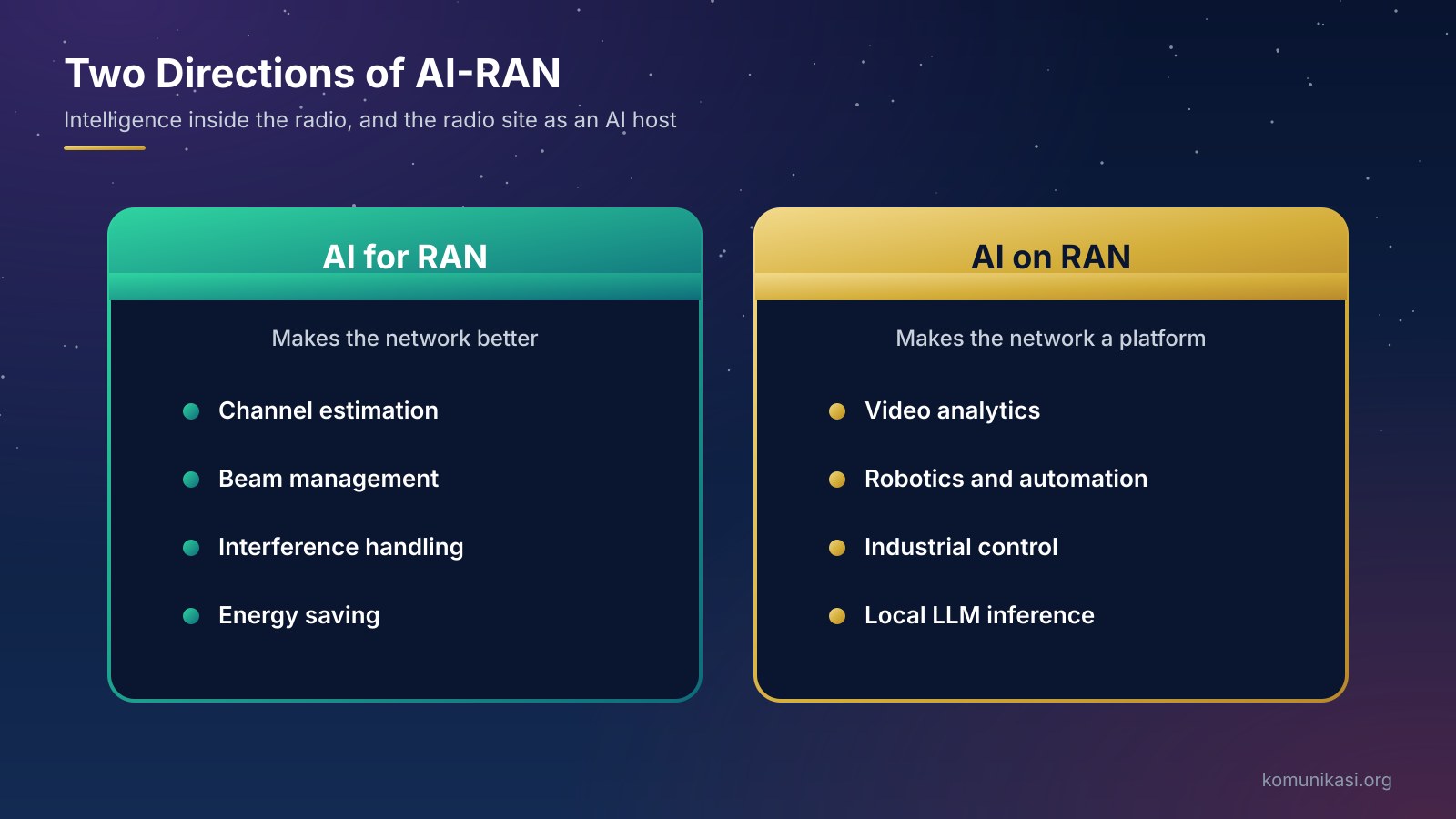
The technical promise works in two directions. AI for RAN uses machine learning inside the radio itself, for tasks such as channel estimation, beam management, and interference handling, to squeeze more capacity out of the same spectrum. AI on RAN uses the same hardware to host inference for nearby users, from video analytics to robotics and industrial control, where latency and data locality matter.
The Hard Questions
Enthusiasm should not hide the open issues. Purpose-built baseband silicon has been optimised for decades for power efficiency, and GPUs must prove that they can match it for everyday radio processing, not only for showcase demos. Multi-tenancy is another challenge: an operator must guarantee that a sudden AI workload never degrades the radio service that is its core business. And someone has to buy the spare compute. Edge AI demand is real, but it is not yet clear how much of it will land at the cell site rather than in metro or regional data centres.
Analysts are optimistic. Dell’Oro Group has projected that AI-RAN could account for about a third of the RAN market by 2029. Yet, by most accounts, broad commercial deployment is still ahead of us, with 2027 shaping up as the year when trials either convert into production networks or quietly fade.
Why It Is Worth Watching
What makes AI-RAN interesting is not the hardware itself but the shift in identity it implies. For thirty years, operators sold connectivity measured in bits. AI-RAN invites them to sell computation placed close to where data is created, using assets they already own: land, power, and thousands of sites. Whether that becomes a new growth engine or another stranded investment will depend less on technology and more on ecosystem design, partnerships, and pricing.
The network is learning to think. The more important question is whether the business around it learns as quickly.