
Open RAN and Virtualised RAN
What it means to open the radio access network, how the architecture works, what has really happened since 2018, and where it is heading next.
- O-RAN
- vRAN
- RIC
- Open Fronthaul
- Multi-Vendor
For most of mobile history, the radio access network arrived as a sealed system: radios, baseband units, and software from a single supplier, joined by interfaces that only that supplier fully understood. Open RAN set out to change this. Its promise was simple: define open interfaces so that parts from different suppliers fit together, run the software on general-purpose computers, and let operators add their own intelligence. Launched with great expectations in 2018, the movement has since produced real networks, one spectacular failure, and a more sober view of what openness can achieve.
The Idea
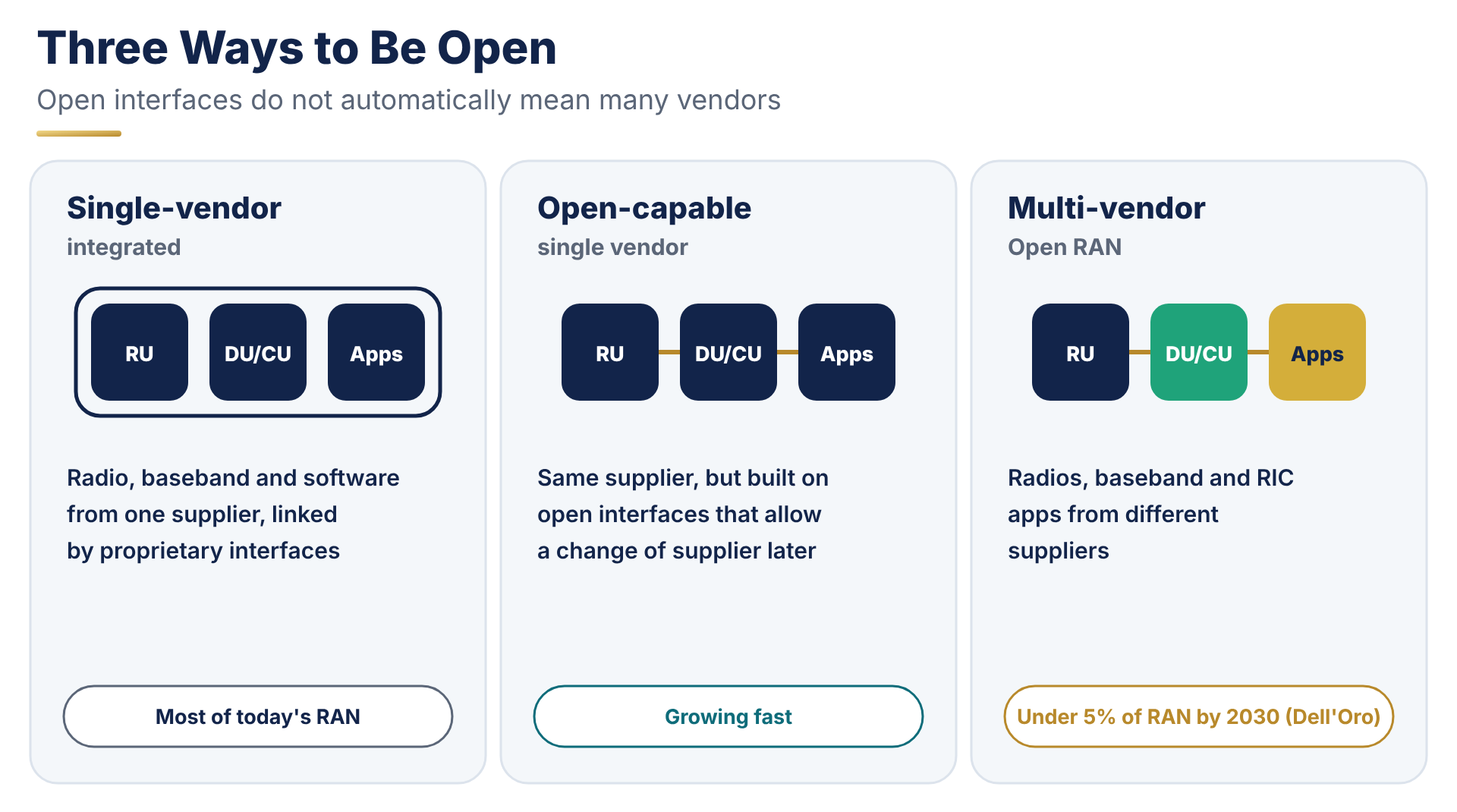
Open RAN combines three shifts that are often confused with one another.
- Disaggregation. The base station is split into separate units, a radio unit, a distributed unit, and a central unit, each of which could in principle come from a different supplier.
- Virtualisation. Baseband functions run as software on general-purpose servers or a cloud platform rather than on purpose-built hardware. This is virtualised or cloud RAN, and it can exist without any openness at all.
- Openness. The interfaces between the units, and between the network and the software that controls it, are published and standardised, so that a radio from one vendor can work with a baseband from another, and third parties can write control applications.
The motivations were partly economic and partly strategic. Operators wanted more suppliers to choose from in a market dominated by a handful of vendors, lower costs through competition and commodity hardware, and the freedom to automate their networks with software of their own choosing. Governments added a security argument, as restrictions on certain suppliers made diversity a matter of national policy.
The Architecture
The O-RAN Alliance, formed in 2018, defines the reference architecture that most of the industry now uses. It builds on 3GPP’s own split between central and distributed units and adds new interfaces of its own.
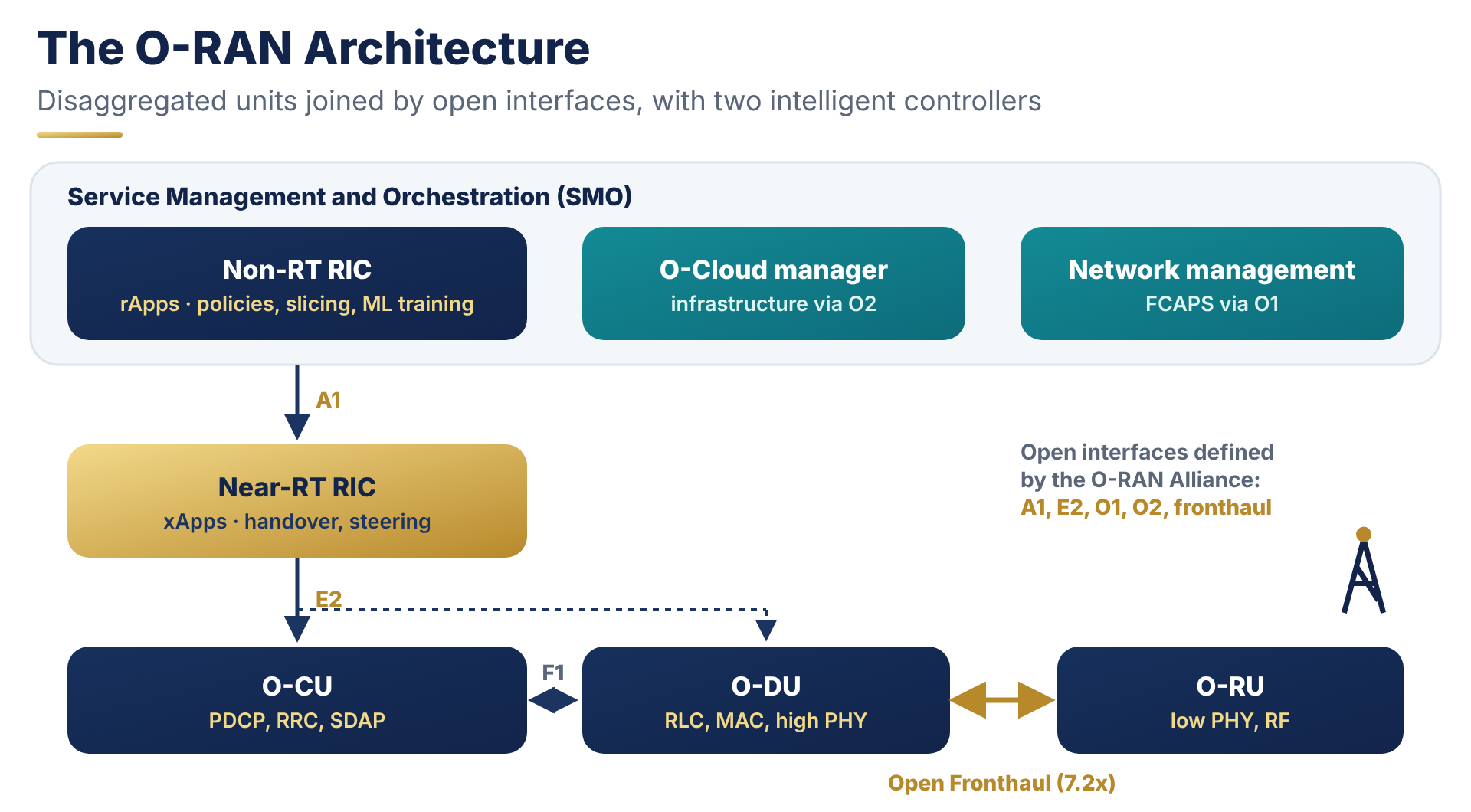
| Interface | Connects | Purpose |
|---|---|---|
| Open Fronthaul | O-DU to O-RU | Carries radio samples and control over Ethernet, using the 7.2x split inside the physical layer |
| F1 | O-CU to O-DU | 3GPP’s higher-layer split between central and distributed units |
| E2 | Near-RT RIC to RAN nodes | Lets xApps observe and steer the base station in near real time |
| A1 | Non-RT RIC to Near-RT RIC | Passes policies, guidance, and machine-learning models |
| O1 | SMO to network functions | Configuration, fault, and performance management |
| O2 | SMO to O-Cloud | Manages the cloud infrastructure that hosts virtualised functions |
Of these, Open Fronthaul matters most commercially. The older fronthaul standard, CPRI, left room for vendor-specific details, which in practice locked a radio to its supplier’s baseband. Open Fronthaul is designed so that a radio and a baseband from different suppliers can interoperate.
RICs and Apps
The most original part of the O-RAN architecture is the RAN Intelligent Controller, or RIC. It opens the network’s behaviour to software written by the operator or by third parties, in the same way that a smartphone opens itself to apps. There are two controllers, each working on a different timescale.
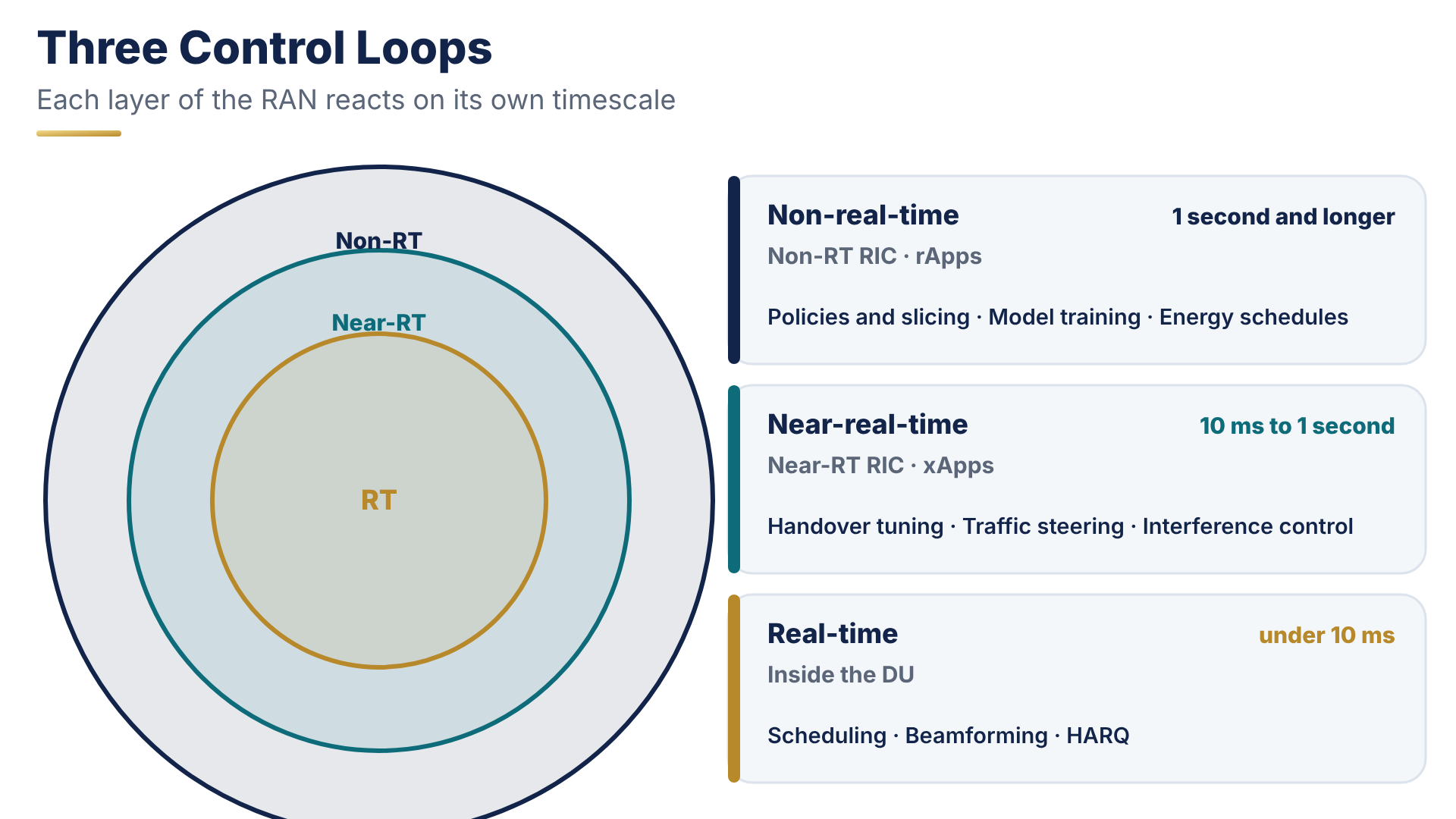
- The non-real-time RIC lives in the management layer and runs rApps. They work on timescales of a second or longer: setting policies, managing slices, planning energy saving, and training machine-learning models.
- The near-real-time RIC runs xApps that act within roughly 10 milliseconds to one second: tuning handovers, steering traffic between cells and bands, and managing interference.
- Real-time decisions, such as scheduling each slot and steering beams, stay inside the distributed unit, because they must happen in under 10 milliseconds.
The RIC has proved to be one of Open RAN’s most durable ideas. AT&T became the first operator to deploy a third-party rApp on a live production network in 2025, and the concept of a programmable automation layer is now spreading into networks that are otherwise supplied by a single vendor. This is also where Open RAN meets AI-RAN.
In Practice
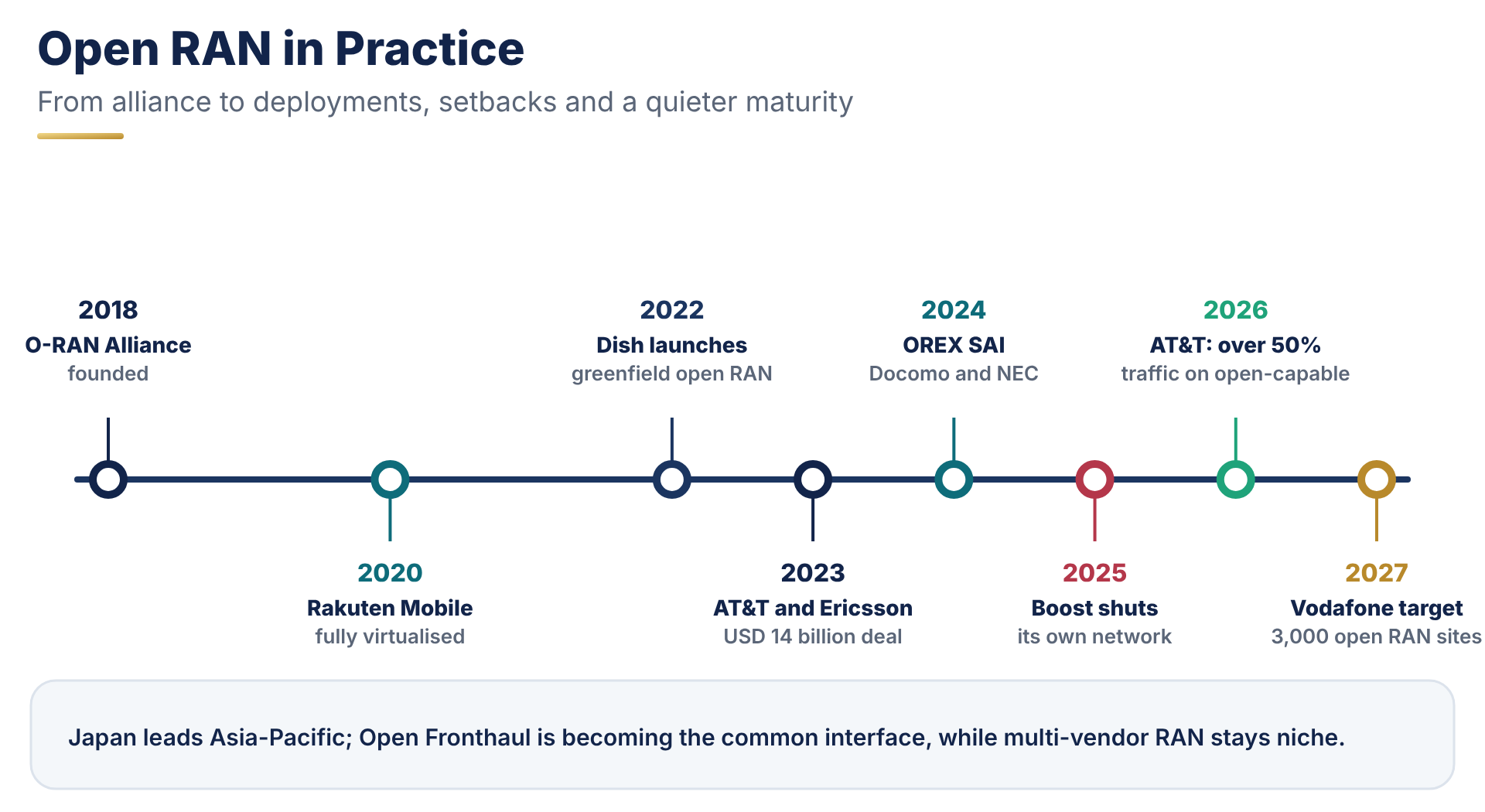
The record is mixed, and the details matter.
- Rakuten Mobile built Japan’s fourth network from scratch on virtualised, open architecture and still operates the largest open vRAN network in the world.
- Dish, later EchoStar’s Boost Mobile, launched a greenfield open RAN network in the United States in 2022 and grew to roughly 25,000 sites. Few customers used it. In 2025, under regulatory pressure, EchoStar sold its spectrum to AT&T and SpaceX, and by November 2025 it had moved all its customers off its own network. The architecture was advanced; the commercial impact was small.
- AT&T signed a five-year deal with Ericsson worth about USD 14 billion in December 2023, aiming to carry 70% of its wireless traffic on open-capable platforms by late 2026. By March 2026, more than half of its traffic ran on open-capable hardware, and it had completed an open RAN call on its commercial network using Ericsson baseband and radios from Fujitsu’s 1Finity.
- Vodafone chose Samsung as its lead open RAN supplier in Europe, starting in Germany, and now targets 3,000 open RAN sites by the end of 2027, a year later than originally planned.
Market analysts have adjusted their expectations accordingly. In February 2026, Dell’Oro Group cut its forecast for multi-vendor RAN to under 5% of the RAN market by 2030. In August it concluded that Open RAN is increasingly a story about interface standardisation rather than supplier diversification, with most deployments still using radios and basebands from the same supplier, even as Open Fronthaul becomes the preferred interface on new platforms.
Asia-Pacific
Asia-Pacific has been central to Open RAN from the start, but the region is far from uniform. Japan is the clear leader. Besides Rakuten Mobile, NTT Docomo has adopted O-RAN widely, including multi-vendor configurations from Nokia and tens of thousands of base stations from 1Finity, and KDDI has begun deploying open vRAN. Analysts at Omdia describe the region in two parts: Japan, and the rest.
Japan is also exporting its model. In 2024, Docomo and NEC formed OREX SAI to package Open RAN for other operators. Since then it has announced a partnership with StarHub in Singapore, a demonstration with Globe Telecom and a fixed wireless project with COMCLARK in the Philippines, a 4G demonstration in Cambodia, and a full-scale 5G fixed wireless deployment with SURGE in Indonesia. Rakuten Symphony, for its part, has partnered with Axiata to offer Open RAN private networks to enterprises across South and Southeast Asia.
| Market | Where Open RAN Shows Up | Typical Use |
|---|---|---|
| Japan | Rakuten, Docomo, KDDI, SoftBank | Nationwide macro networks and vRAN |
| Singapore | StarHub with OREX SAI | 4G and 5G commercial deployment |
| Philippines | Globe trials; COMCLARK | Field trials and fixed wireless |
| Indonesia | SURGE with OREX SAI | Affordable 5G fixed wireless access |
| Wider region | Axiata with Rakuten Symphony | Enterprise private 4G and 5G |
The pattern outside Japan is telling: Open RAN tends to win where incumbents are weakest, in fixed wireless, rural coverage, private networks, and challenger operators, rather than in the core macro networks of the largest carriers.
What Comes Next
| Question | Why It Matters |
|---|---|
| Who integrates? | Multi-vendor networks shift integration and testing work from the supplier to the operator or a systems integrator |
| Energy | General-purpose processors must match purpose-built silicon on power per bit |
| Security | More interfaces and third-party apps mean a larger attack surface that has to be managed |
| AI-RAN | Accelerated computing platforms may finally deliver the shared, software-defined RAN that Open RAN promised |
| 6G | Whether 6G radios are open from the first day, or openness again arrives later as an add-on |
References
- O-RAN ALLIANCE, architecture description and specifications; “Multiple operators are getting their hands dirty deploying O-RAN-based networks,” April 2026.
- Dell’Oro Group, Open RAN reports, February and August 2026.
- AT&T, “AT&T advances Open RAN readiness,” March 2026; AT&T and Ericsson announcement, December 2023.
- Analysys Mason, “EchoStar’s retreat from its Open RAN deployment serves as a warning for new entrants,” 2025; EchoStar SEC filings.
- Omdia via RCR Wireless, “Japan leads APAC for O-RAN but integration challenges remain,” February 2026.
- OREX SAI press releases, 2024 to 2026; Light Reading, “1Finity ramps open RAN at Rakuten Mobile and beyond,” July 2026.