
Non-Terrestrial Networks in 3GPP
How satellites became part of the mobile standard: the releases, the architectures, the physics problems, the bands, and the road to 6G.
- Release 17
- Release 19
- NR-NTN
- IoT-NTN
- 6G
Satellite and mobile networks grew up as separate worlds, with their own standards, chips, and cores. A satellite phone was a different device on a different network. Non-terrestrial networks, or NTN, change that. Since Release 17 in 2022, 3GPP has specified how 5G New Radio and narrowband IoT run over satellites, so that the same chipset, the same core network, and the same roaming arrangements can serve both. This page explains what the standard covers, why satellites are hard for a radio designed for towers, and how NTN is moving into products and into 6G.
Why a Standard
Proprietary satellite systems work, but each one is an island. Devices are expensive because volumes are small, and every new service needs its own chips and its own core. By writing satellite access into the 3GPP standard, the industry gains the scale of the mobile ecosystem.
- Chipsets. Smartphone and IoT modems can add NTN support at low cost. Several flagship phones already carry Release 17 narrowband NTN.
- Core networks. Satellite access becomes one more radio technology attached to the same 5G core, with the same subscriber management and security.
- Roaming. A mobile operator can let its customers roam onto a satellite network, just as it does onto a foreign network.
- Platforms. The same specifications cover low, medium, and geostationary orbits, and also high-altitude platforms such as stratospheric aircraft and balloons.
Release by Release
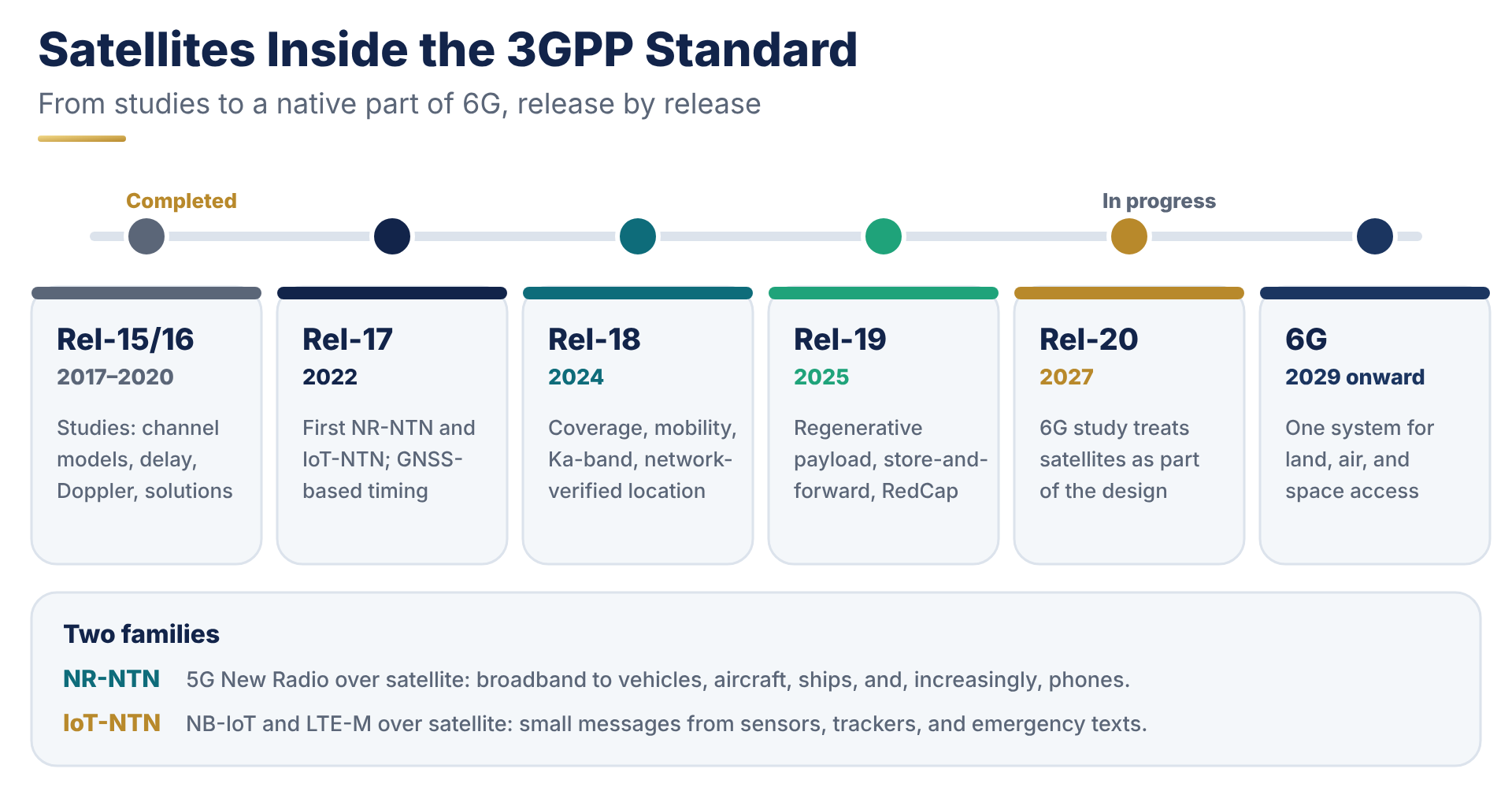
| Release | Main NTN Content |
|---|---|
| 15 and 16 (studies) | Channel models, deployment scenarios, and candidate solutions for delay, Doppler, and moving cells |
| 17 (2022) | First normative NR-NTN and IoT-NTN; GNSS-assisted timing and frequency correction; transparent payloads; L-band and S-band |
| 18 (2024) | Coverage enhancements; mobility and service continuity between satellite and terrestrial networks; network-verified device location; Ka-band above 10 GHz |
| 19 (2025) | Regenerative payloads with the gNB on board; store-and-forward for IoT; RedCap devices over NTN; direct UE-satellite-UE paths; uplink capacity improvements |
| 20 (2027) | 6G study, in which satellite access is treated as part of the design from the beginning |
Two families run in parallel. NR-NTN brings 5G New Radio to satellites, first for vehicles, aircraft, ships, and fixed terminals, and increasingly for handheld devices. IoT-NTN adapts NB-IoT and LTE-M for small, infrequent messages from sensors, trackers, and wearables, and it is the family that reached the market first.
Payloads
A key architectural choice is where the base station sits.
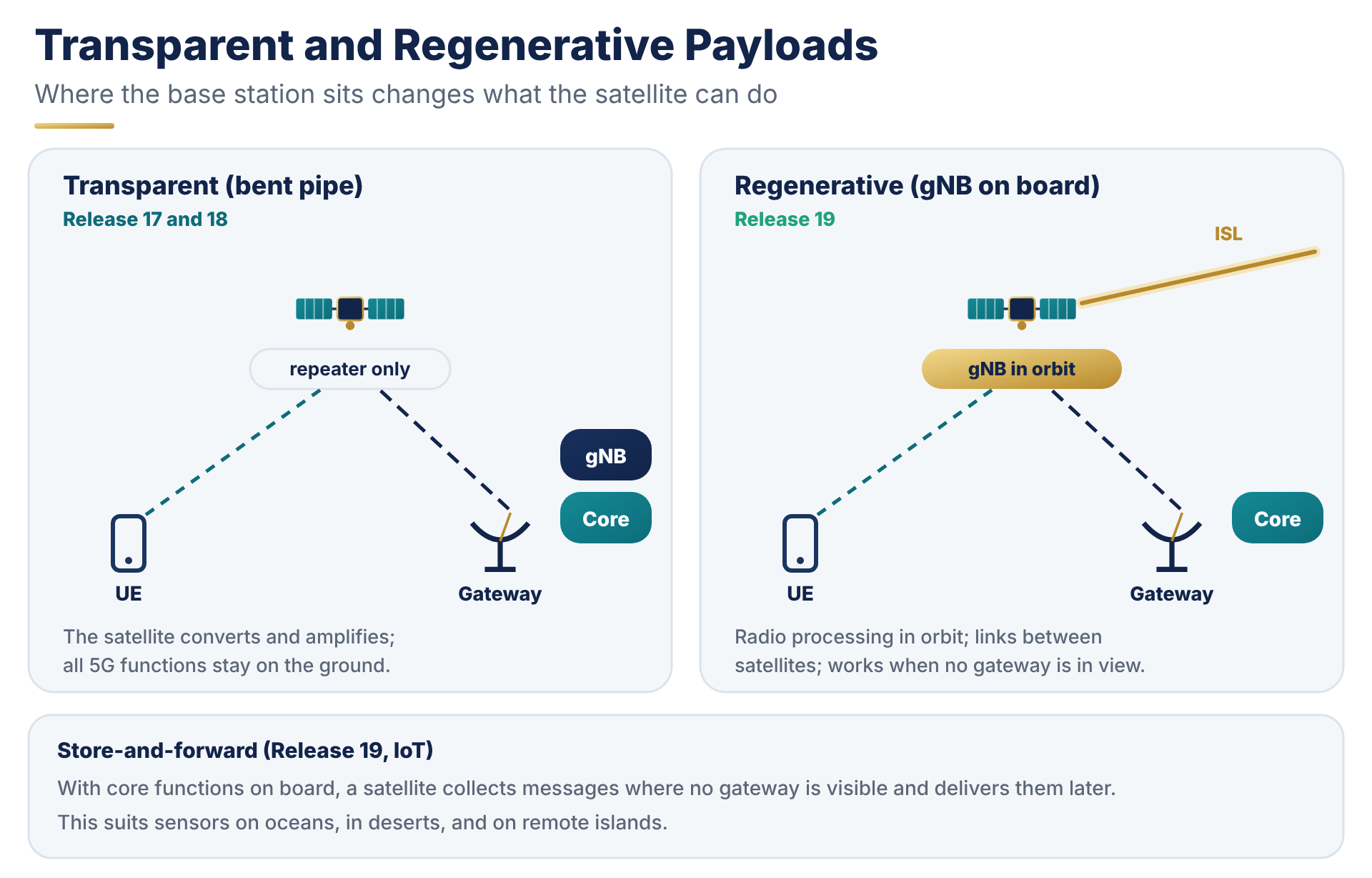
- Transparent payloads, specified first, act as repeaters. The satellite receives the signal, shifts its frequency, amplifies it, and sends it to a gateway, where the gNB and the core network sit. The satellite stays simple, but a gateway must be in view.
- Regenerative payloads, added in Release 19, place a complete gNB on the satellite. Radio processing happens in orbit, satellites can coordinate with each other over inter-satellite links, and traffic between two users can take a shorter path.
- Store-and-forward, also in Release 19 for IoT, goes further by putting core functions on board. A satellite can collect messages where no gateway is visible and deliver them when one comes into view, which suits sensors on oceans, in deserts, and on remote islands.
The Physics
5G was designed for base stations a few kilometres away that stay in one place. Satellites break those assumptions in four ways.
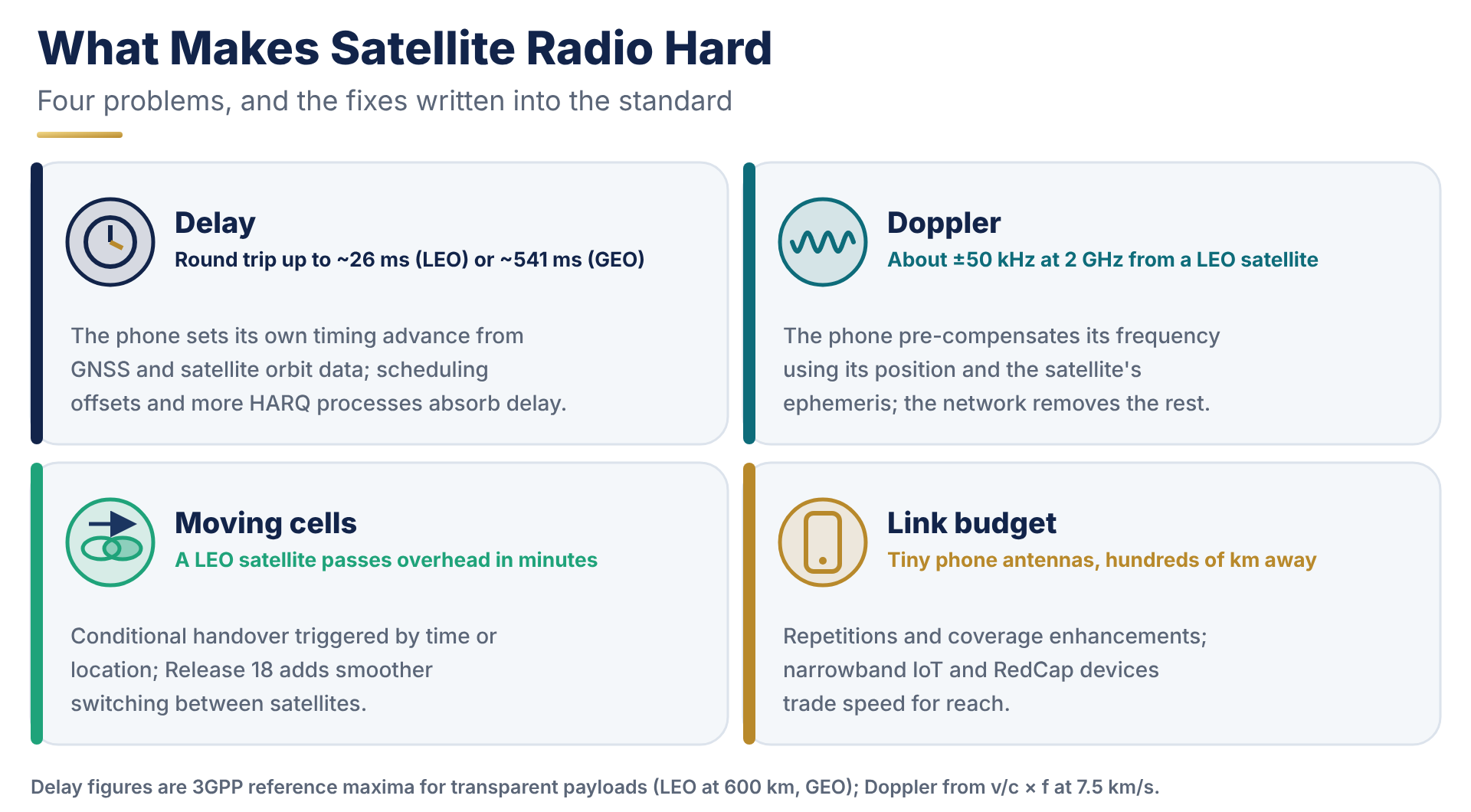
The common thread is knowledge of position. A Release 17 device uses GNSS to know where it is, and the network broadcasts the satellite’s orbit data. With both, the device can calculate its own timing advance and pre-correct its frequency before transmitting, which is how a 5G waveform designed for towers can survive a link to a satellite moving at about 7.5 kilometres per second. Release 18 added network-based verification of the device’s reported location, which matters for emergency calls, lawful interception, and charging.
Bands
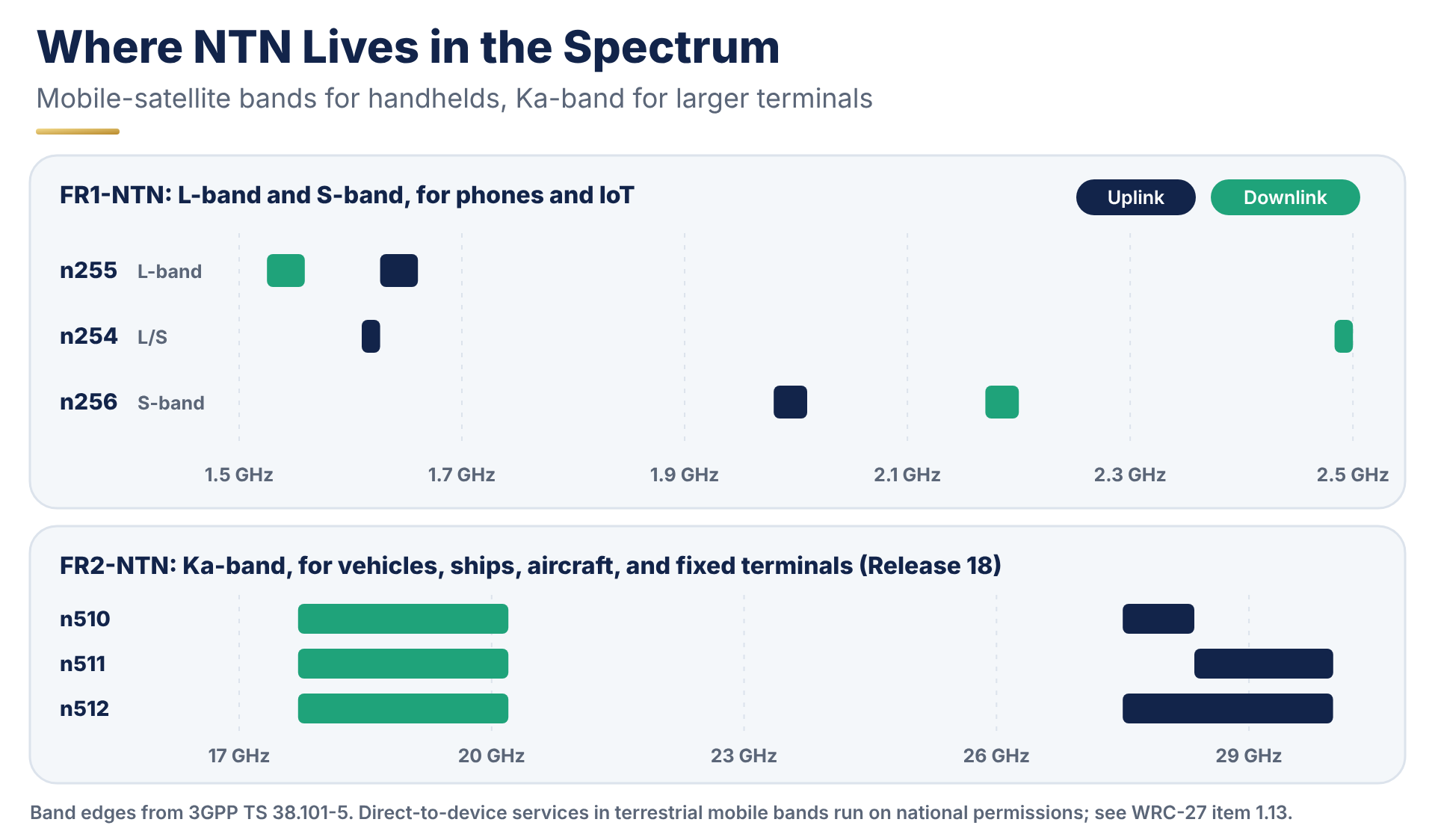
| Band | Range | Typical Use |
|---|---|---|
| n255 | L-band: 1525–1559 MHz down, 1626.5–1660.5 MHz up | IoT and messaging, handhelds |
| n256 | S-band: 2170–2200 MHz down, 1980–2010 MHz up | Handhelds and IoT |
| n254 | 2483.5–2500 MHz down, 1610–1626.5 MHz up | Handhelds and IoT |
| n510–n512 | Ka-band: 17.7–20.2 GHz down, 27.5–30 GHz up | Vehicles, ships, aircraft, fixed terminals |
These bands belong to the mobile-satellite service, licensed to satellite operators. Some direct-to-device services instead reuse a mobile operator’s own terrestrial bands, under national permissions. Creating a global framework for that second approach is one of the questions for WRC-27, explained on the Spectrum page.
In the Market
2026 was widely described as the year NTN moved from demonstration to commercial service. GSA counted 123 publicly announced partnerships between satellite and mobile operators by mid-2026, of which 23 had launched a service.
| Service or Milestone | What It Shows |
|---|---|
| Skylo | Release 17 narrowband NTN over partner satellites, built into Pixel and Galaxy phones and IoT modules; commercial in more than 41 countries; entering Korea with KT SAT in November 2026 |
| Iridium NTN Direct | Activated in November 2026 as a standards-based NB-IoT and direct-to-device service with global coverage, including the poles |
| Terrestar, Canada | Launched a hybrid satellite and cellular IoT service in February 2026, built entirely on Release 17 |
| Vodafone IoT | Added NTN NB-IoT from both Skylo and Iridium to its global IoT offer |
| Keysight and Samsung | Validated Release 19 NR-NTN in S-band in January 2026, a step toward NTN in consumer devices |
| Chunghwa Telecom, KT SAT | Early NR-NTN demonstrations over geostationary satellites in Taiwan and Korea |
Toward 6G
In 5G, satellite support was added after the terrestrial design was finished, which is why so many Release 17 features are workarounds. 6G aims to do better. The Release 20 study treats satellites as part of the system from the start, so that the waveform, mobility, and network architecture can serve land, air, and space access together. Regenerative payloads and inter-satellite links point toward a network in which processing, and perhaps computing, happens in orbit as well as on the ground.
References
- 3GPP TR 38.811 and TR 38.821 (NTN studies); TS 38.300 and TS 38.101-5 (Release 17 to 19 NTN specifications and bands).
- Ericsson, “How we reached a common vision on the architecture for 5G NTN in 3GPP Rel-19,” 2024.
- A. Ghosh et al. and others, survey and tutorial papers on 3GPP NTN, arXiv:2412.16611 and arXiv:2601.04882.
- GSA, 5G Non-Terrestrial Networks Key Data, August 2026.
- Iridium, NTN Direct service activation, November 2026; Skylo and KT SAT, November 2026; Vodafone IoT announcements, 2025 to 2026.
- Mavenir and Terrestar, February 2026; Keysight and Samsung, January 2026.