
6G and IMT-2030
What 6G is meant to do, how the global standard is being written, where it will find spectrum, and how much of 5G it keeps.
- IMT-2030
- Release 21
- Upper Mid-Band
- AI-Native
- ISAC
Every mobile generation starts as a vision and ends as a specification. 6G is now in between: the vision is agreed at the ITU, the requirements are set, the study phase in 3GPP is drawing to a close, and the dates for writing the actual standard are fixed. This page explains each step, and the news behind the dates is in 6G Now Has a Calendar.
The Vision: IMT-2030
At the ITU, 6G goes by the name IMT-2030, just as 5G was IMT-2020. Its framework, Recommendation ITU-R M.2160, was published in December 2023. It defines six usage scenarios. Three of them grow out of 5G: enhanced mobile broadband becomes immersive communication, ultra-reliable low-latency communication becomes hyper-reliable and low-latency communication, and massive machine-type communication becomes massive communication. Three are new: ubiquitous connectivity, AI and communication, and integrated sensing and communication.
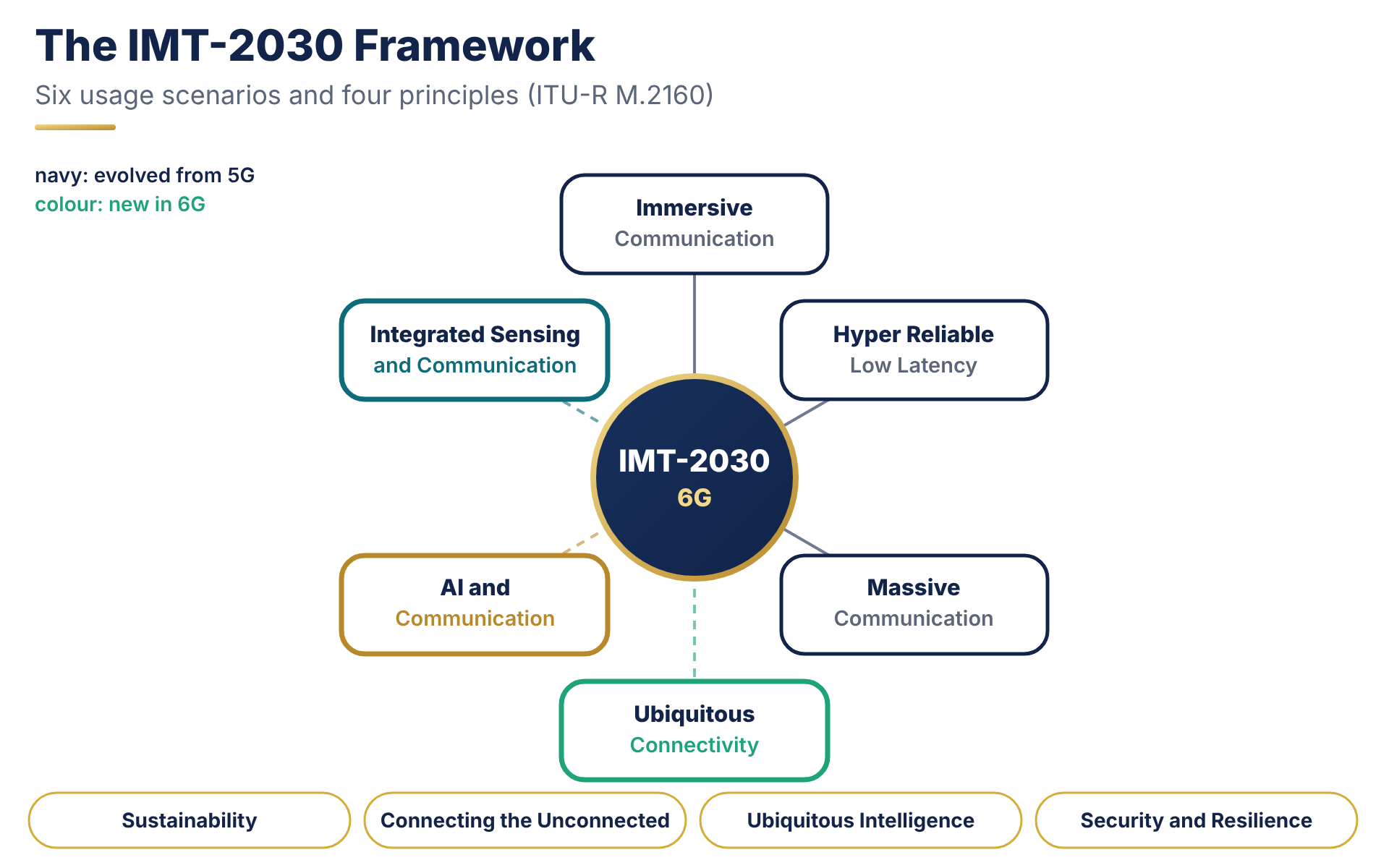
Around these scenarios sit four overarching principles: sustainability, connecting the unconnected, ubiquitous intelligence, and security and resilience. The framework also lists fifteen capabilities, with research targets for peak data rates of 50, 100, and 200 Gbit/s depending on the scenario, compared with 20 Gbit/s for 5G.
In February 2026, ITU-R Working Party 5D agreed on twenty technical performance requirements that candidate 6G technologies must meet, seven of them new to 6G. In June 2026 it completed the guidelines for evaluating candidate technologies. Both documents go to the parent Study Group 5 for formal approval in December 2026.
The Timeline
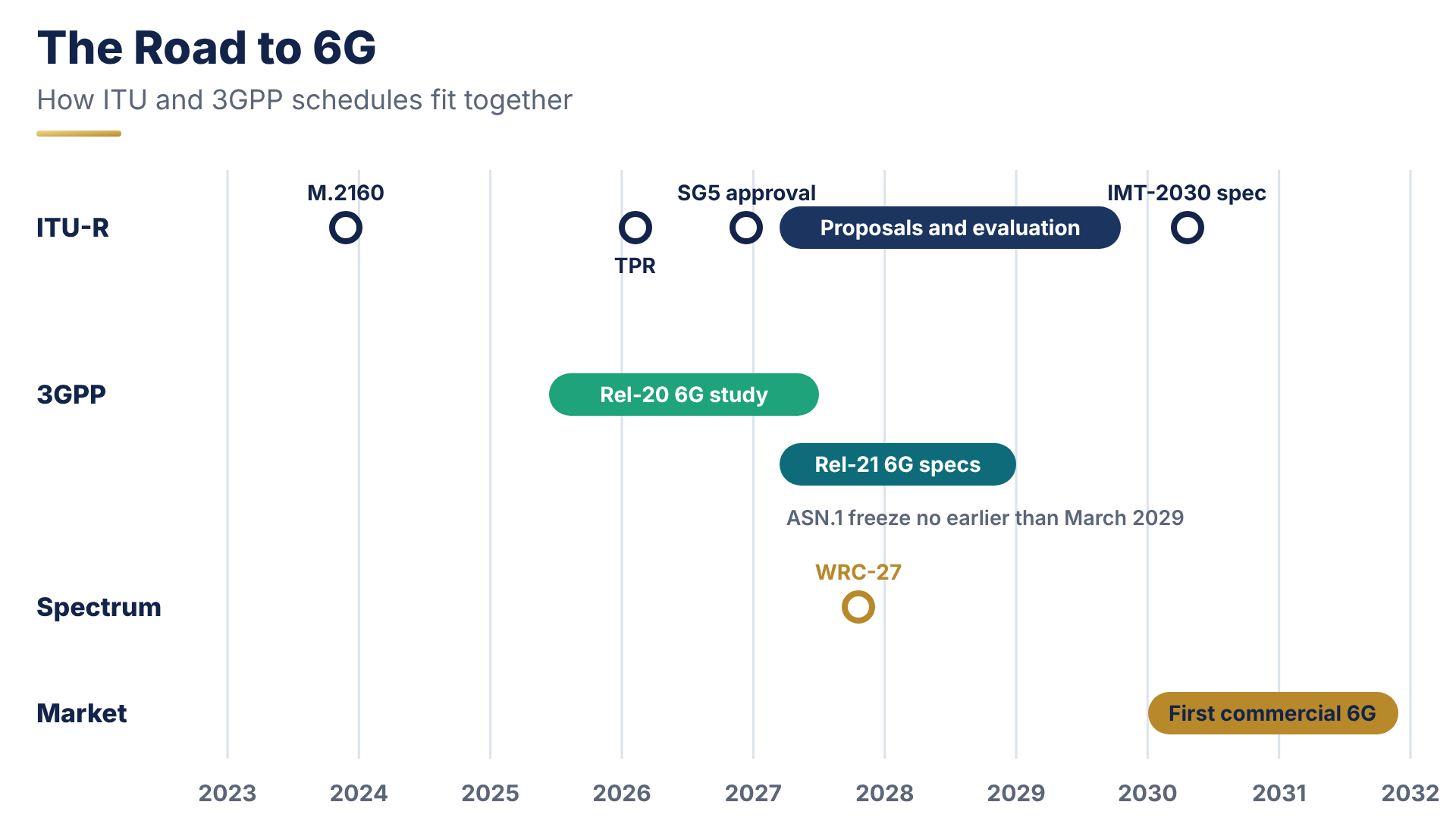
The ITU sets the requirements and certifies the result, while 3GPP writes the technology. The two schedules interlock.
| When | Milestone |
|---|---|
| Dec 2023 | ITU publishes the IMT-2030 framework (M.2160) |
| 2025 | 3GPP starts the 6G study in Release 20; RAN1 meets on 6G for the first time in August |
| Feb 2026 | ITU-R WP 5D agrees on the IMT-2030 technical performance requirements |
| Jun 2026 | 3GPP approves the 6G scenarios and requirements report (TR 38.914) and fixes the Release 21 schedule |
| Mar 2027 | Release 21 starts: the first 6G specifications are written |
| Late 2027 | WRC-27 decides on new spectrum for IMT |
| End 2028 | Release 21 content completes; protocol freeze no earlier than March 2029 |
| Around 2030 | First commercial 6G networks; ITU completes the IMT-2030 specification |
The Spectrum
Each generation has been defined by a new band: 3.5 GHz for 5G, and most likely the upper mid-band between 7 and 15 GHz for 6G. That range offers much wider channels than today’s mid-band while staying low enough to cover a city from existing sites.
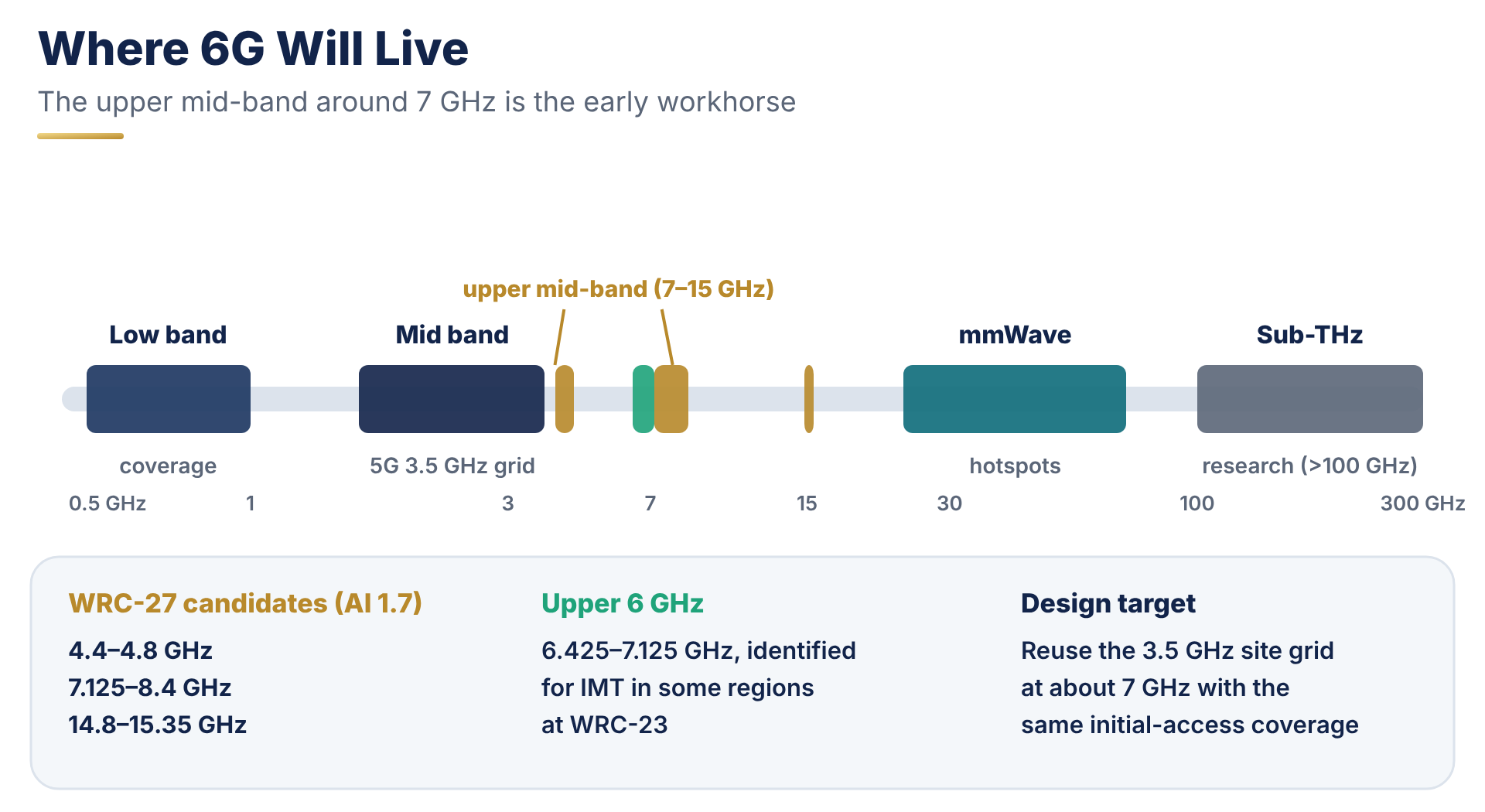
Three ranges are on the table at WRC-27 under agenda item 1.7: 4.4–4.8 GHz, 7.125–8.4 GHz, and 14.8–15.35 GHz. Sharing studies with satellites and other incumbents are still under way. The upper 6 GHz band, 6.425–7.125 GHz, was already identified for IMT in some regions at WRC-23 and is contested with Wi-Fi.
The engineering target is ambitious. 3GPP aims to reuse the existing 5G mid-band site grid at about 3.5 GHz for 6G deployments around 7 GHz while keeping the same initial-access coverage, so that operators can add 6G on the towers they already have. Channels of up to 400 MHz are foreseen in this range. Above 100 GHz, the ITU has published a report on the technical feasibility of IMT, but sub-terahertz links remain a research topic rather than part of the first 6G release.
The Design
After the costly 5G rollout, operators asked for an evolution with clear economics rather than another revolution taken on faith. The early 3GPP agreements reflect that request.
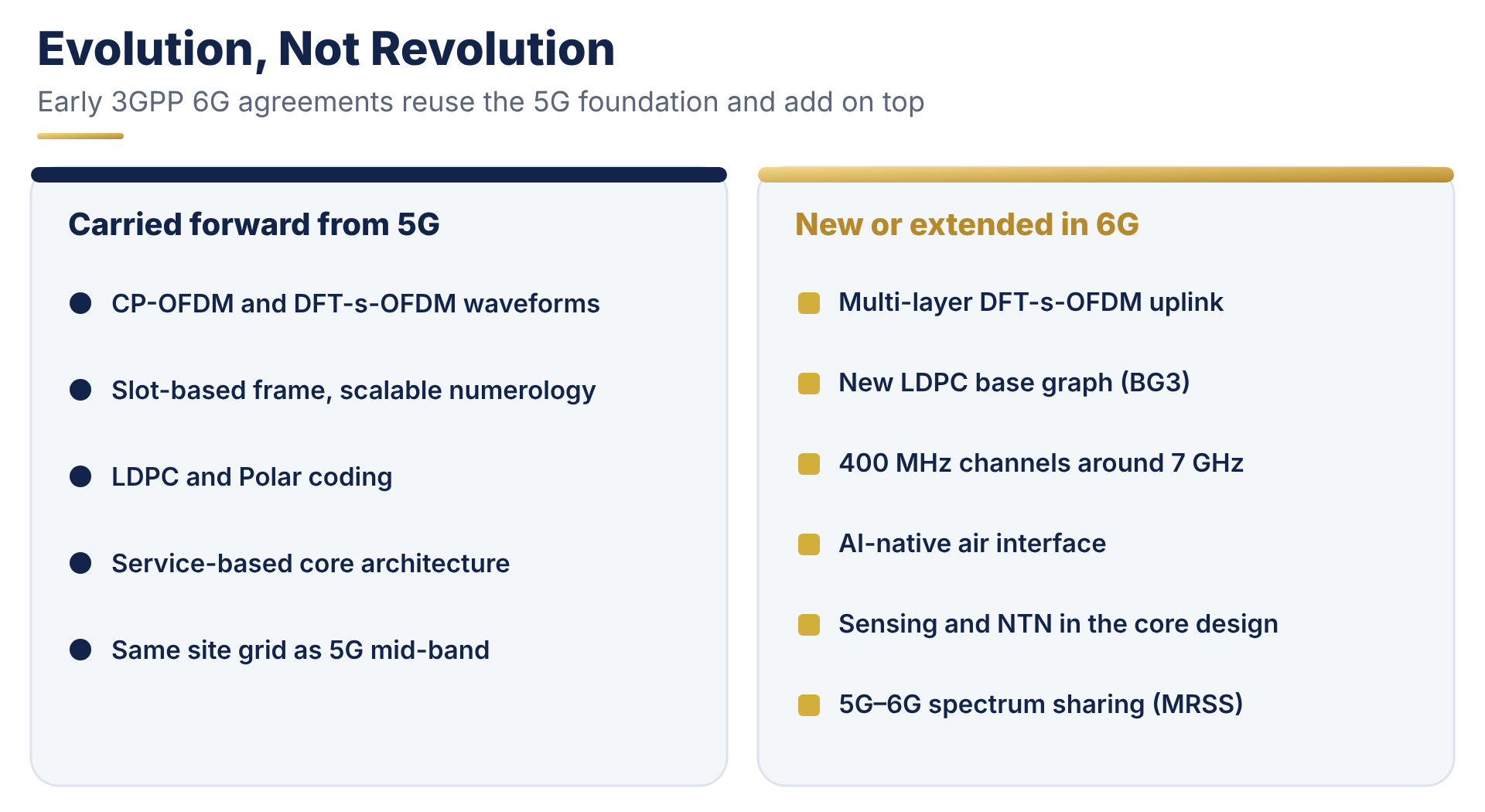
- Waveform and frame. CP-OFDM and DFT-s-OFDM remain the baseline for downlink and uplink, and 6G reuses the 5G slot-based frame with scalable numerology.
- Uplink. DFT-s-OFDM, the power-efficient uplink waveform that 5G limited to a single layer, is extended to multiple layers, improving uplink throughput at the cell edge.
- Channel coding. LDPC and Polar codes stay, with a third LDPC base graph added to make high-rate decoders smaller and more efficient.
- Coexistence. 5G and 6G must share spectrum during the transition, so multi-RAT spectrum sharing is part of the design from the start.
- Device range. 6G aims for a scalable design that covers very simple devices as well as premium phones, with the bandwidth of the simplest device class debated well into 2026.
- Native capabilities. AI in the air interface, sensing, and non-terrestrial access are being designed in rather than bolted on, building on what 5G-Advanced has tested.
Open Questions
- How tightly to couple the 6G core to the 5G core. Interfaces between the new radio and the existing core are still under study, and the answer will decide how painful migration becomes.
- Whether sensing creates value or worry. A network that can detect drones and vehicles can also detect people, so privacy and regulation will shape what integrated sensing is allowed to do.
- Who pays. Without a clearer revenue story than 5G had, operators will deploy 6G slowly, starting where capacity runs out rather than everywhere at once.
- How green it can be. Wider channels and more antennas consume more power, and the sustainability principle will be tested against real deployments.
For countries such as Indonesia, the most important point is timing. The 6G study phase is the window in which national priorities can still shape the standard, through 3GPP, ITU-R Working Party 5D, and regional spectrum preparation for WRC-27. Once Release 21 freezes, the design is largely fixed for a decade.
Continue in MobileAI-Native Air Interface and AI-RAN→References
- ITU-R, Recommendation M.2160, Framework and overall objectives of the future development of IMT for 2030 and beyond, 2023.
- ITU, “IMT-2030: Technical requirements for the 6G future,” March 2026; ITU-R WP 5D IMT-2030 page, June 2026.
- Ericsson, “6G standardization: key milestones and RAN decisions,” June 2026.
- Qualcomm, “Building the 6G standard: what 3GPP’s June 2026 plenary decisions mean for device makers,” June 2026.
- 3GPP, Highlights, Release 20 progress article by the TSG RAN Chair, October 2026; TR 38.914.
- “6G: The Intelligent Network of Everything,” arXiv:2407.09398.