
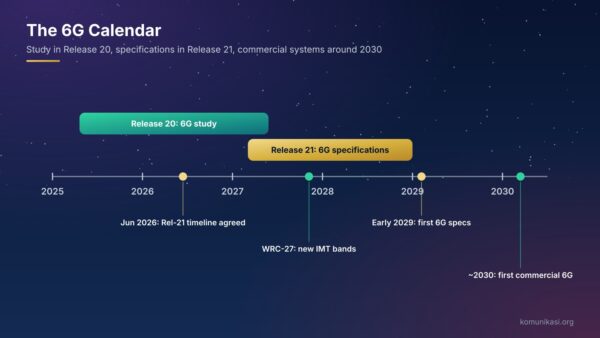
For several years, 6G lived mostly in white papers: terahertz links, holographic calls, networks that sense as well as communicate. Useful for inspiration, less useful for planning. That changed quietly in June 2026, when 3GPP met in Singapore and agreed on the schedule for the first release that will actually define 6G.
The Timeline in Plain Terms
3GPP is splitting the work into two releases. Release 20 carries the 6G study phase alongside the final evolution of 5G-Advanced. Release 21 is where the 6G specifications are written. According to the agreed plan, Release 21 runs from March 2027 to the end of 2028, with the first 6G specifications expected in early 2029. Ericsson, among others, expects the first commercial 6G systems around 2030.
The June meetings also concluded the RAN-level study on 6G scenarios and requirements, and built on earlier agreements in RAN1 that set the baseline for the new air interface. The O-RAN Alliance has started its own 6G studies and committed to align with the 3GPP timeline, allowing for a few months of lag.
What Is Actually Being Decided
The interesting part is not the dates but the design choices. The industry is debating how much of 5G to carry forward, how tightly a 6G core should be tied to the existing 5G core, and how operators can migrate without a disruptive “rip and replace” cycle. After the expensive and sometimes disappointing 5G rollout, operators are asking for evolution with clear economics, not another revolution on faith.
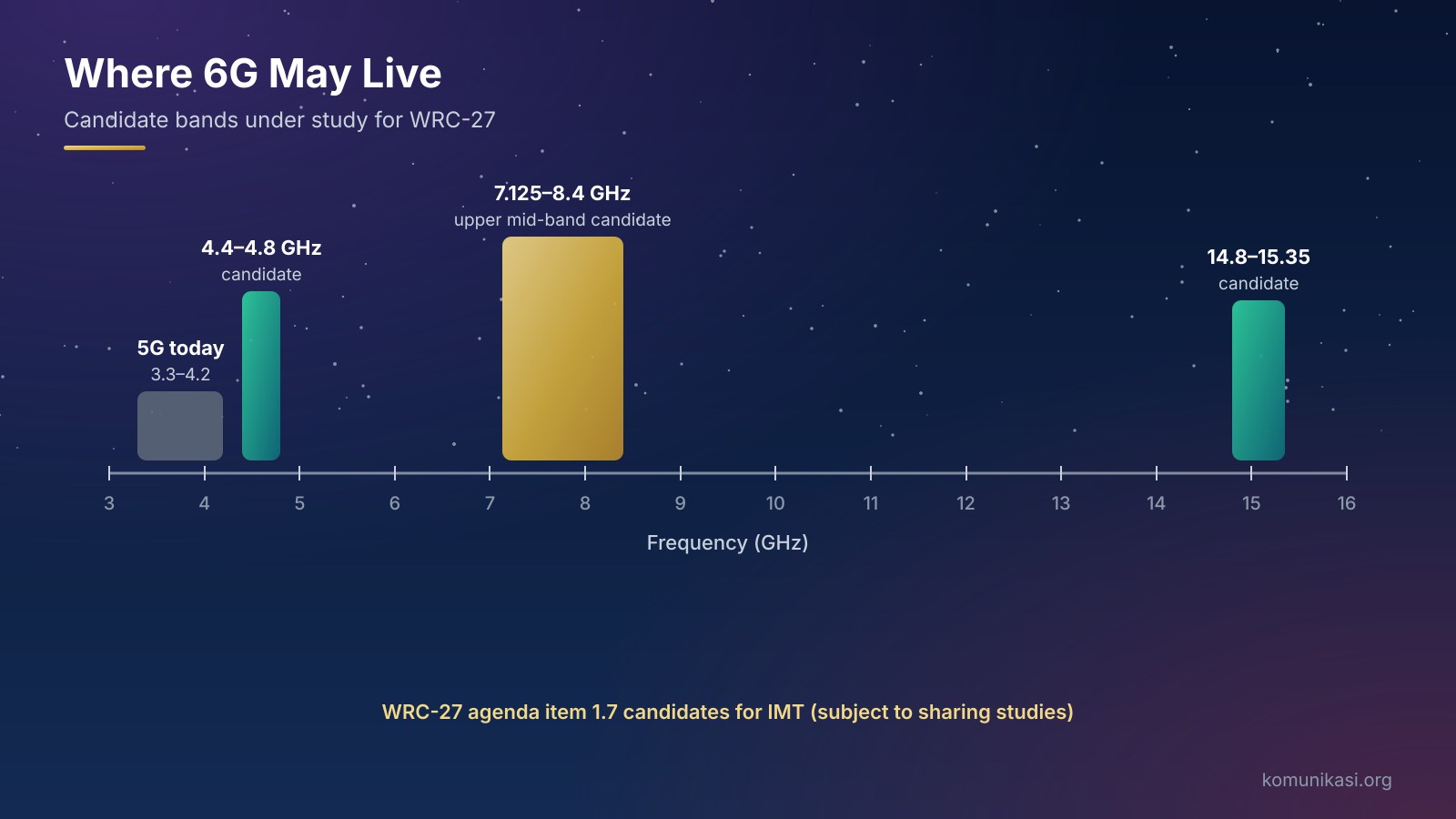
Spectrum is the other half of the story. At WRC-27, under agenda item 1.7, administrations will consider identifying the 4.4–4.8 GHz, 7.125–8.4 GHz, and 14.8–15.35 GHz ranges for IMT. The upper midband around 7 GHz is widely seen as the workhorse for early 6G, offering wider channels than today’s mid-band while keeping coverage within reach of existing grids. Sharing studies with satellite and other incumbent services are still under way.
Reading the Signal
Three points stand out. First, 6G is being shaped as much by operator economics as by physics; efficiency, energy, and AI-native operation sit beside peak data rates. Second, sensing and non-terrestrial integration are entering the core design rather than being added later. Third, the window for influencing the standard is now, during the study phase, not in 2029 when the specifications are frozen.
For countries like Indonesia, that last point deserves attention. Participation in 3GPP, ITU-R Working Party 5D, and regional spectrum preparation is not a ceremonial activity. It is where the boundaries of future national networks are drawn. 6G finally has a calendar. The question is who will be in the room while it is being filled in.