
Subsea Cables: The Physical Internet
How subsea cable systems work, who builds them now, which new cables are reshaping Southeast Asia, and how to keep them running.
- Fibre pairs
- Hyperscalers
- Bifrost
- Candle
- Resilience
More than 95% of international data travels through cables on the seabed, not through satellites. A few hundred systems, each about the width of a garden hose in deep water, link the continents and carry everything from video calls to financial transactions and AI training data. Over the past decade, the business has changed: content and cloud companies now fund and own many of the largest new cables, systems carry up to 24 fibre pairs, and security concerns have moved cables from engineering journals to national security reviews. Southeast Asia, and Indonesia in particular, sits at the centre of a new wave of construction.
How a System Works
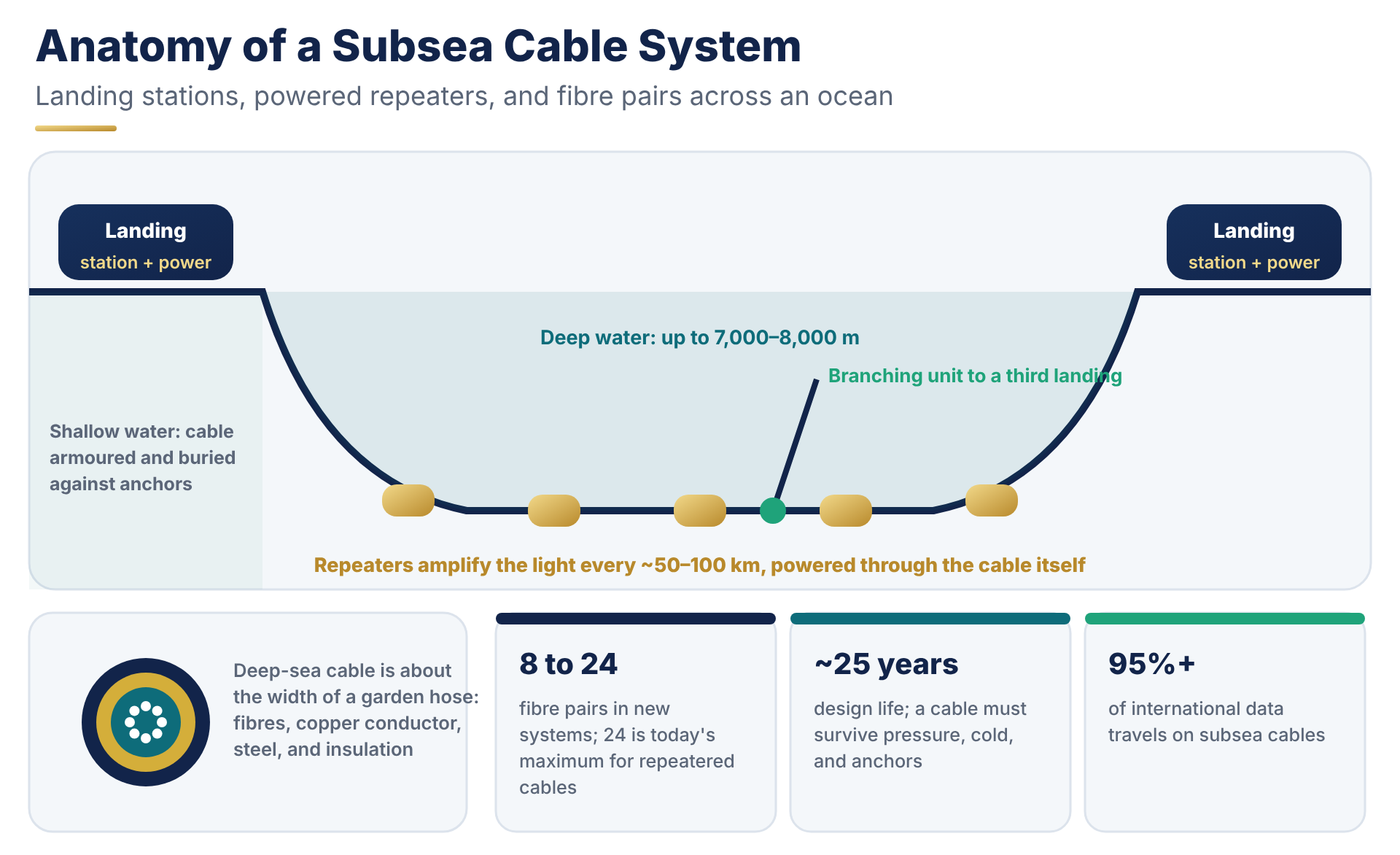
- Landing stations connect the cable to terrestrial networks and supply power, fed at high voltage through a copper conductor in the cable.
- Repeaters amplify the light at regular intervals along the route. Because power to the repeaters is limited, it caps how many fibre pairs a cable can carry.
- Fibre pairs are the unit of capacity. Many new systems carry 8 to 16 pairs; Meta’s newest designs use 24, the current maximum for repeatered cables.
- Branching units let one trunk serve several countries, which matters for archipelagic regions.
- Upgrades come from the ends: new coherent modems at the landing stations raise capacity without touching the wet plant.
Who Builds Cables
Telecom consortia once built almost all international cables. Today, content and cloud companies such as Meta, Google, Amazon, and Microsoft fund, co-own, or buy large shares of new systems, because their own traffic dominates many routes. Meta alone has been involved in more than 20 cables. Its Project Waterworth, announced in 2025, will span more than 50,000 km and link the United States, India, Brazil, South Africa, and other regions using 24 fibre pairs, routed through deep water of up to 7,000 metres to reduce the risk of damage.
Regional operators remain essential partners, especially for landing rights. In Southeast Asia, Indonesia’s Telin, Singapore’s Keppel, the Philippines’ Globe, Malaysia’s IPS, and Japan’s SoftBank have joined hyperscaler-led systems, while new independent builders are announcing their own projects across the Indo-Pacific.
Southeast Asia
| System | Route | Notes |
|---|---|---|
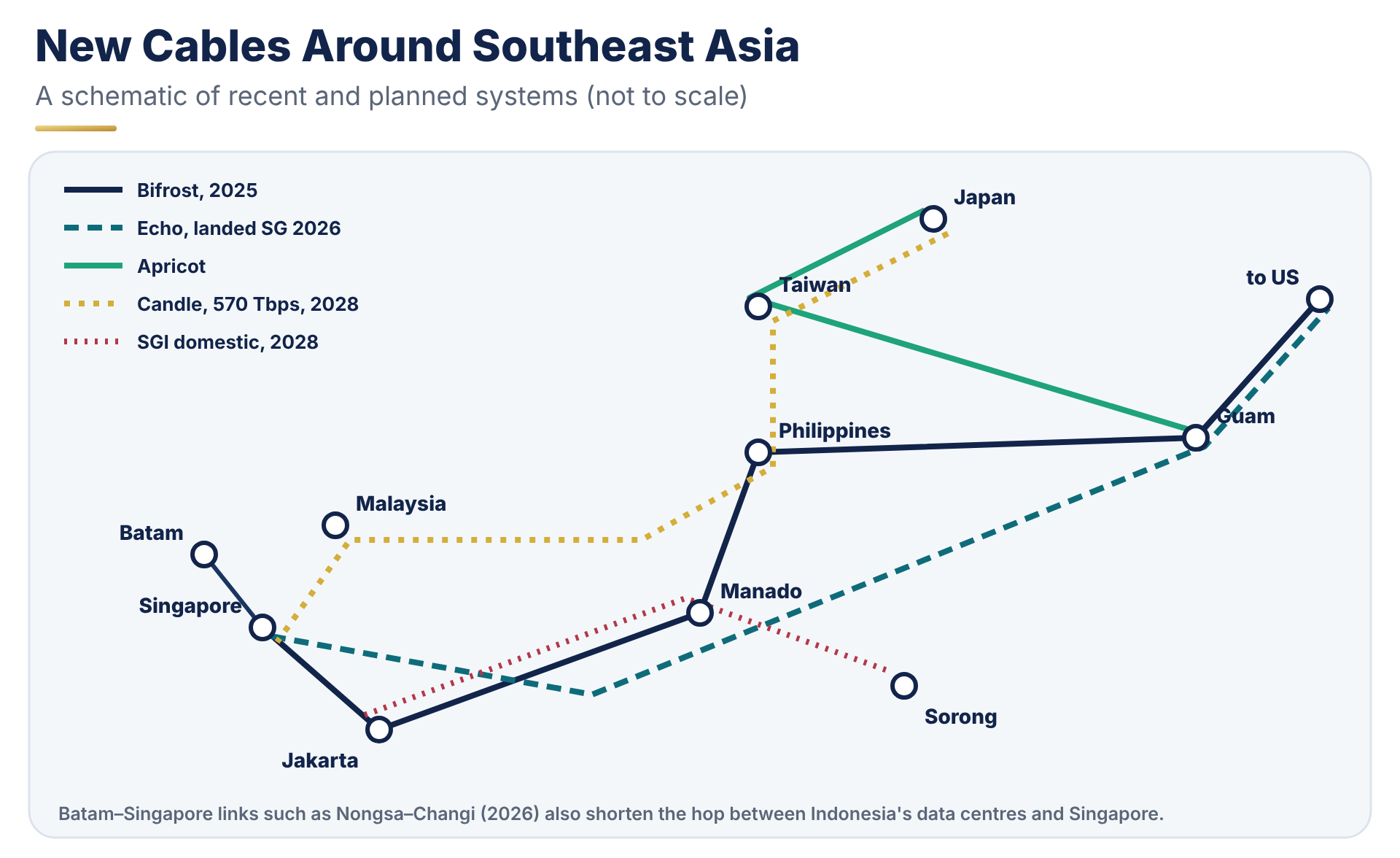
| Bifrost | Singapore, Jakarta, Manado, the Philippines, Guam, United States | Ready for service October 2025; over 260 Tbps; built with Keppel and Telin; Mexico extension planned |
| Echo | United States, Guam, Singapore | 260 Tbps; landed in Singapore in 2026, a second trans-Pacific route that avoids the South China Sea |
| Apricot | Japan, Taiwan, Guam; later the Philippines, Indonesia, Singapore | About 290 Tbps planned; intra-Asia backbone |
| Candle | Japan, Taiwan, the Philippines, Indonesia, Malaysia, Singapore | 8,000 km, 570 Tbps, the region’s largest; due 2028; Meta with Telin, Globe, IPS, SoftBank |
| SGI Cable System | Jakarta to Sorong, 14 landings across Indonesia | 6,870 km, 16 fibre pairs, 25 Tbps; due end-2028 |
| Nongsa–Changi | Batam to Singapore | Inaugurated July 2026 by Telkom Group, linking Batam’s data centres to Singapore |
Two themes stand out. The first is route diversity: Bifrost and Echo were designed as the first trans-Pacific cables to cross the Java Sea, giving Southeast Asia paths to the United States that do not depend on the busy South China Sea. The second is Indonesia’s domestic backbone. With more than 17,000 islands, the country depends on subsea cables for its own national connectivity, and new systems such as SGI aim to tie eastern, central, and western Indonesia together for data centres, cloud, and AI.
Resilience
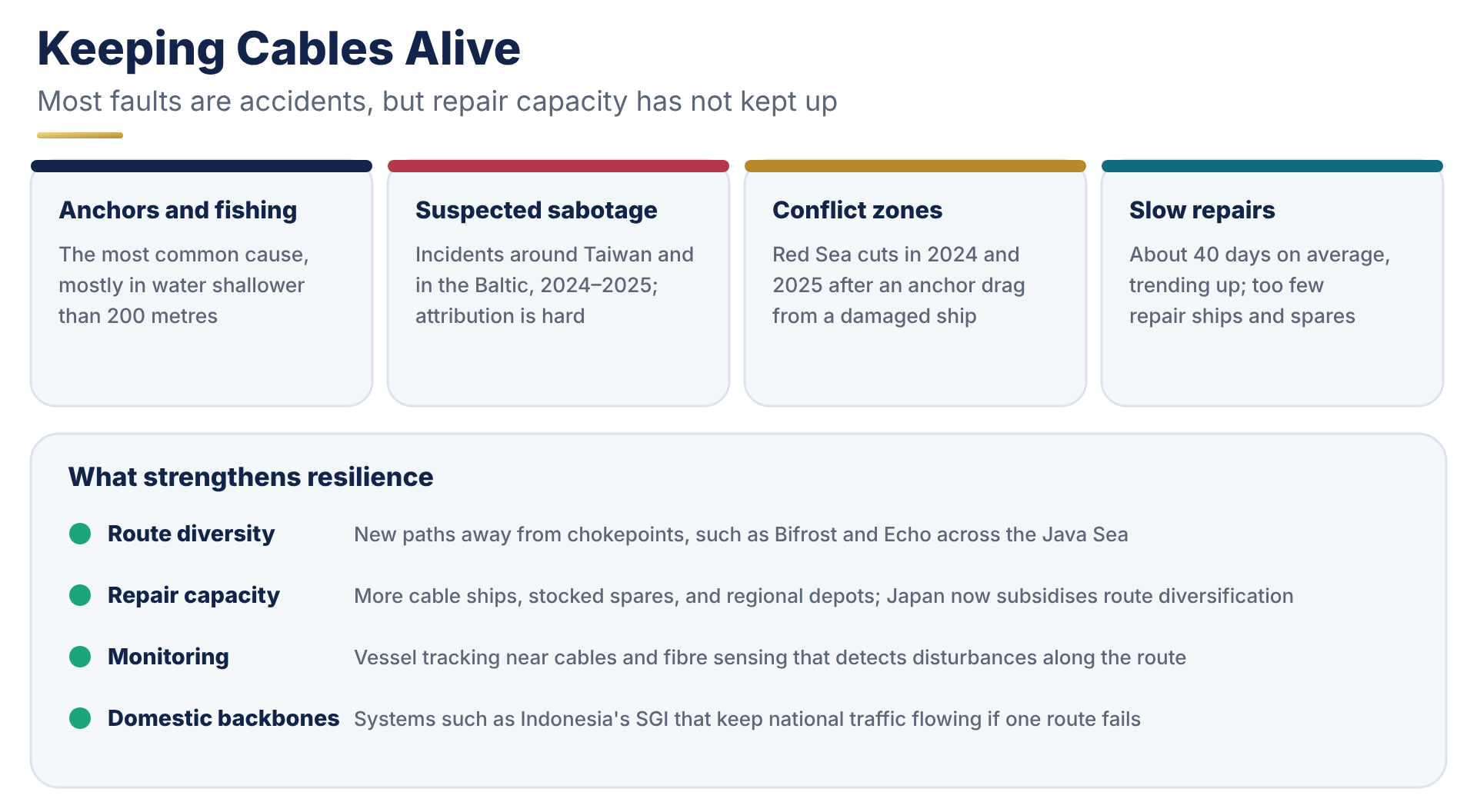
Most cable faults are accidental, caused by anchors and fishing gear in water shallower than 200 metres. But a series of incidents around Taiwan and in the Baltic Sea in 2024 and 2025, several involving vessels linked to Russia or China, and cuts in the Red Sea after a ship damaged in an attack dragged its anchor, have made cable security a policy priority. Attribution is difficult, and repair is slow: Recorded Future estimates an average of about 40 days, trending upward, because there are too few cable ships, spares, and trained crews.
- Japan now subsidises subsea route diversification, selecting projects in Hokkaido, Wakayama, and Tokushima in October 2026.
- Indonesia manages more than 115,000 km of cables and has designated statutory corridors where new systems must be laid, but has few domestic repair ships.
- Regional cooperation on repair depots, permits, and vessel monitoring is increasingly discussed as a shared Asia-Pacific need.
What Comes Next
Expect more fibre pairs, multicore fibre in new systems as described on the New Fibre page, more cables owned by cloud companies, and more routes designed for diversity rather than shortest distance. Expect also more attention to the unglamorous parts of the system: repair ships, spares, permits, and monitoring.
References
- Meta Engineering, “Introducing the Candle subsea cable,” October 2025, and “Project Waterworth,” February 2025; IEEE Spectrum on Waterworth.
- Converge Digest and Submarine Networks on Bifrost, Echo, and Apricot; W.Media on Echo landing in Singapore, August 2026.
- Light Reading on the SGI Cable System, October 2026; The Jakarta Post and RRI on the Nongsa–Changi cable, July 2026.
- Recorded Future (Insikt Group), “Submarine Cables Face Increasing Threats,” 2025; Texas National Security Review, Summer 2026.
- APNIC Blog, “Submarine cable resilience,” October 2026; Submarine Networks on Japan’s route diversification programme.
- South China Morning Post on Indonesia’s cable network and repair capacity.