
QUIC: The Transport Protocol That Rewired the Web
Why the web moved part of its traffic from TCP to QUIC, what it changes for operators, and how multipath and media extensions extend it.
- RFC 9000
- HTTP/3
- Multipath
- MASQUE
- Media over QUIC
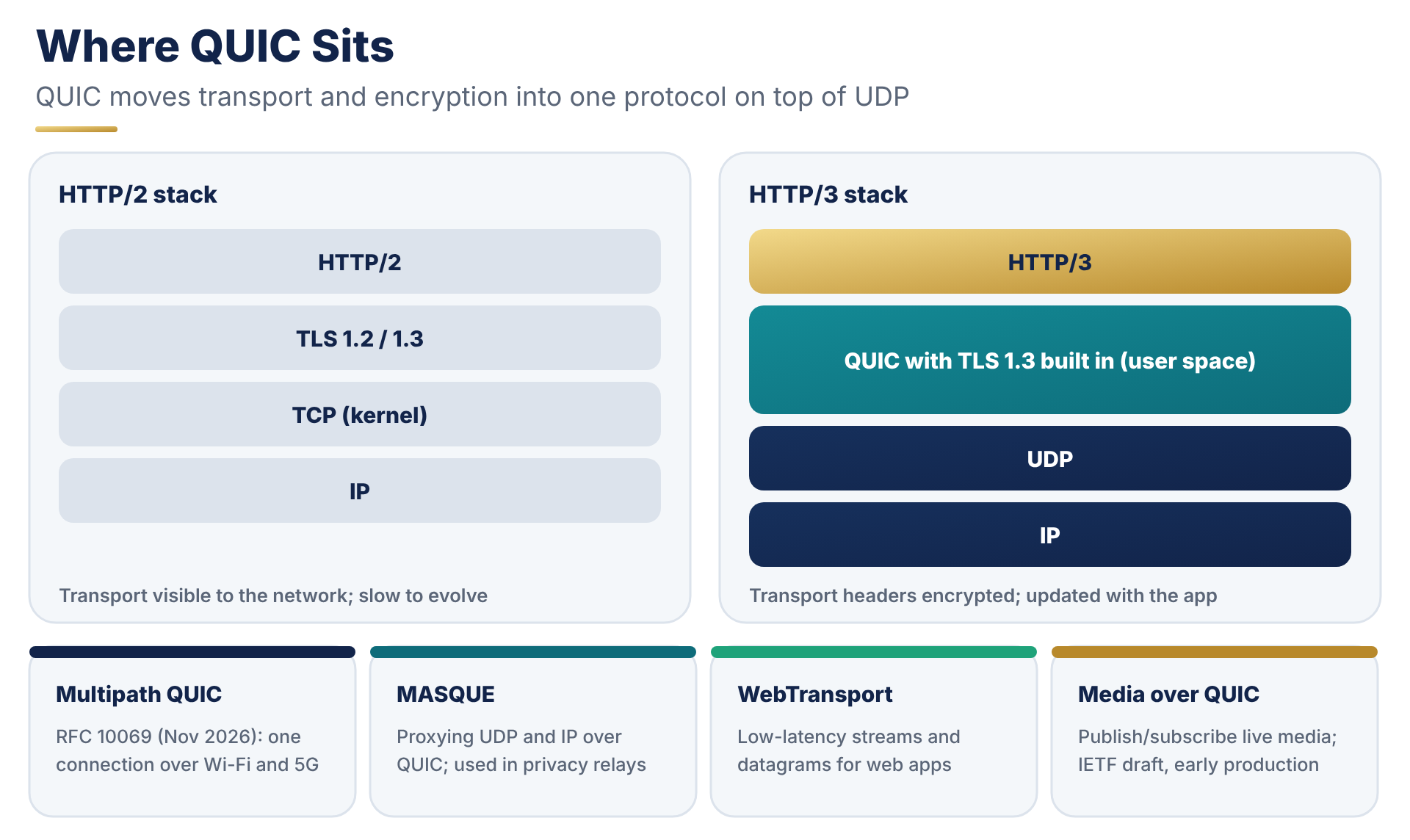
For forty years, most internet applications relied on TCP to deliver data reliably. QUIC, first developed at Google and standardised by the IETF in 2021, replaces TCP for many applications. It runs over UDP, builds TLS 1.3 encryption into the transport itself, and lives in application software rather than the operating system kernel. HTTP/3 runs on QUIC, and so do growing numbers of video, messaging, and real-time services. For network operators, QUIC is a mixed blessing: users get faster and more robust connections, but the network sees much less of what is happening inside them.
Why QUIC
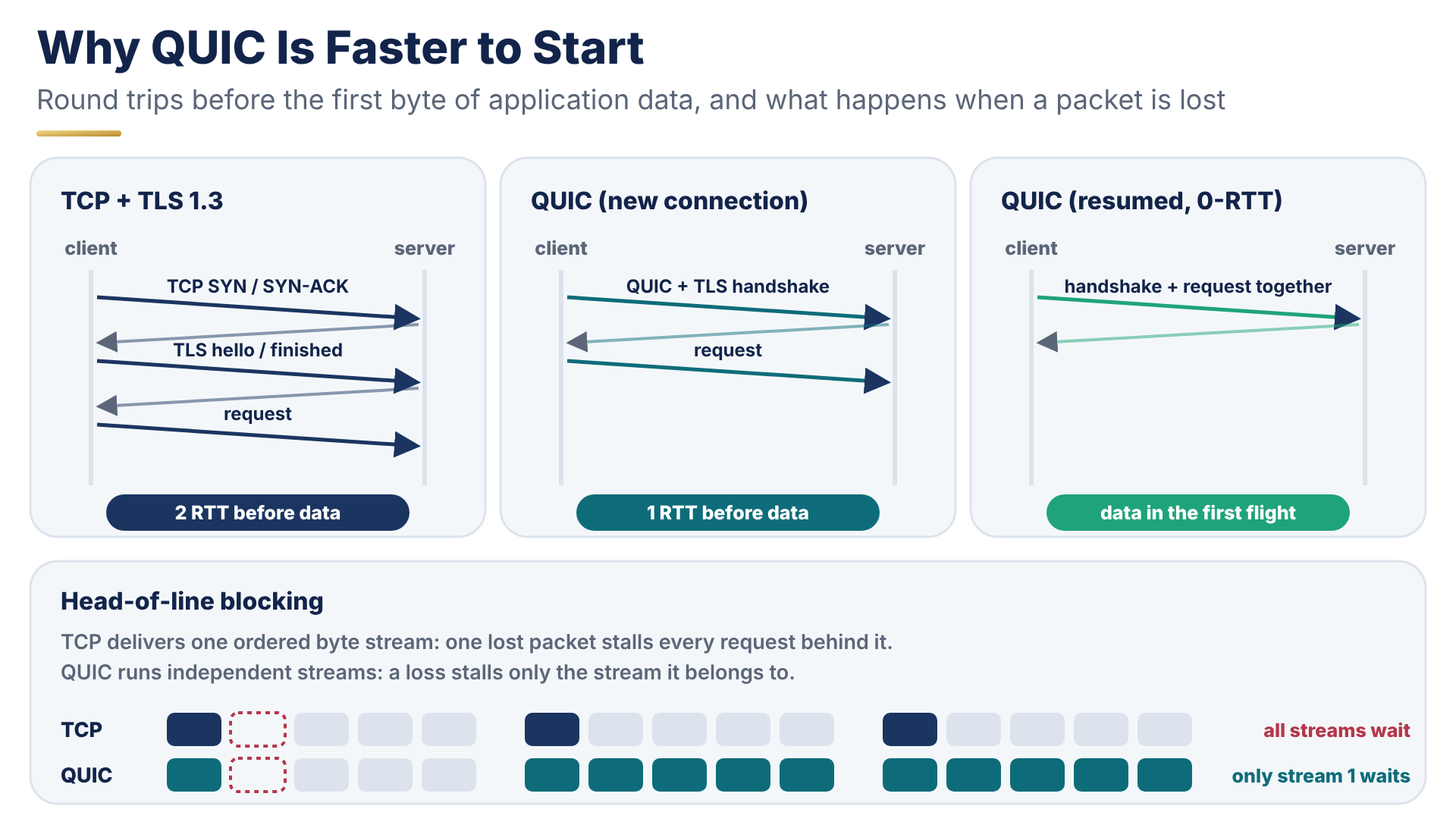
- Faster setup. QUIC combines the transport and encryption handshakes, so a new connection needs one round trip before data flows, and a resumed one can send data immediately (0-RTT).
- No head-of-line blocking. A QUIC connection carries many independent streams. A lost packet delays only its own stream, not every request on the connection.
- Connection migration. A connection is identified by an ID, not by IP addresses, so it can survive a move from Wi-Fi to mobile data.
- Always encrypted. Almost all of the transport header is encrypted, protecting users and preventing middleboxes from freezing the protocol in place.
Where It Sits
| Standard | Year | What It Defines |
|---|---|---|
| RFC 9000 | 2021 | QUIC transport protocol |
| RFC 9001 | 2021 | Using TLS 1.3 to secure QUIC |
| RFC 9114 | 2022 | HTTP/3 over QUIC |
| RFC 9298 and related | 2022 onward | MASQUE: proxying UDP and IP over HTTP and QUIC |
| RFC 10069 | November 2026 | Multipath QUIC: one connection over several paths |
Multipath QUIC is the newest piece. Its main authors include engineers from Alibaba, whose earlier XLINK multipath work on Taobao short video showed lower tail latency and less rebuffering when phones used Wi-Fi and cellular at the same time. Media over QUIC (MoQ), still an IETF draft, applies QUIC to live and real-time media; Meta moved Instagram Live ingest to MoQ in 2026, and Alibaba uses it in production for voice search and AI assistants.
Adoption
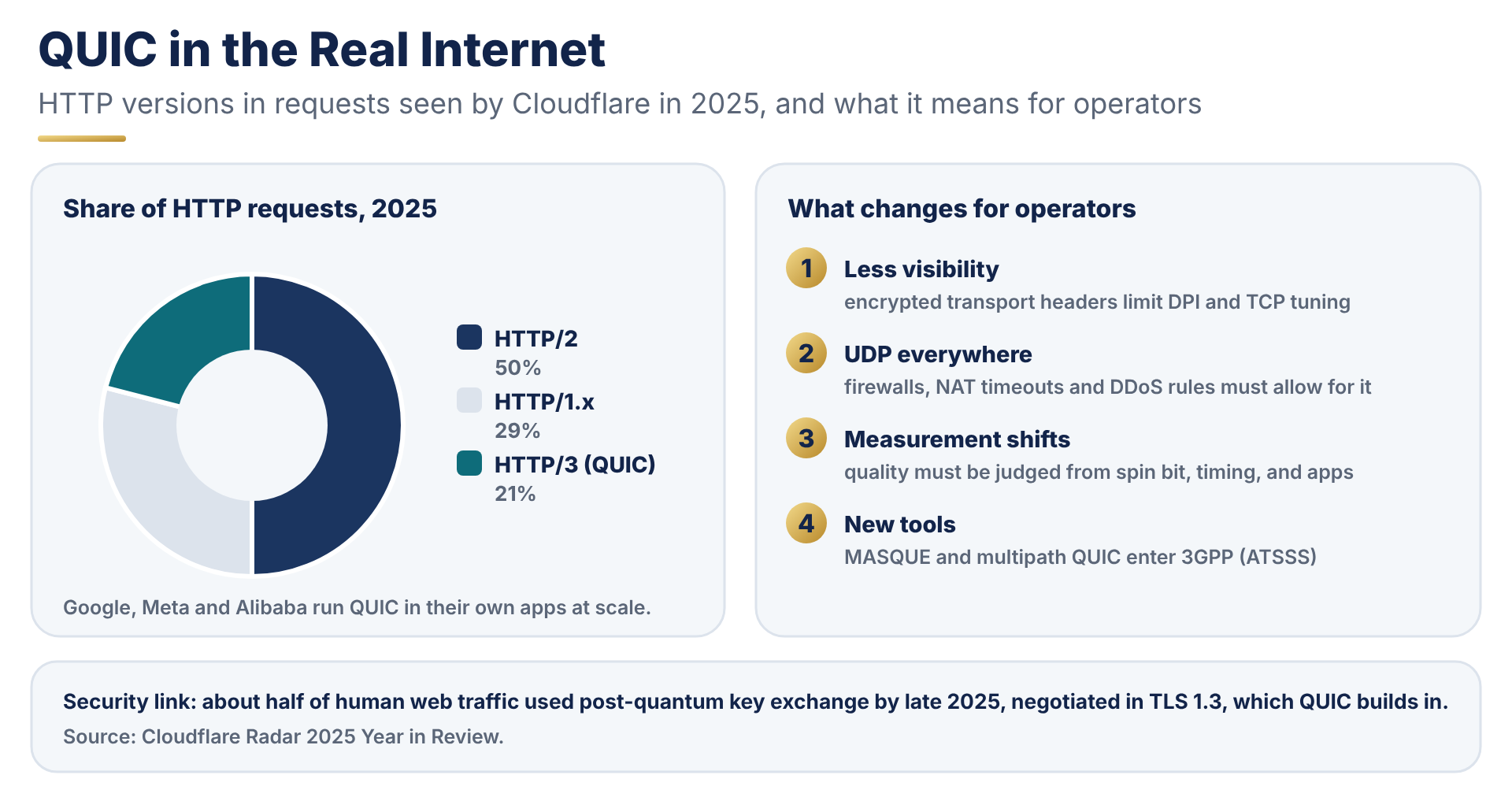
Cloudflare’s 2025 review found HTTP/3 in about 21% of requests on its network, with HTTP/2 at about 50% and older versions at 29%. HTTP/3’s share grew only slightly during 2025, but large content and app providers, including Google, Meta, and Alibaba, also run QUIC heavily inside their own apps. QUIC is now a permanent part of internet traffic.
What It Means for Operators
- Less visibility. Encrypted transport headers prevent deep packet inspection and TCP optimisation proxies from seeing loss, retransmissions, or application details. Operators must rely on traffic patterns, the optional spin bit, and cooperation with content providers.
- UDP at scale. Firewalls, NAT devices, and DDoS protection must handle large volumes of UDP traffic and longer-lived flows.
- New roles. 3GPP Release 18 added MPQUIC steering to ATSSS, so a 5G core can split or switch a device’s traffic between 5G and Wi-Fi using QUIC-based proxying.
- Security link. About half of human web traffic on Cloudflare used post-quantum key exchange by the end of 2025, negotiated in TLS 1.3, which QUIC builds in. The wider picture is on the Quantum Networking page.
What Comes Next
Expect multipath QUIC in phones that combine 5G and Wi-Fi, MoQ for live streaming and interactive AI, and MASQUE-based relays for privacy and enterprise access. The trend is clear: more of the transport layer moves into applications, and networks cooperate with them through explicit interfaces such as the ones on the Network APIs page.
References
- IETF RFC 9000, 9001, 9002 (2021), RFC 9114 (2022), RFC 9298 (2022), and RFC 10069 (November 2026).
- Cloudflare Radar 2025 Year in Review, December 2025; InfoQ and PPC Land coverage.
- Z. Zheng et al., “XLINK: QoE-driven multi-path QUIC transport in large-scale video services,” ACM SIGCOMM 2021.
- Meta Engineering, Media over QUIC for Instagram Live, October 2026; Alibaba XQUIC team, “MoQ Production Practice,” IETF 125.
- 3GPP TS 23.501 clause 5.32 and TS 24.193 (ATSSS, Release 18).