
Network Slicing: Selling Performance, Not Just Bandwidth
What a network slice is, how it works end to end, and how operators in Asia-Pacific are turning it into commercial products.
- 5G SA
- S-NSSAI
- URSP
- SLA
- Differentiated connectivity
Mobile networks have always treated most traffic the same way: best effort, shared by everyone in the cell. Network slicing changes that. It lets an operator run several logical networks on one physical network, each with its own performance targets, from guaranteed uplink for a live broadcast to priority for a factory’s robots. After years of demonstrations, slicing has become a commercial product. Ericsson counted 84 commercial offers worldwide in June 2026, and in Asia-Pacific the first consumer slicing plans and the first regulatory rules for them both appeared in 2026.
What a Slice Is
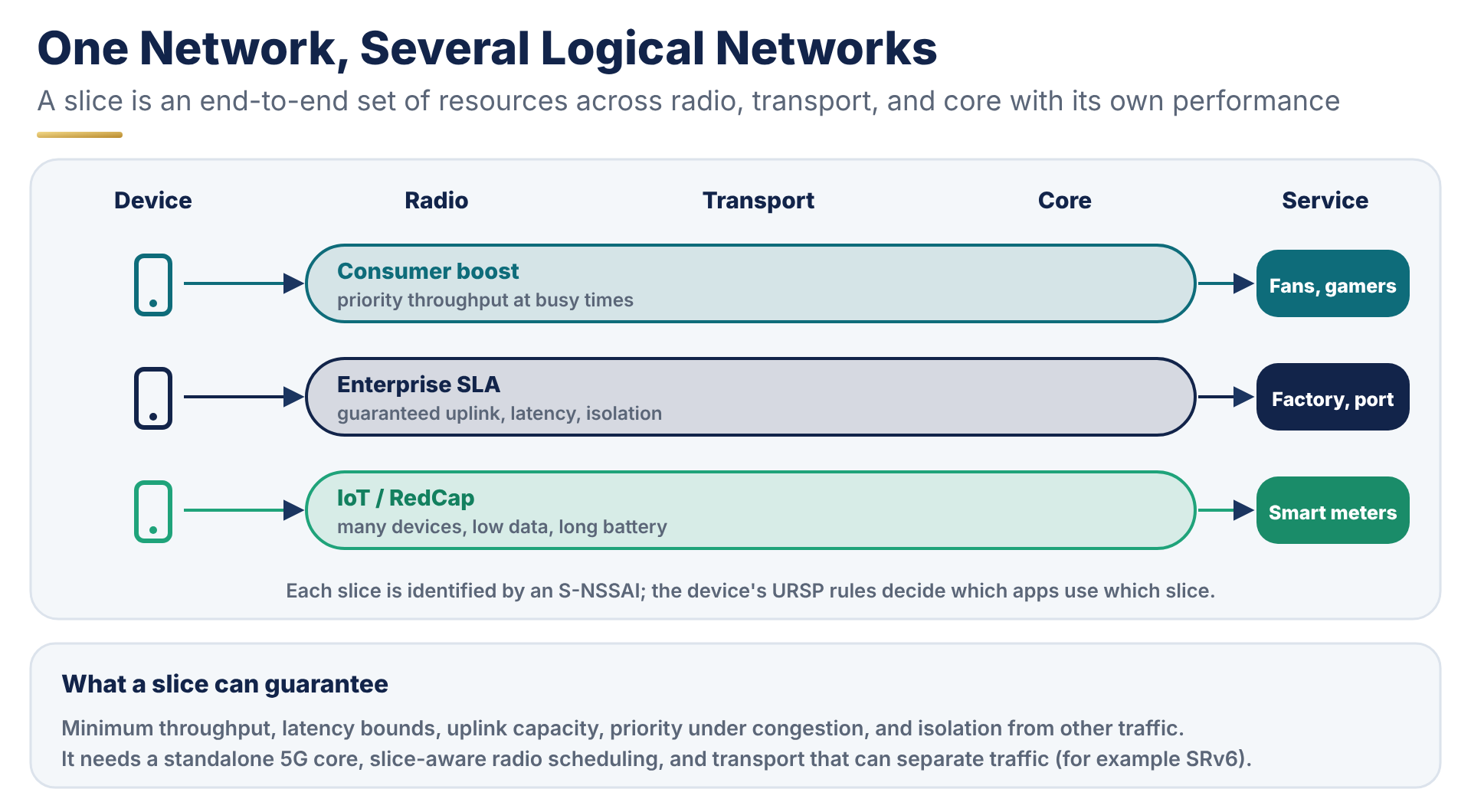
- End to end. A slice spans the radio, the transport network, and the core. The radio scheduler reserves or prioritises resources; transport keeps slice traffic separate, often using SRv6; the core runs functions per slice.
- Identified by S-NSSAI. Each slice has an identifier that the device and network use to request and select it.
- Chosen per app. On the device, URSP rules from the operator decide which apps use which slice, so a video-call app can use a priority slice while other apps use the default one.
- Requires standalone 5G. Slicing needs a 5G core, which is why its growth follows the spread of standalone networks described on the Cloud Core page.
From Trials to Offers
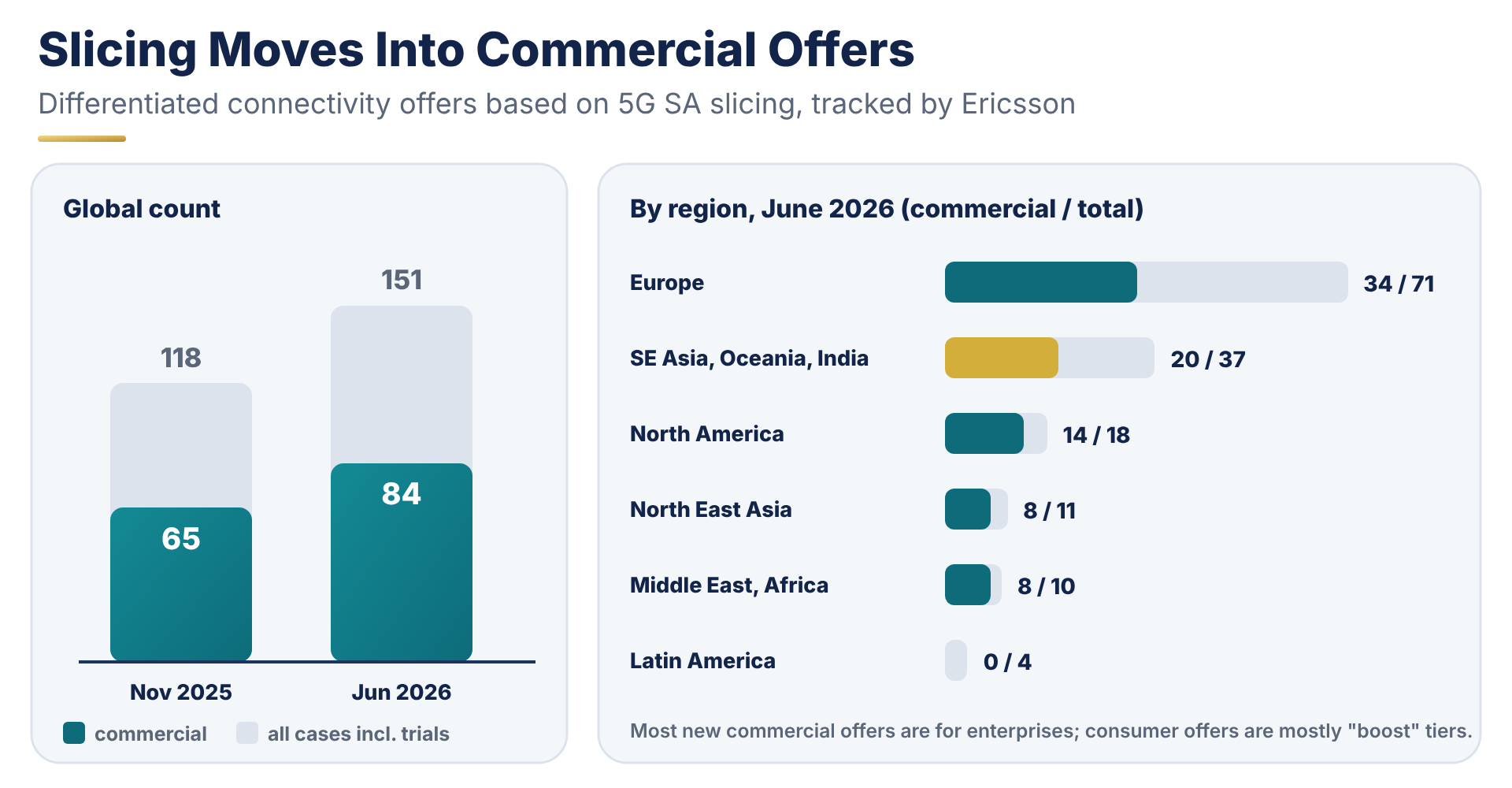
Ericsson tracks what it calls differentiated connectivity: services where operators sell performance rather than just data volume. Its June 2026 report found 151 cases, of which 84 were commercial, up from 65 six months earlier. Europe has the most, followed by Southeast Asia, Oceania, and India. Most new commercial offers target enterprises, often with service-level agreements, while consumer offers are mostly simple “boost” tiers for busy periods, gaming, or live events.
| Offer Type | Typical Example |
|---|---|
| Consumer priority | A monthly add-on that keeps speeds up at concerts, stadiums, or rush hour |
| Live production | Guaranteed uplink for broadcasters and news crews at events |
| Enterprise SLA | A dedicated slice for a port, factory, or retail chain, with performance commitments |
| Public safety | Priority and isolation for police, fire, and emergency services |
| Premium FWA | A home broadband tier with steadier speeds, related to the FWA page |
Asia-Pacific
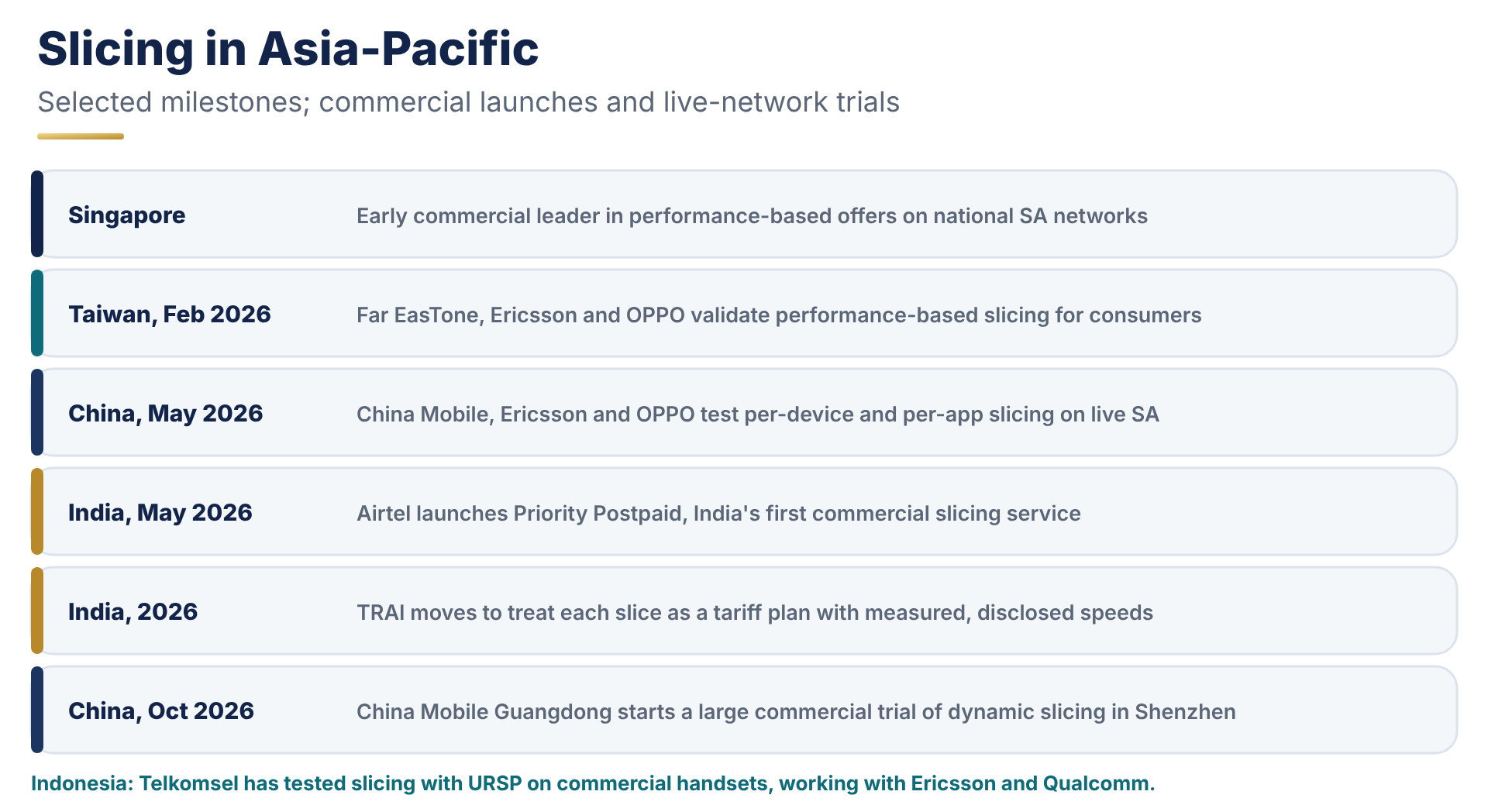
- Singapore moved early, with operators offering performance-based services on its standalone networks; Ericsson has cited it as a leading market.
- India. Bharti Airtel launched Priority Postpaid in May 2026, described as the country’s first commercial slicing service. The regulator TRAI has moved to treat each slice as a distinct tariff plan, with operators required to publish measured speeds per slice, and the government has proposed safeguards so that slices do not degrade ordinary users’ service.
- China is testing finer-grained slicing: per-device and per-app slices on China Mobile’s live network with Ericsson and OPPO, and a large commercial trial of dynamic slicing in Shenzhen from October 2026.
- Taiwan. Far EasTone, Ericsson, and OPPO validated performance-based slicing for consumers in early 2026.
- Indonesia. Telkomsel has tested slicing with URSP on commercial handsets with Ericsson and Qualcomm, and offers slicing as part of its 5G SA enterprise solutions.
What Makes It Hard
- End-to-end orchestration. A slice must be configured consistently across radio, transport, and core, often from different vendors.
- Assurance. Selling a guarantee means measuring it continuously and proving it to the customer.
- Device support. URSP and slice selection need recent devices and operating systems.
- Fairness and regulation. Prioritising paying users raises net neutrality questions, which is why India’s regulator has stepped in early.
- Pricing. Operators are still learning what customers will pay for and how to package it.
What Comes Next
Slicing is converging with network APIs: developers will be able to request a slice or a quality boost for a session through standard APIs such as Quality on Demand, described on the Network APIs page. Automation and AI will be needed to run many slices at once, and 5G-Advanced adds features that make slices more dynamic.
References
- 3GPP TS 23.501 (network slicing, S-NSSAI) and TS 24.526 (URSP).
- Ericsson Mobility Report, November 2025 and June 2026, differentiated connectivity articles.
- ABI Research, “Network Slicing Moves from Promise to Product,” May 2026.
- RCR Wireless and Communications Today on Airtel Priority Postpaid, May 2026; TeckNexus, Advanced Connectivity Insights, August 2026.
- Ericsson press releases with China Mobile and OPPO (May 2026) and with Far EasTone and OPPO (2026); Mobile World Live on China Mobile Guangdong, October 2026.
- Telkomsel, Ericsson and Qualcomm collaboration on 5G SA and slicing.