
Network APIs: Opening the Network to Developers
How operators expose network capabilities through standard APIs, which APIs are selling, and why Indonesia became an early example.
- CAMARA
- Open Gateway
- Aduna
- Number Verification
- Quality on Demand
Operators know things about their networks and subscribers that applications cannot see: whether a phone number really belongs to the device in use, whether a SIM card was swapped yesterday, roughly where a device is, or whether the network can support a video call right now. Network APIs expose these capabilities in a controlled way, with consent and privacy rules, so that banks, apps, and enterprises can use them. Since the GSMA launched Open Gateway in 2023, network APIs have moved from concept to commercial use, led by fraud prevention, and a global joint venture of operators and Ericsson, Aduna, now sells them across many markets.
How It Works
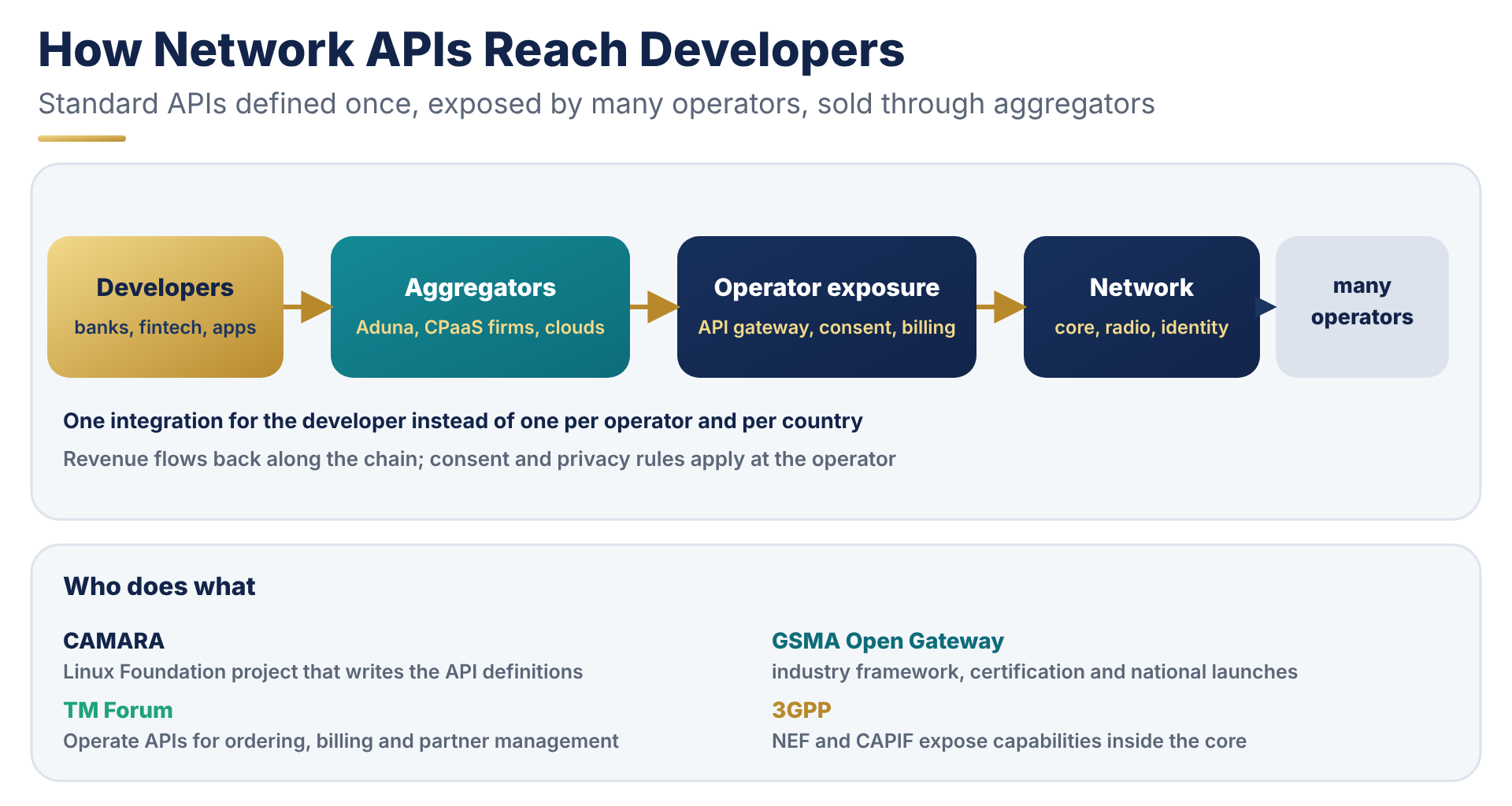
- CAMARA, a Linux Foundation project, writes the API definitions as open source, so the same API looks the same on every operator.
- GSMA Open Gateway provides the framework, certification, and coordination of national launches. The GSMA says more than 300 networks now have access to Open Gateway APIs.
- TM Forum provides Operate APIs for ordering, billing, and partner management, aligned with Open Gateway since 2025.
- Aggregators such as Aduna, Vonage, Sinch, Infobip, and the cloud providers resell APIs from many operators through one interface.
- Inside the network, the 5G core’s exposure function (NEF) and 3GPP’s CAPIF framework connect the APIs to real network functions, as described on the Cloud Core page.
What the APIs Do
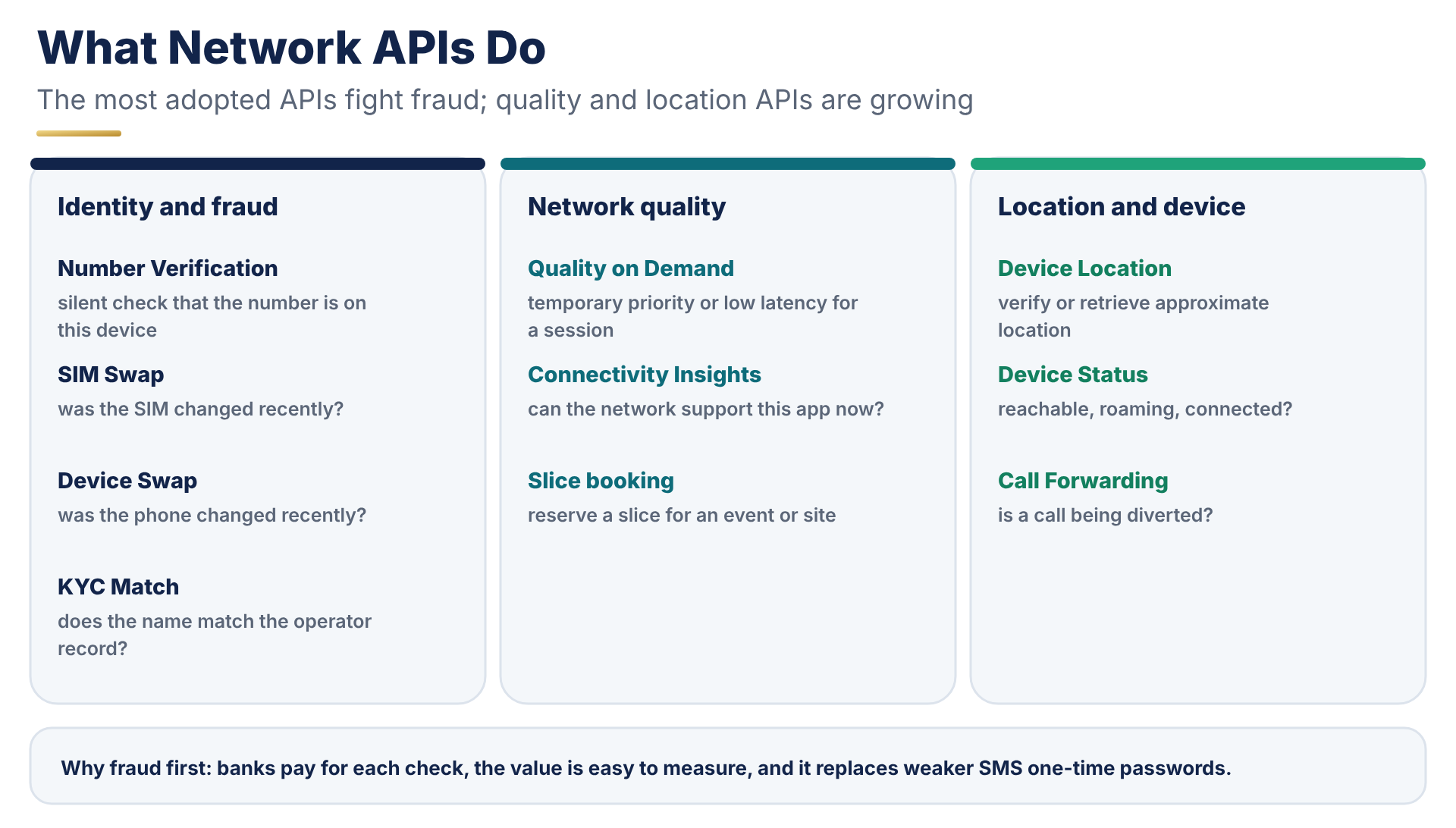
The first APIs to sell well are about identity and fraud. A bank can check that the phone number a customer gives is the one on the device being used, silently, without sending an SMS code. It can check whether the SIM or device was changed recently, a common sign of account takeover. These checks are easy to price per use and their value is easy to measure. Quality APIs, such as Quality on Demand, let an application request temporary priority or lower latency, and connect network APIs with slicing.
Asia-Pacific
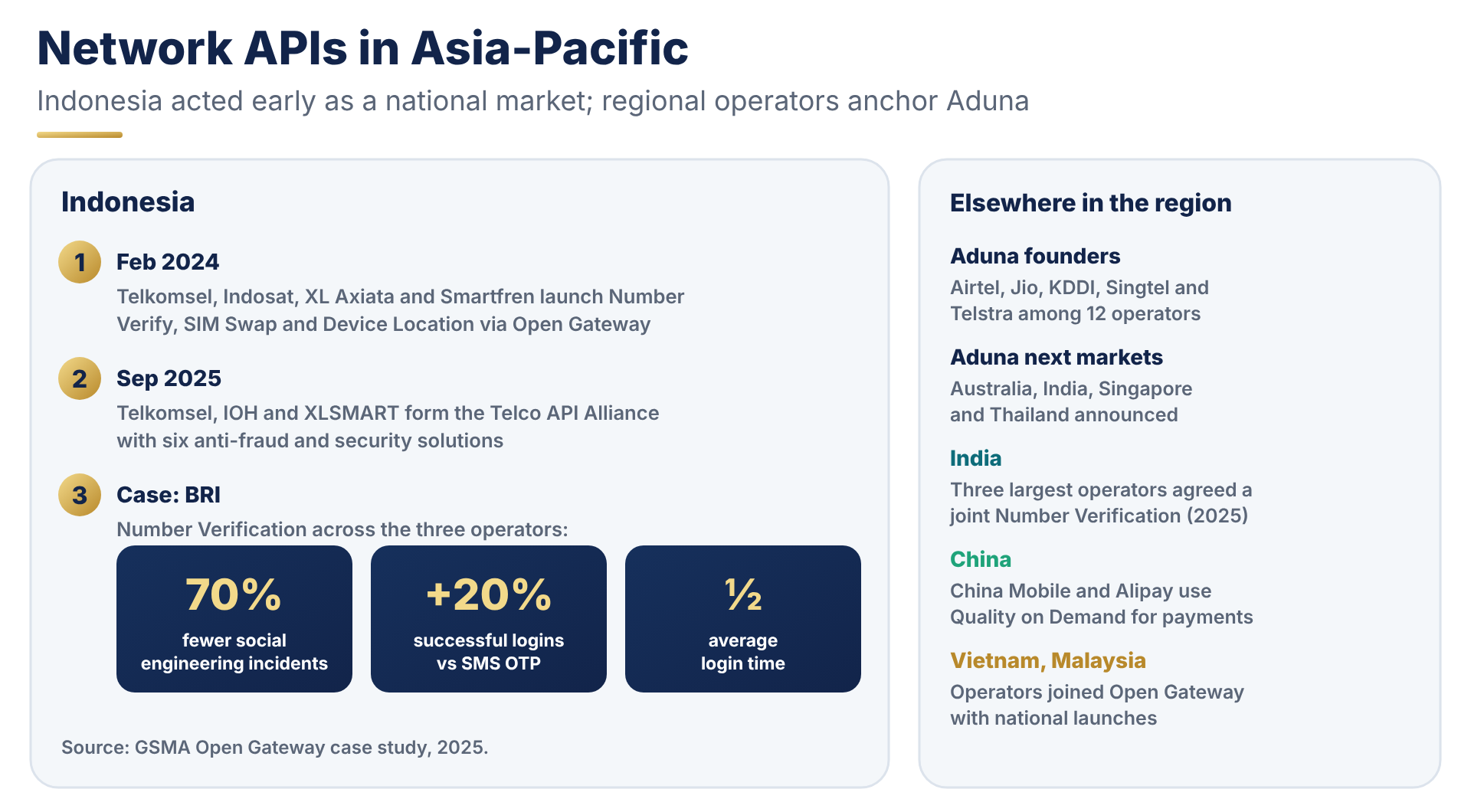
- Indonesia. In February 2024, Telkomsel, Indosat Ooredoo Hutchison, XL Axiata, and Smartfren jointly launched Number Verify, SIM Swap, and Device Location through Open Gateway. In September 2025, Telkomsel, IOH, and XLSMART formed the Telco API Alliance with six anti-fraud and security solutions.
- BRI. Bank Rakyat Indonesia used the Number Verification API across the three operators. The GSMA reports a 70% reduction in social-engineering incidents in its mobile apps, 20% more successful logins than with SMS one-time passwords, and average login time cut by half.
- Aduna. The joint venture launched by Ericsson and 12 operators includes Bharti Airtel, Jio, KDDI, Singtel, and Telstra. In March 2026 it covered 40 operators, with live services in six countries and Australia, India, Singapore, and Thailand among the next markets.
- India‘s three largest operators agreed in 2025 to offer a joint Number Verification API, aimed at replacing SMS one-time passwords for banks and online retailers.
- China. China Mobile works with Alipay on Quality on Demand to improve completion of mobile payments.
Open Questions
- Revenue scale. Fraud APIs are selling, but total revenues are still small compared with connectivity. Operators hope quality, location, and AI-related APIs will add more.
- Consent and privacy. Location and identity data are sensitive. CAMARA, the GSMA, and TM Forum are developing consent frameworks, and national data protection laws apply.
- Pricing and settlement. Aggregators, operators, and developers must agree how to split revenue across many countries.
- Agentic AI. AI agents may become major API users, calling network APIs automatically to verify identities or request quality for a task. Operators demonstrated agent-driven API use at MWC 2026.
What Comes Next
Network APIs will extend from fraud to quality, slicing, and edge computing, and will increasingly be used by AI agents rather than human developers. Their success depends on coverage, simplicity, and trust, which is why operators in the same market are cooperating instead of competing on the API layer.
References
- GSMA Open Gateway programme pages and MWC 2026 overview; GSMA press release on Indonesian operators, February 2024.
- GSMA Open Gateway, BRI Bank case study, 2025.
- Telkomsel, “Telkomsel, IOH and XLSMART launch joint Telco API Alliance,” September 2025.
- Aduna press releases, March 2026; TM Forum Inform on network APIs and Operate APIs.
- TelecomTV, “Network APIs gain traction across Asia,” 2025; Linux Foundation CAMARA project.