
SRv6: Programming the IP Network
How Segment Routing over IPv6 turns packet headers into programs, why compressed SIDs made it practical, and where it is replacing MPLS.
- Segment routing
- IPv6
- uSID
- RFC 9800
- MPLS migration
For two decades, operators have built their IP backbones on MPLS: labels added to packets so that routers can forward them along engineered paths and keep customer VPNs apart. MPLS works, but it needs extra protocols, stops at the edge of each network domain, and adds layers of operational complexity. Segment Routing over IPv6 (SRv6) takes a different approach. The path and the services a packet needs are written into the packet itself as a list of IPv6 addresses. With compressed identifiers now standardised, SRv6 has moved from early adopters to large-scale deployment in mobile transport, metro networks, and AI data centres.
How SRv6 Works
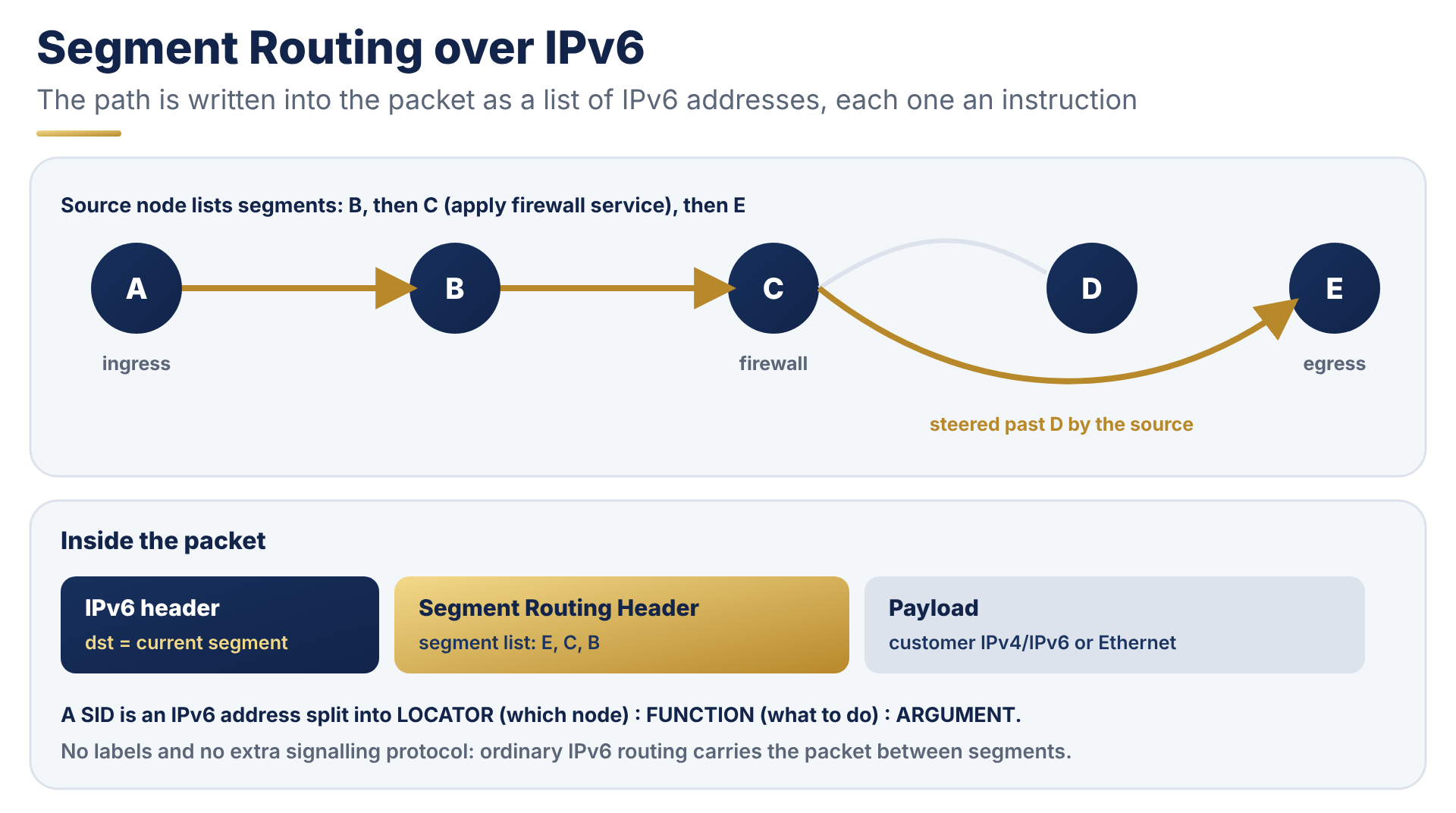
- Segments. Each segment identifier (SID) is an IPv6 address. Its first part, the locator, says which node; the rest says what function to apply, such as forwarding along a path, delivering into a VPN, or passing through a firewall.
- Source routing. The ingress node writes the list of segments into a Segment Routing Header. Routers in between need no per-flow state.
- Network programming. RFC 8986 defines a set of standard behaviours, so a SID can act like an instruction in a small program executed as the packet crosses the network.
- One protocol everywhere. Because SRv6 is plain IPv6, it can run across data centres, WAN, and even hosts, without the boundaries MPLS creates.
Making It Compact
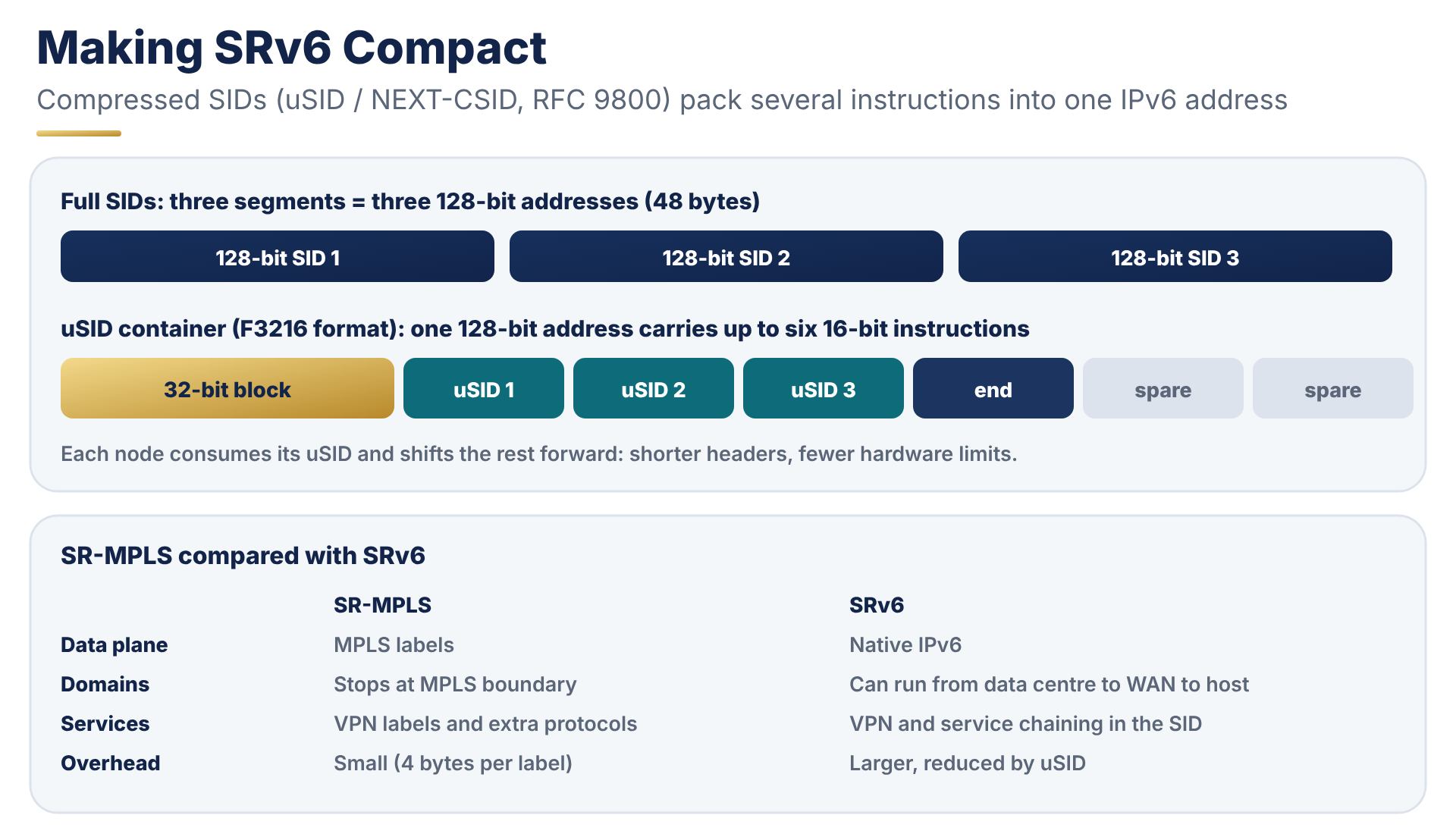
Early SRv6 had a clear weakness. Each segment took 16 bytes, so long paths produced large headers that some hardware could not handle at full speed. Compressed SIDs fix this by packing several short instructions into one IPv6 address. The most common format, often called uSID, uses a 32-bit block followed by 16-bit identifiers, so one 128-bit address can carry up to six instructions. The IETF standardised this approach as RFC 9800 in June 2025, ending years of debate between competing compression methods. China Mobile and Chinese vendors have also used a related format known as G-SRv6.
Deployments
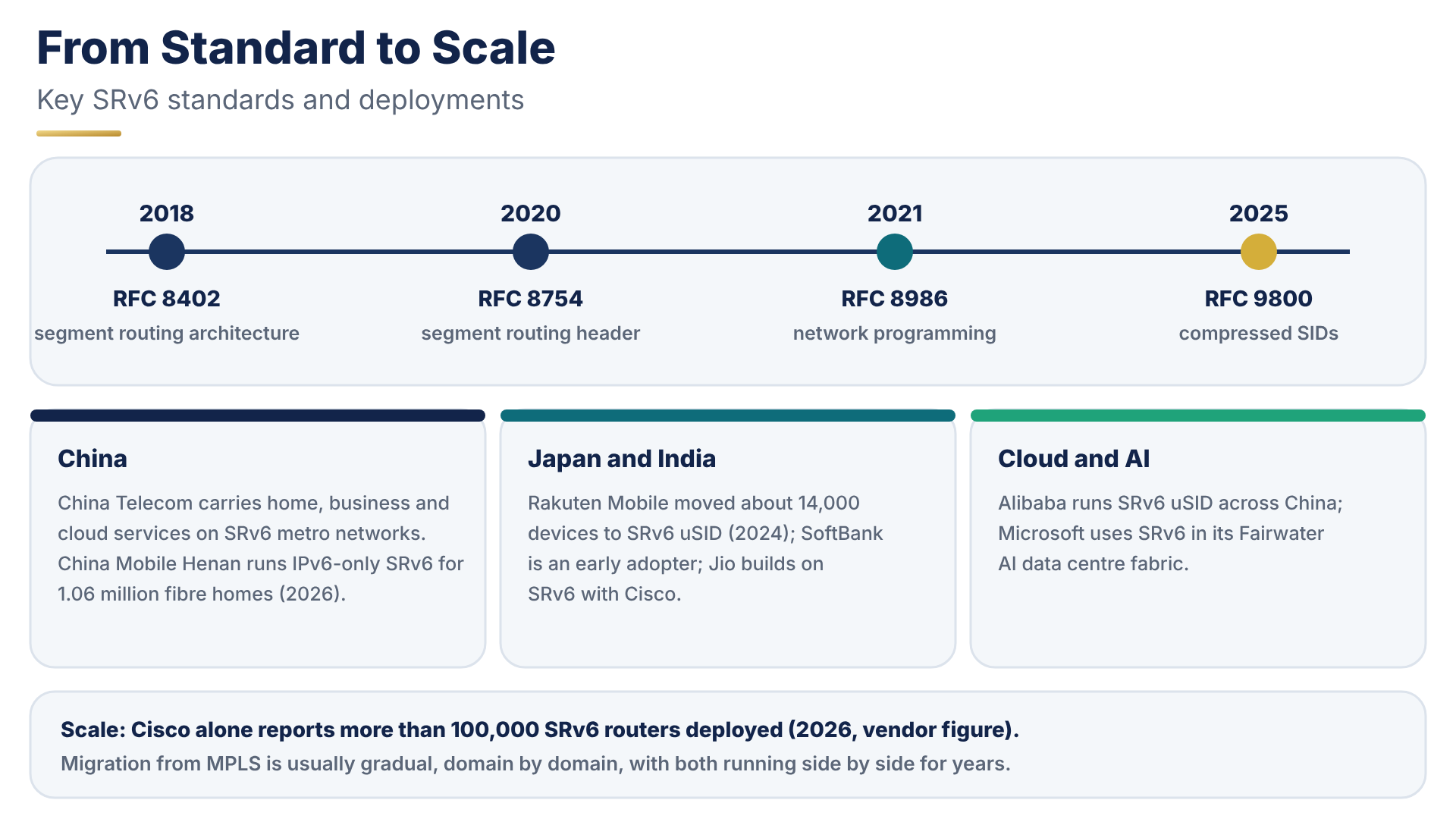
- Japan. Rakuten Mobile migrated its IP transport, about 14,000 devices, to SRv6 uSID with Cisco by 2024, reporting large reductions in routing state, configuration touchpoints, and service-affecting incidents. SoftBank was one of the earliest SRv6 adopters.
- China. China Telecom carries home, business, and cloud services on SRv6-based metro networks. In 2026, China Mobile Henan deployed an IPv6-only SRv6 metro network in Kaifeng that serves about 1.06 million fibre broadband users, carrying IPv4 traffic inside IPv6.
- India. Reliance Jio is building its transport on SRv6 with Cisco for 5G and future services.
- Cloud and AI. Alibaba runs SRv6 uSID across its network in China, and Microsoft uses SRv6 in its Fairwater AI data centre fabric.
Why Operators Move
| Benefit | What It Means in Practice |
|---|---|
| Fewer protocols | No LDP or RSVP-TE; IGP and BGP carry what is needed |
| Simpler services | VPNs, traffic engineering, and fast reroute in one framework |
| End-to-end paths | From a data centre server across the WAN to a cell site |
| Slicing in transport | Separate paths and resources per slice, supporting the Slicing page |
| IPv6-only networks | IPv4 carried as a service over a single IPv6 network |
What Comes Next
The next frontier is AI networking: SRv6 is being used to steer traffic across GPU clusters and between data centres, alongside the optical links described on the Coherent Optics page. Operators are also linking SRv6 paths to application intent, so that a network API or an automated controller can request a path with specific latency or resilience.
References
- IETF RFC 8402 (2018), RFC 8754 (2020), RFC 8986 (2021), and RFC 9800 (June 2025).
- IETF SRv6 Operations working group: draft-ietf-srv6ops-srv6-deployment and operator presentations, IETF 122–126.
- Rakuten Mobile and Cisco, SRv6 uSID deployment, July 2024; Rakuten presentation at IETF 120.
- China Telecom, “SRv6 Practice in China Telecom,” IETF 122; ifeng/PT Expo 2026 on China Mobile Henan’s SRv6 single-stack project.
- Cisco, “Building the Future: Reliance Jio’s SRv6-Powered Network,” 2025; C. Filsfils, SRv6 update, 2026.