
Coherent Optics: From 100G to 1.6T
How coherent detection multiplied the capacity of every fibre, why it moved into pluggable modules, and how AI is pulling it toward 1.6T and beyond.
- DSP
- 800ZR
- 1600ZR
- Pluggables
- AI scale-across
Almost every long-distance bit on the internet now travels as a coherent optical signal. The technique, borrowed from radio, encodes data in the amplitude, phase, and polarisation of light, and relies on a powerful digital signal processor to recover it. Since the first 100G systems around 2010, the capacity of a single wavelength has grown sixteen-fold. In 2026, coherent optics is no longer only the domain of long-haul transport shelves: it sits in router ports, links data centres across cities, and is being simplified to work inside campuses. The demand driver has changed too. AI training clusters spread across several buildings now need more capacity between them than almost anything before.
How Coherent Works
Simple optical links switch a laser on and off, or between a few brightness levels, and a photodiode measures how much light arrives. This is called intensity modulation with direct detection. It is cheap and works well over short distances, but it uses only one property of light.
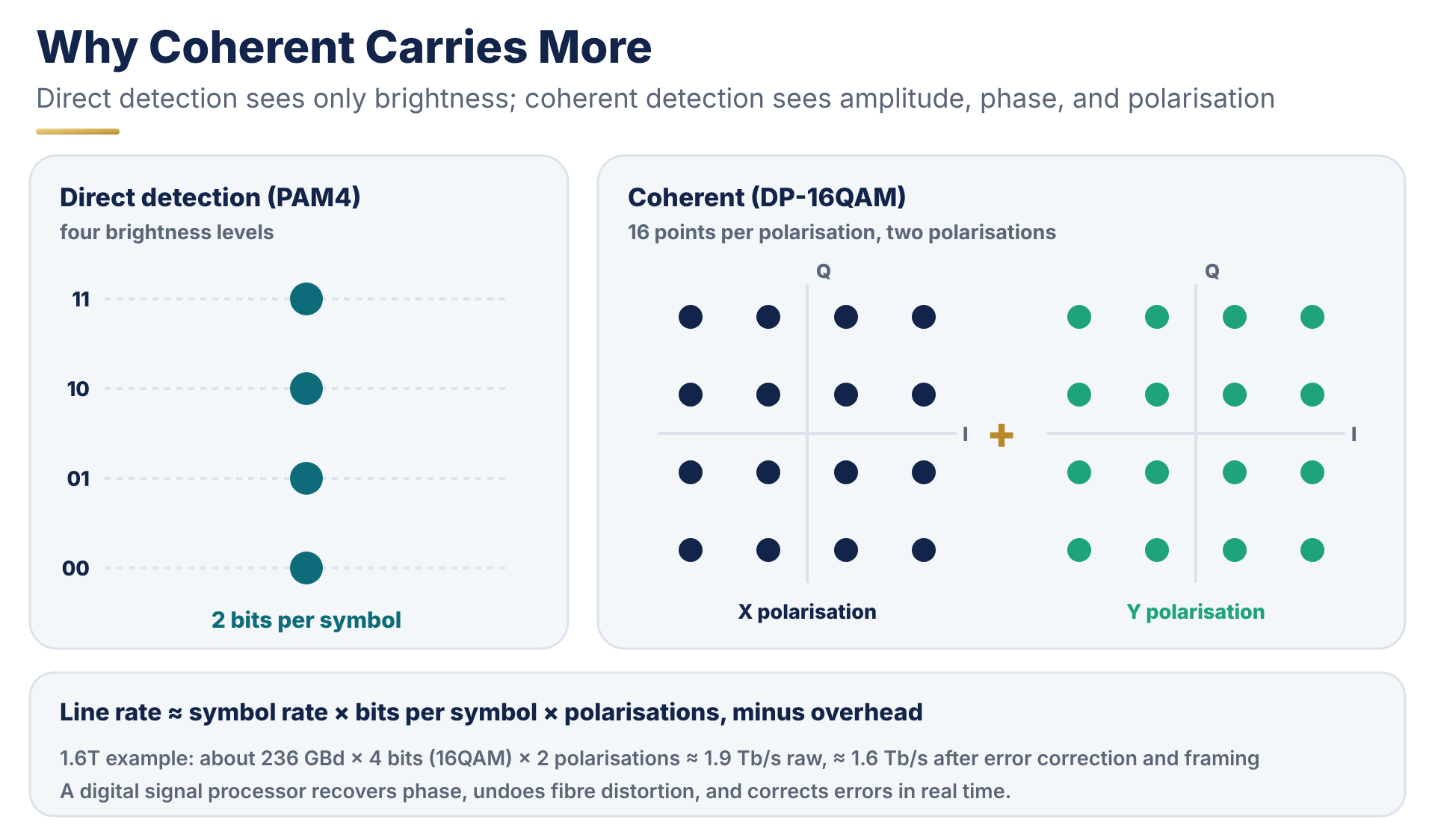
- Phase and amplitude. A coherent receiver mixes the incoming signal with a local laser, so it can measure both the in-phase (I) and quadrature (Q) components. Modulation formats such as QPSK and 16QAM place symbols on a two-dimensional grid.
- Two polarisations. Light can carry independent signals in two orthogonal polarisations, doubling capacity on the same wavelength.
- Digital signal processing. The DSP compensates for chromatic dispersion and polarisation effects in the fibre, recovers the carrier phase, and corrects errors. This is what made coherent practical: problems once solved with optical components are now solved in silicon.
- Probabilistic shaping. Modern DSPs adjust how often each constellation point is used, which lets a link run close to the theoretical limit for its distance.
Generations
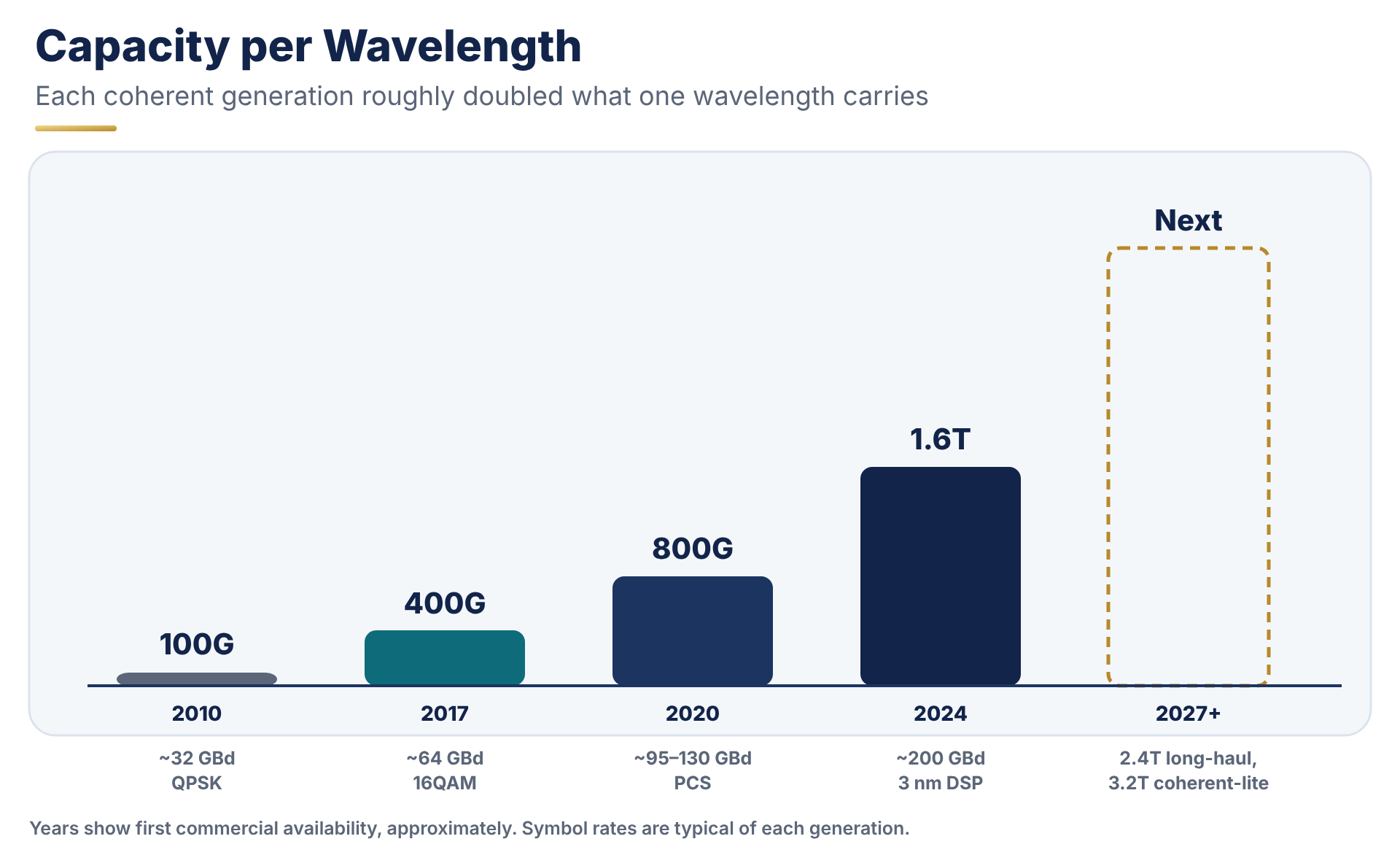
Two levers drive each generation: a faster symbol rate, which needs faster electronics and modulators, and a denser modulation format, which needs a cleaner signal. Each new DSP generation has also moved to a smaller chip process, which is what keeps power per bit falling. Ciena’s WaveLogic 6 Extreme, built on 3 nm silicon, carries 1.6 Tb/s on a single wavelength over metro distances and 800 Gb/s over the longest links. Operators such as Lumen in the United States, e& in the UAE, and Cirion in Latin America have adopted it for cloud and AI traffic.
| Measure | What Limits It |
|---|---|
| Symbol rate | Bandwidth of the modulator, digital-to-analogue converters, and receiver; around 200 GBd today |
| Bits per symbol | Signal-to-noise ratio, which falls with distance and the number of amplifiers |
| Reach | A trade-off: the same hardware sends 1.6T over a metro link or 800G across a continent |
| Power per bit | Chip process and integration; the main constraint for pluggable modules |
Pluggables
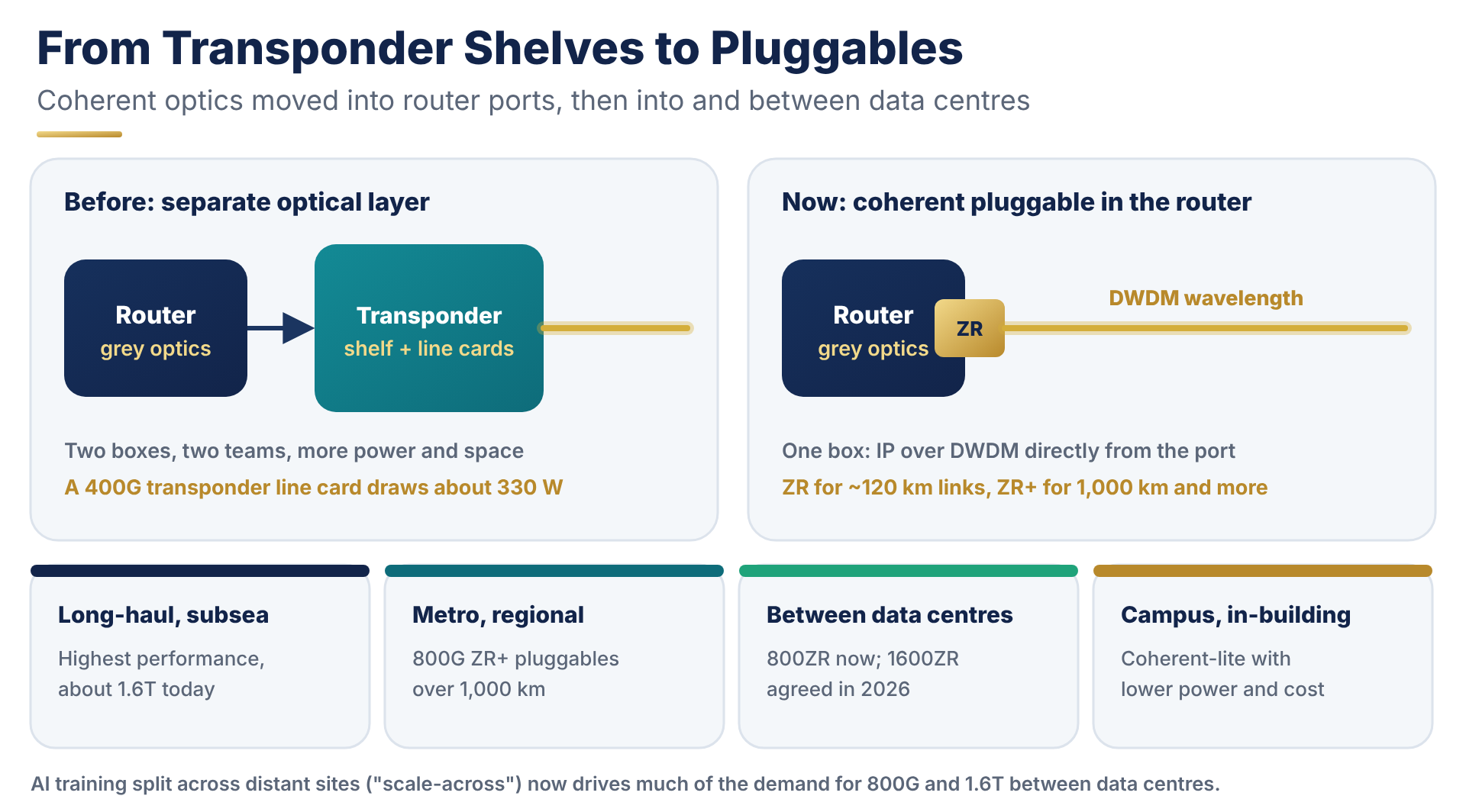
The biggest change of the past five years is packaging. Once a coherent DSP was small and efficient enough to fit inside a pluggable module, routers could send DWDM wavelengths straight from their ports. The Optical Internetworking Forum (OIF) defines interoperable versions, so modules from different vendors can talk to each other.
| Interface | Use | Status |
|---|---|---|
| 400ZR / OpenZR+ | Data centre interconnect up to about 120 km, and regional reach | Widely deployed |
| 800ZR / 800G ZR+ | Metro and data centre interconnect; ZR+ reaches 1,000 km and more | Ramping through 2026 |
| 1600ZR | 1.6T over a single wavelength for amplified links up to 120 km | OIF agreement published September 2026 |
| 1600ZR+ | 1.6T for longer, multi-span links | In development; vendors announced 2 nm DSPs |
AI Changes the Map
AI training needs enormous bandwidth between processors. When a single site cannot supply enough power, operators spread a training cluster across several data centres tens or hundreds of kilometres apart, a pattern the industry calls scale-across. The links between those sites must carry far more traffic than ordinary data centre interconnect, with low and predictable latency. This is why 800G and 1.6T coherent demand rose so quickly, and why the 1600ZR agreement arrived before 800ZR had even reached its peak volumes.
The same pressure is pushing coherent technology inward. Vendors now offer “coherent-lite” designs for campus links of a few kilometres, and researchers are exploring “coherent extra lite” approaches that remove much of the digital processing to cut power inside the data centre. Cignal AI expects 800G and 1.6T pluggables to account for about 60% of coherent revenues by 2030.
Security is also moving into the optical layer. Vendors now offer encryption at 1.6T designed to resist future quantum computers, a topic covered on the Quantum Networking page.
Asia-Pacific
- Australia. Telstra set a record for 1.6 Tb/s on a single wavelength across 736 km between Melbourne and Canberra, one of the country’s busiest routes.
- Indonesia. Coherent upgrades are lifting capacity on the Batam–Jakarta undersea corridor, where a 1 Tb/s-per-wavelength deployment was reported, as Batam grows into a data centre hub next to Singapore.
- China. Operators are pairing coherent backbones with all-optical access, and the national ICT plan to 2030 pairs a 50G-PON target with networks built for AI traffic.
- Subsea. New regional cables, described on the Subsea page, are designed around the latest coherent modems, so their capacity grows each time the terminal equipment is upgraded.
What Comes Next
The next steps are already announced: 1.6T pluggables based on 2 nm DSPs, 2.4T performance modems for long-haul, and 3.2T coherent-lite for short links. Beyond higher symbol rates, the industry is looking at using more of the fibre’s spectrum, with C and L bands together, and at multi-rail systems that light many parallel fibres at once. New fibre types, from hollow core to multicore, are the subject of the New Fibre page.
References
- OIF, 1600ZR Coherent Interface Implementation Agreement, September 2026; OIF 1600G coherent project pages.
- Ciena, WaveLogic 6 product materials and OFC 2026 demonstrations; Lightwave on WaveLogic 6 Extreme and Telstra’s 1.6T record.
- Fierce Network, “Optical transmission vendors predict high demand for 400G, 800G in 2026.”
- Dell’Oro Group, OFC 2026 analyst notes; Nokia, “OFC 2026 takeaways: pluggables, multi-rail, HCF and AI.”
- Acacia, “Looking Ahead to 1600G,” OFC blog; WWT, “Coherent DWDM in the 800G Era.”
- Network World, “The race to 1.6T,” September 2026; Computer Weekly on NAP Info’s Batam–Jakarta corridor.