
Passive Optical Networks: From GPON to 50G-PON
How one fibre serves dozens of homes without powered equipment in the street, how PON generations evolved, and why fibre now reaches into every room.
- GPON
- XGS-PON
- 25GS-PON
- 50G-PON
- FTTR
Fibre to the home is built almost everywhere on the same idea: a passive optical network. A single fibre leaves the exchange, is split by a small glass device into 32 or 64 branches, and reaches each home without any powered equipment in between. Because the fibre itself lasts for decades, operators upgrade capacity by changing the electronics at the two ends. That is why PON has moved from 2.5 Gb/s GPON to 10G, 25G, and now 50G generations on the same glass. This page explains how PON works, where each generation stands in 2026, and how fibre is being pushed past the front door into every room.
How PON Works
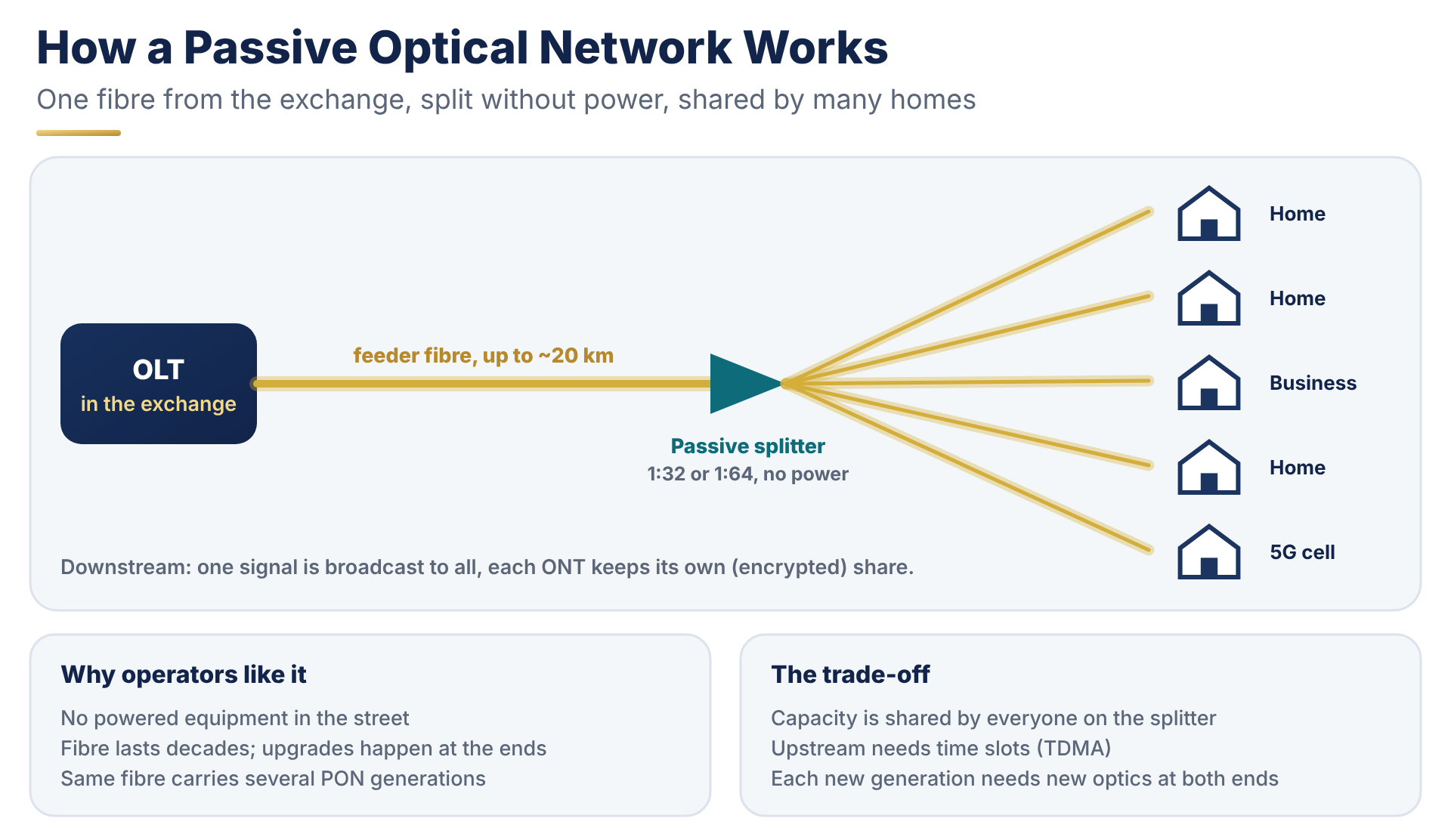
- OLT. The optical line terminal in the exchange sends one downstream signal and schedules upstream transmissions.
- Splitter. A passive device divides the light among 32 or 64 fibres. It needs no power and no maintenance, which keeps costs low and reliability high.
- ONT. The optical network terminal at each premises picks out its own traffic from the shared downstream stream, which is encrypted, and transmits upstream only in its assigned time slots.
- Coexistence. Different generations use different wavelengths, so an operator can add a faster PON on the same fibre while existing customers stay on the old one.
Generations
| Generation | Rates (down/up) | Status in 2026 |
|---|---|---|
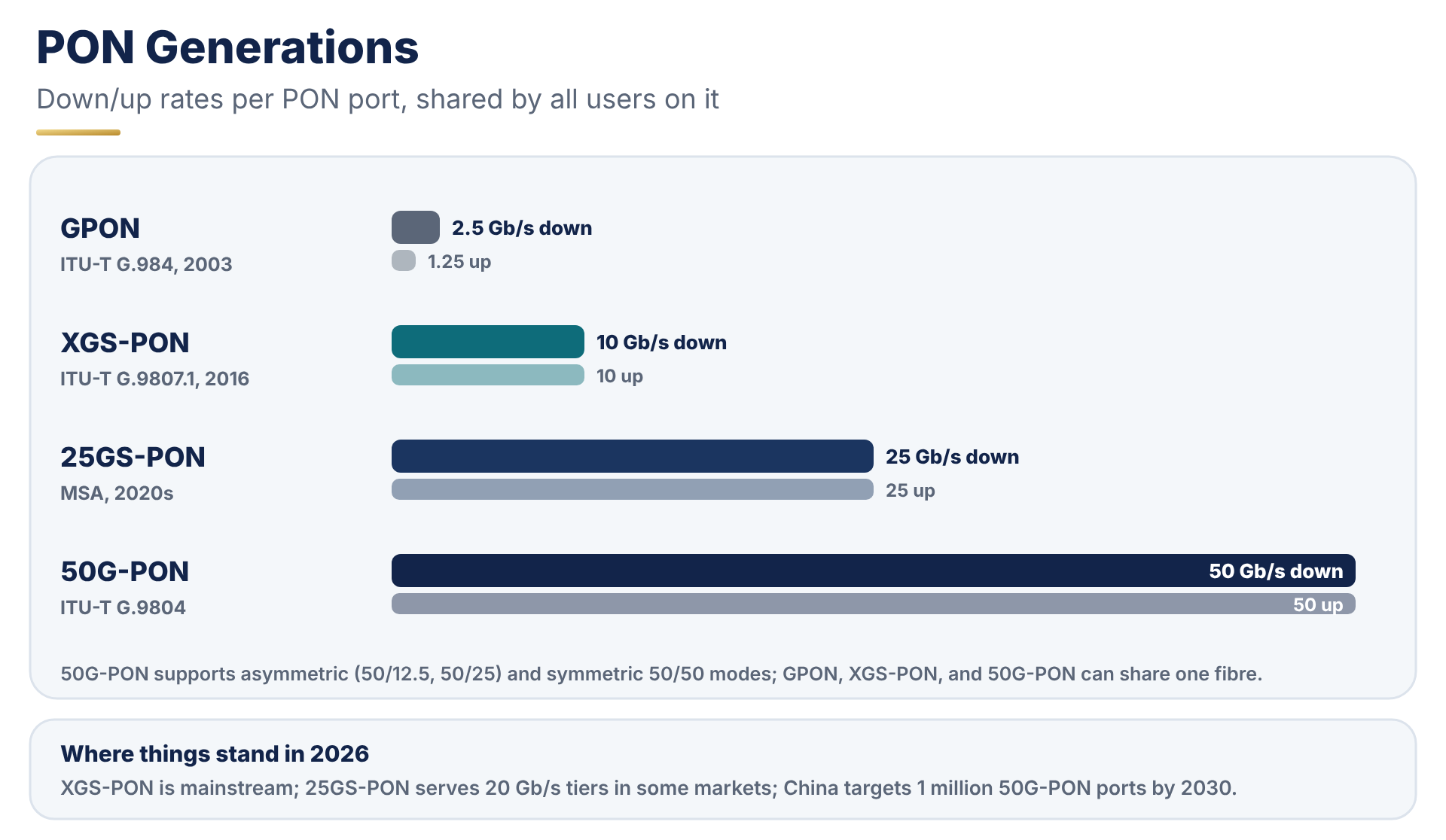
| GPON | 2.5 / 1.25 Gb/s | Still the largest installed base worldwide |
| XGS-PON | 10 / 10 Gb/s | The mainstream choice for new builds and upgrades |
| 25GS-PON | 25 / 25 Gb/s | Industry multi-source agreement; used for 20 Gb/s services in the US and trialled in Australia |
| 50G-PON | Up to 50 / 50 Gb/s | ITU-T G.9804 standard; early commercial use, led by China |
The industry has debated whether to take an intermediate step at 25G or move directly to 50G. 25GS-PON is available now and reuses much of XGS-PON’s optics. 50G-PON is the ITU standard path and the one China has chosen. Its new five-year plan sets a target of 1 million 50G-PON ports by 2030, up from about 20,000 in 2025, and operators there say the remaining obstacles are cost, power, and demand rather than technology.
Fibre to the Room
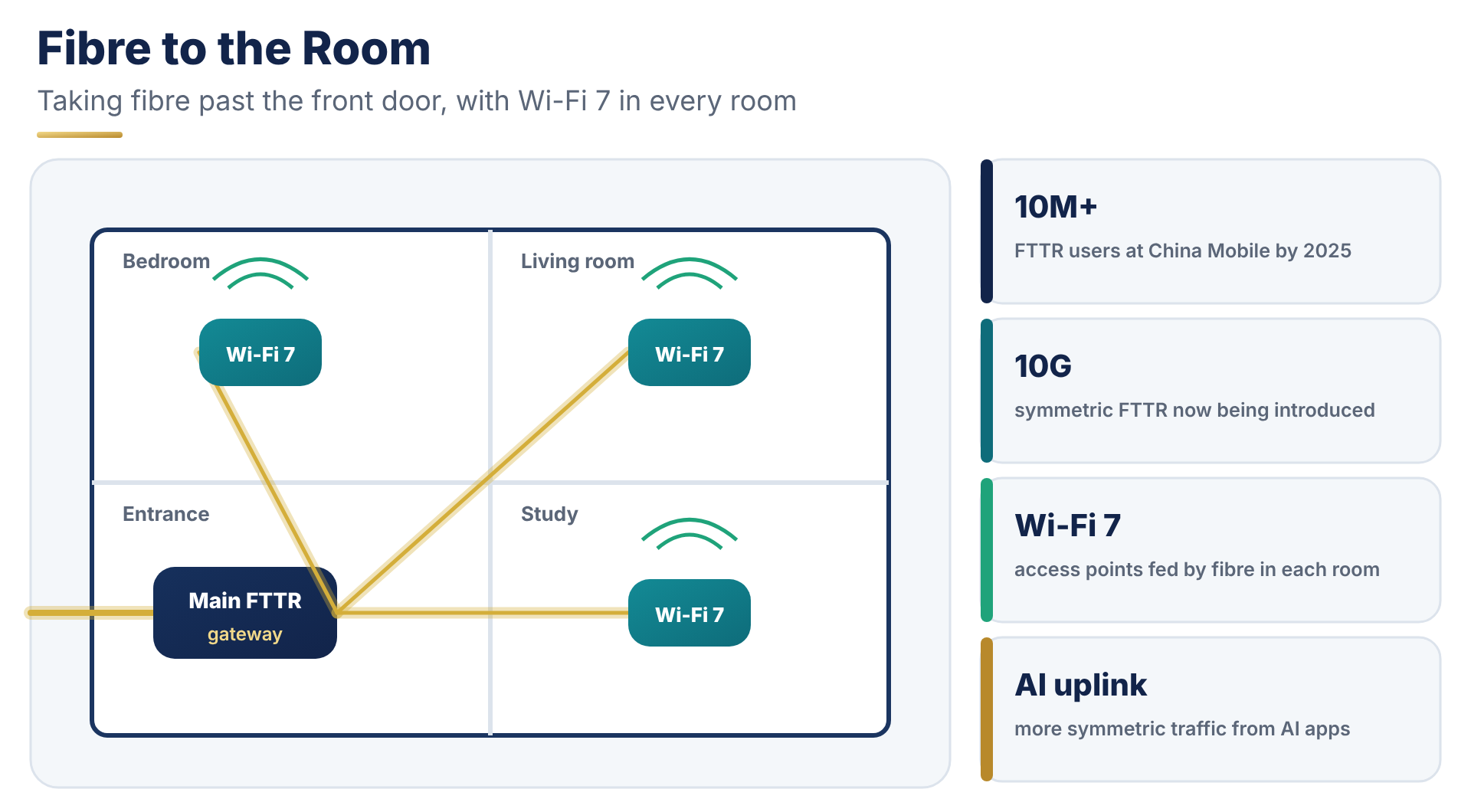
A gigabit fibre connection is often wasted on a single Wi-Fi router struggling through concrete walls. Fibre to the room solves this by running thin fibre inside the home to small access points in each room, managed as one system from the main gateway. China Mobile had more than 10 million FTTR users by 2025 and is moving from 2.5G to symmetric 10G FTTR with Wi-Fi 7. The approach is spreading beyond China to apartments, hotels, and offices, where it is sometimes called FTTR-B for business. The Wi-Fi side of the story is on the Wi-Fi page.
Asia-Pacific
- China leads in scale: China Mobile switched all new deployments to 10G PON in 2021, 136 “10-gigabit optical network” pilots were completed in 2025, and 50G-PON is now a national planning target.
- Australia is converting copper to fibre. NBN Co upgraded more than 575,000 premises in the year to June 2026, and expects more than 11 million homes and businesses to be able to access multi-gigabit speeds by 2030. In March 2026 it ran GPON, XGS-PON, 50G-PON, and coherent optics together on the same live fibre.
- Hong Kong was an early adopter of 25G PON through Hong Kong Broadband Network.
- Indonesia has large room to grow. Household fixed broadband penetration is around a quarter of homes; Telkomsel’s IndiHome serves about 10.3 million customers and holds more than half of fixed connections. The World Bank estimates that about 39 million homes are within reach of fixed broadband, but only about 17 million are connected.
What Comes Next
The ITU is already studying PON beyond 50G, and research is exploring coherent techniques for access networks, borrowed from the transport technology described on the Coherent Optics page. In practice, the next few years will be about deploying XGS-PON widely, choosing between 25G and 50G for premium tiers, and extending fibre inside buildings.
References
- ITU-T Recommendations G.984 (GPON), G.9807.1 (XGS-PON), and G.9804 series (50G-PON); 25GS-PON MSA.
- Light Reading and IEEE ComSoc Technology Blog on China’s 50G-PON target, October 2026; C114 on CIOE 2026.
- China Mobile Research Institute, “Progress on 10-Gigabit Optical Broadband Based on 50G PON and FTTR,” ITU workshop, 2025.
- NBN Co media statements, March, August, and September 2026; Computer Weekly on 25G PON in the US and Australia.
- Opensignal, Indonesia Fixed Broadband Experience, October 2026; Bisnis.com on IndiHome, 2026; World Bank, Indonesia Economic Prospects, December 2025.