
Autonomous Networks: From Automation to Agents
What the levels of network autonomy mean, how AI agents are changing operations, and where Asia-Pacific operators stand.
- TM Forum
- Level 4
- Intent
- Agentic AI
- Closed loop
A large mobile network has hundreds of thousands of cells, millions of configuration parameters, and alarms arriving every second. For years, operators automated it in pieces: scripts, rules, and tools for specific tasks. The goal now is autonomy, where the network detects problems, decides on fixes, and applies them with minimal human involvement, guided by business intent. The TM Forum’s framework defines six levels, from manual to fully autonomous, and the industry’s near-term goal is Level 4. Agentic AI, systems that can reason and act through tools, has given that goal new momentum since 2025.
The Levels
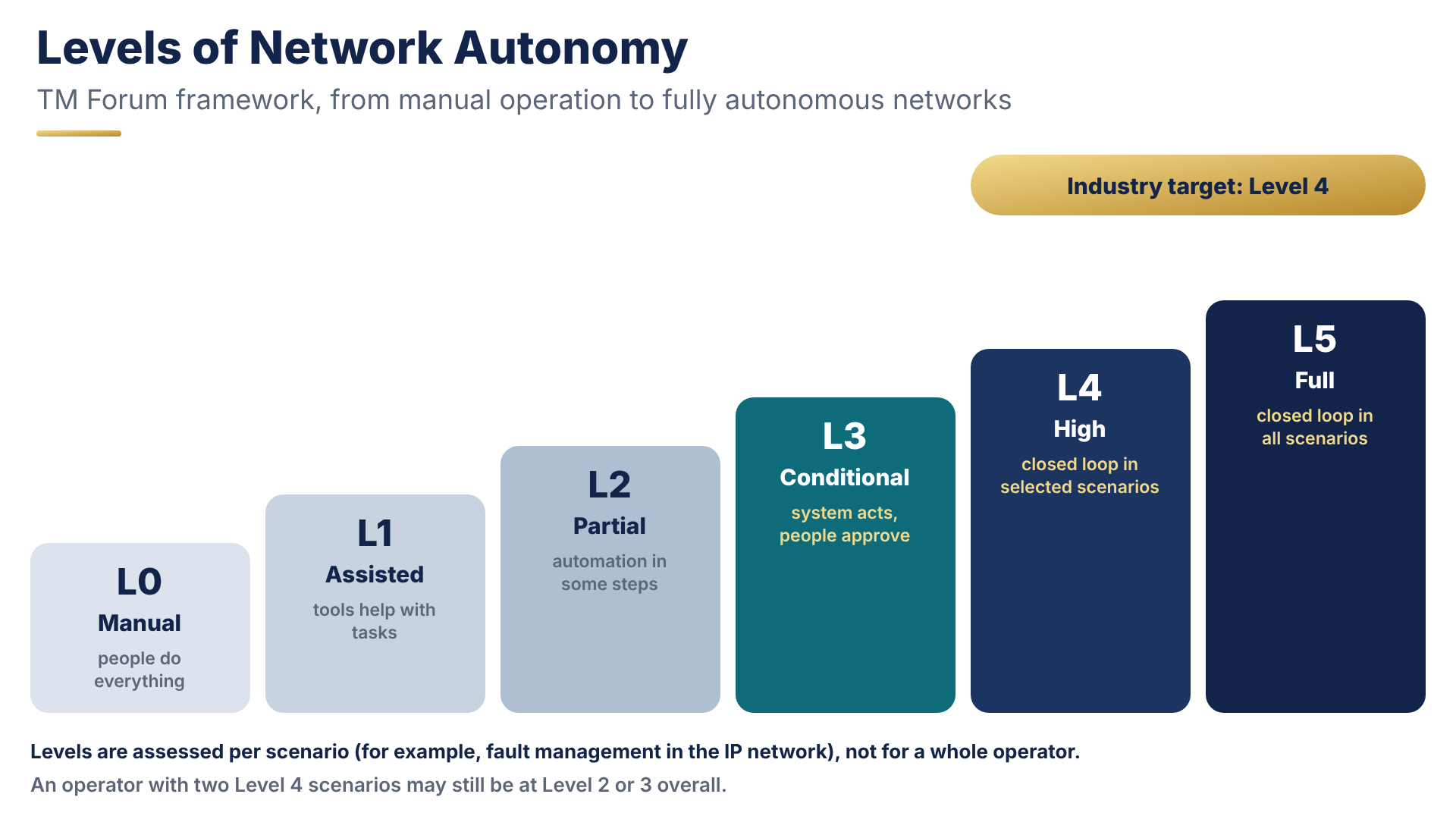
| Level | Name | In Practice |
|---|---|---|
| L0 | Manual | Engineers do everything by hand |
| L1 | Assisted | Tools support individual tasks |
| L2 | Partial | Some steps are automated with fixed rules |
| L3 | Conditional | The system analyses and proposes; people approve |
| L4 | High | Closed loop in selected scenarios, with people setting intent |
| L5 | Full | Closed loop in all scenarios |
How the Loop Works
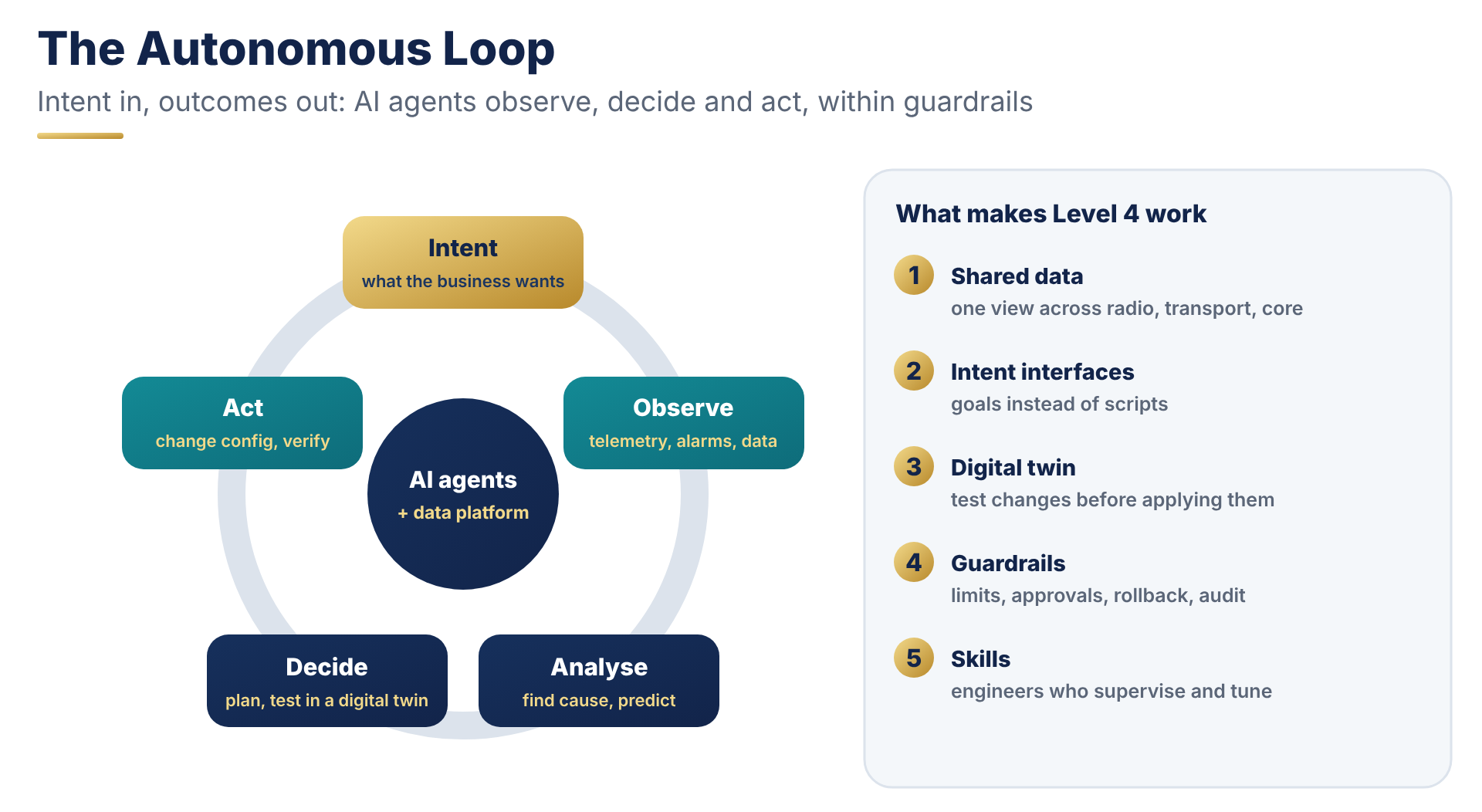
- Intent. People state goals, such as availability or energy targets, instead of writing step-by-step scripts.
- Observe. Telemetry, alarms, and performance data from radio, transport, and core flow into a shared data platform.
- Analyse and decide. AI models find root causes and predict problems; agents plan actions and test them, sometimes in a digital twin of the network.
- Act and verify. The system applies changes, checks the outcome, and rolls back if needed.
- Guardrails. Limits, approvals for risky actions, audit trails, and clear accountability keep humans in control of what the system may do.
Where Things Stand
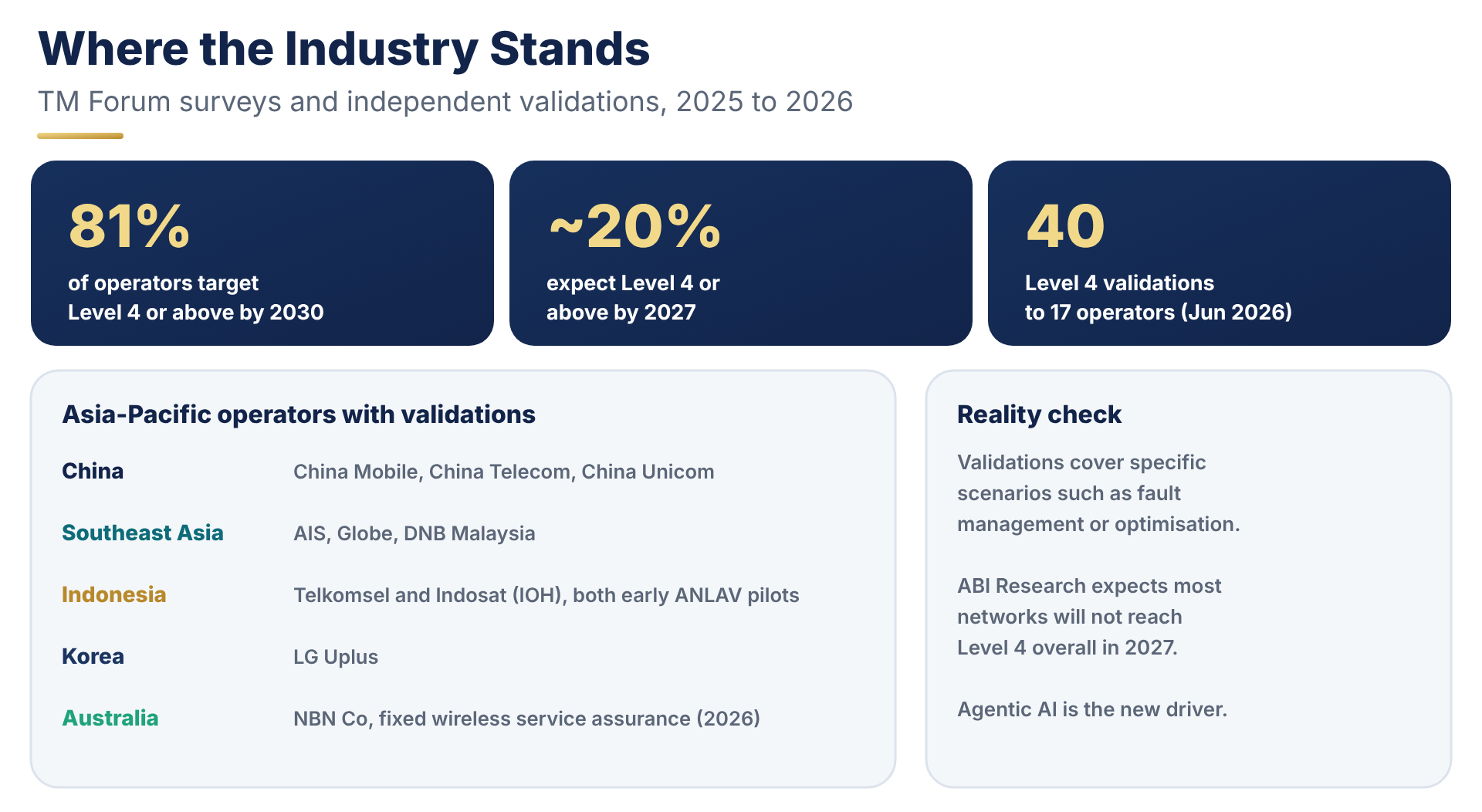
TM Forum reports that 81% of operators aim for Level 4 or above by 2030, and about a fifth expect to get there by 2027. Since 2025, its Autonomous Network Level Assessment Validation (ANLAV) service has independently checked operators’ claims; by June 2026 it had awarded 40 Level 4 validations to 17 operators. Independent analysts are more cautious: ABI Research expects most networks will not reach Level 4 overall in 2027, because scaling beyond individual use cases needs shared data, cross-domain orchestration, and strong controls.
Asia-Pacific
- China. China Mobile has reported approaching Level 4 in several domains, including IP backhaul and radio fault management, with an 80% reduction in major network faults. China Mobile, China Telecom, and China Unicom provinces hold multiple validations.
- Indonesia. Telkomsel and Indosat Ooredoo Hutchison were among the six operators that piloted the ANLAV validation service in 2025. Indosat also co-led a TM Forum Catalyst with Huawei, China Mobile, and others to make Level 4 operational with agentic AI.
- Southeast Asia. AIS in Thailand, Globe in the Philippines, and DNB in Malaysia received validations in November 2025.
- Korea and Australia. LG Uplus holds validations, and NBN Co earned Australia’s first Level 4 validation in June 2026, for service assurance in its fixed wireless network, working with Ericsson.
Asia-Pacific is ahead of other regions in coordinated programmes, helped by large operators with strong vendor partnerships. The same AI that runs the network is also moving into the radio itself, covered on the AI-RAN page.
What Comes Next
The next phase is cross-domain autonomy: agents that coordinate radio, transport, core, and IT systems, and that connect operations to business outcomes such as customer experience and energy use. The hard problems are less about algorithms than about data quality, trust, accountability, and skills. Engineers will spend less time executing changes and more time setting intent, supervising agents, and handling exceptions.
References
- TM Forum, Autonomous Networks project, ANLAV announcements at DTW Ignite 2025 and Innovate Asia 2025, and Autonomous Networks industry report 2026.
- Fierce Network, “Telcos pick up the pace to Level 4 autonomous networks,” 2026; TelecomLead, “Autonomous Telecom Networks 2026.”
- TechForge, “Level 4 autonomous networks explained,” August 2026.
- ABI Research, “Reaching Level 4 Autonomy Requires More Than Better AI in Mobile Networks,” October 2026.
- TelecomTV on ANLAV certificates, November 2025; TM Forum Inform, “Level 4 autonomy starts with showing the value.”