
Cloud Core: The 5G Core as Software
How the mobile core became a set of cloud-native services, where it runs, and why standalone 5G is the gateway to everything else on this menu.
- 5G SA
- SBA
- CNF
- Kubernetes
- Public cloud
The core network is the part of a mobile system that users never see: it authenticates devices, sets up sessions, applies policy, tracks mobility, and connects traffic to the internet. In 2G, 3G, and 4G, these functions ran on dedicated boxes from a handful of vendors. The 5G core was designed differently from the start, as a set of software services that talk to each other through web-style APIs and run on cloud infrastructure. That design is what makes slicing, network APIs, and much of network automation possible. Yet most of the world’s 5G still runs on the older 4G core, and the move to a standalone 5G core remains one of the industry’s slowest transitions.
Service-Based Design
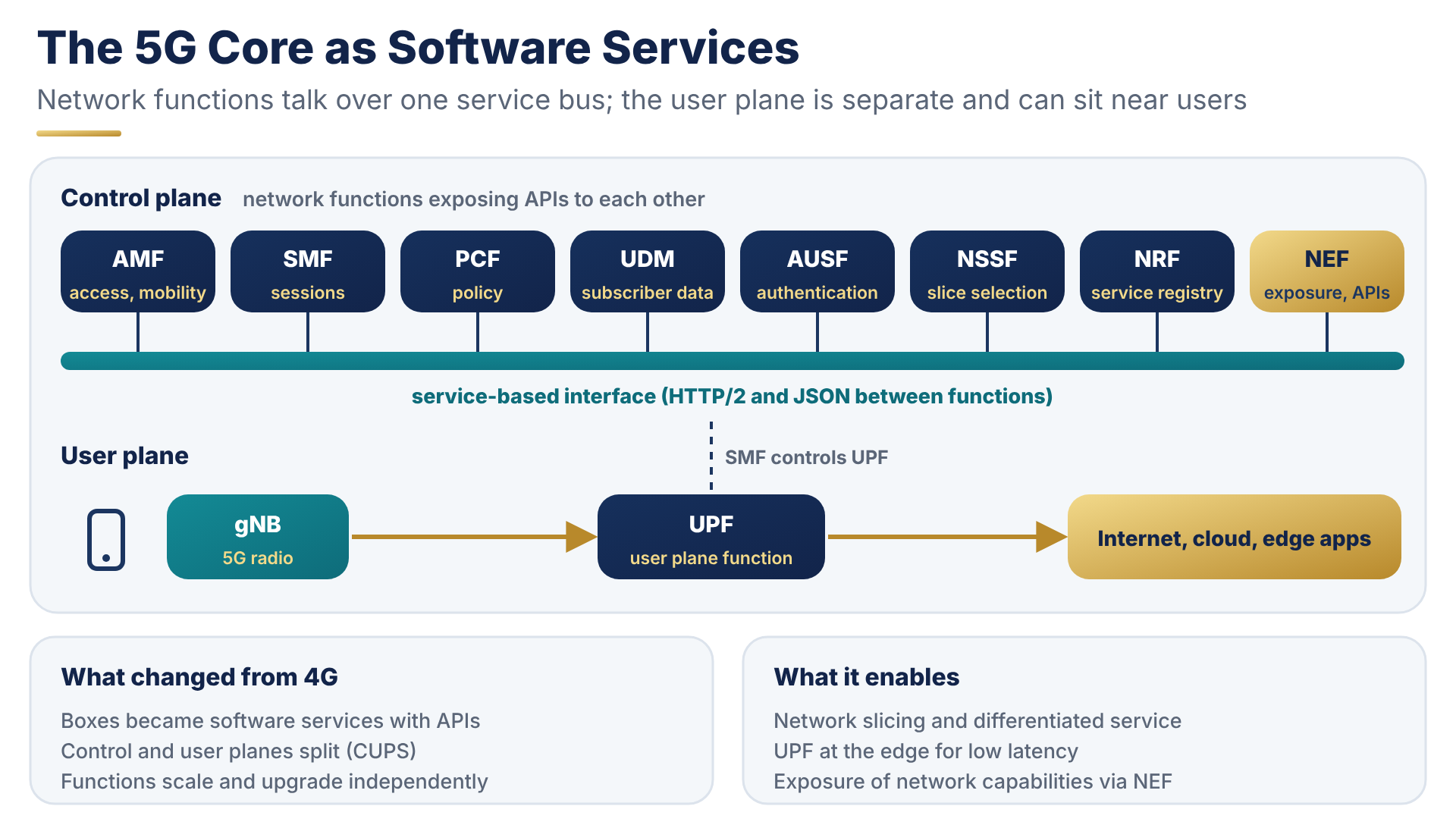
- Network functions as services. The access and mobility function (AMF), session management (SMF), policy (PCF), subscriber data (UDM), and others each offer services over a common interface, using HTTP/2 and JSON rather than telecom-specific protocols.
- Control and user plane separation. The user plane function (UPF) carries traffic and can be placed close to users, in a city or a factory, while control functions stay central.
- Registry and exposure. The NRF lets functions discover each other; the NEF exposes selected capabilities to applications, which is the starting point for the Network APIs page.
- Slice awareness. The NSSF selects the right slice for each device, so one core can serve many logical networks, as explained on the Slicing page.
Where the Core Runs
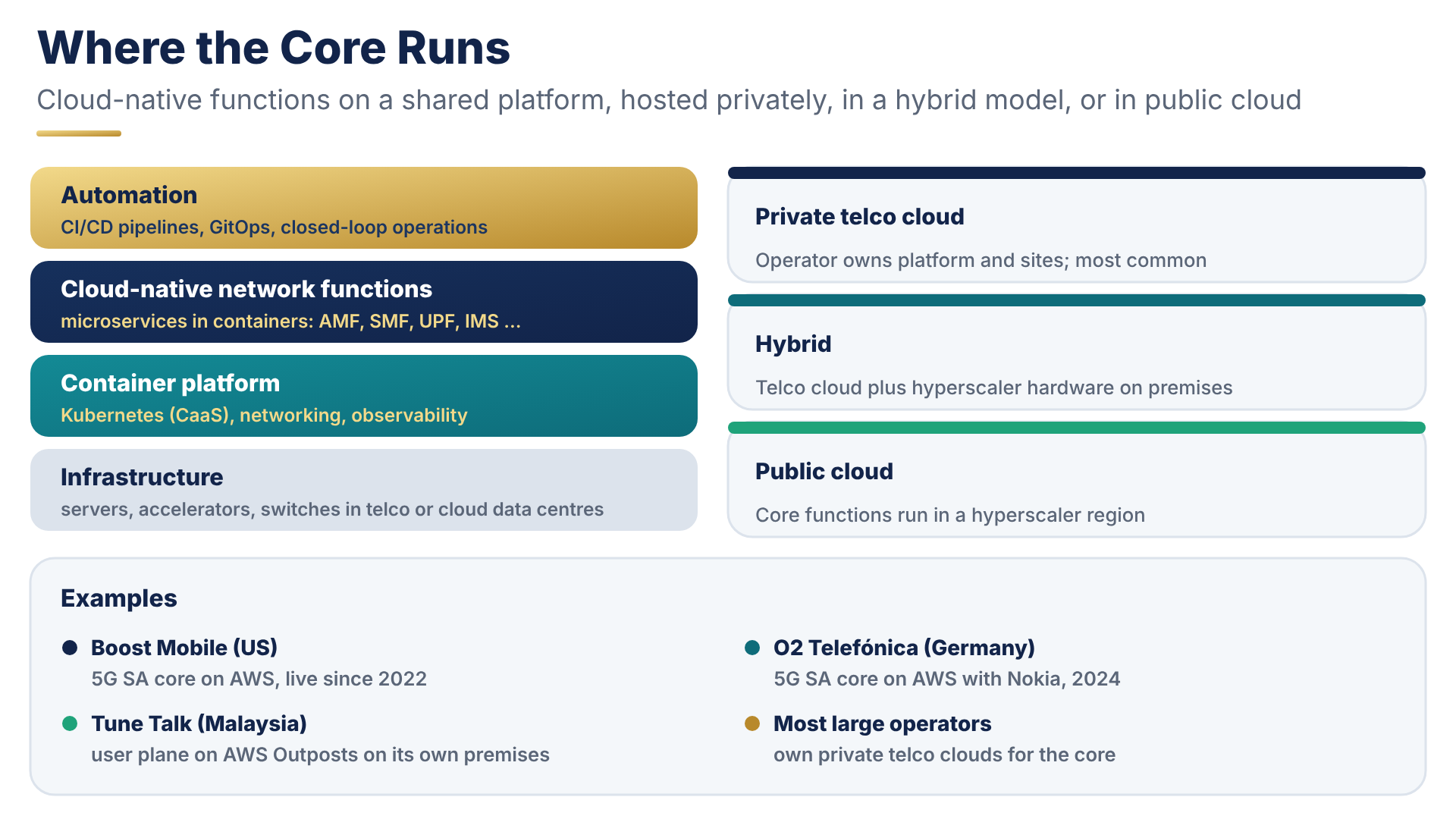
A cloud-native core packages each function as microservices in containers, usually orchestrated by Kubernetes. In theory, this lets operators scale functions independently, upgrade without downtime, and use the same automation tools as web companies. In practice, telecom workloads need careful networking, strict timing, and very high availability, so the platform matters as much as the software.
| Model | How It Works | Examples |
|---|---|---|
| Private telco cloud | The operator runs its own container platform in its own data centres | Most large operators worldwide |
| Hybrid | Telco platform plus hyperscaler hardware installed on the operator’s premises | Tune Talk (Malaysia) runs its user plane on AWS Outposts on site |
| Public cloud | Core functions run in a hyperscaler’s regions and local zones | Boost Mobile in the US since 2022; O2 Telefónica in Germany since 2024 |
The Standalone Gap
Early 5G launches used non-standalone (NSA) mode: 5G radio for extra capacity, with the 4G core and 4G signalling underneath. NSA was fast to deploy, but it cannot deliver the main features of 5G. Standalone (SA) mode connects 5G radio to a 5G core, enabling slicing, lower latency, better uplink, RedCap devices for IoT, and the APIs that sit on top.
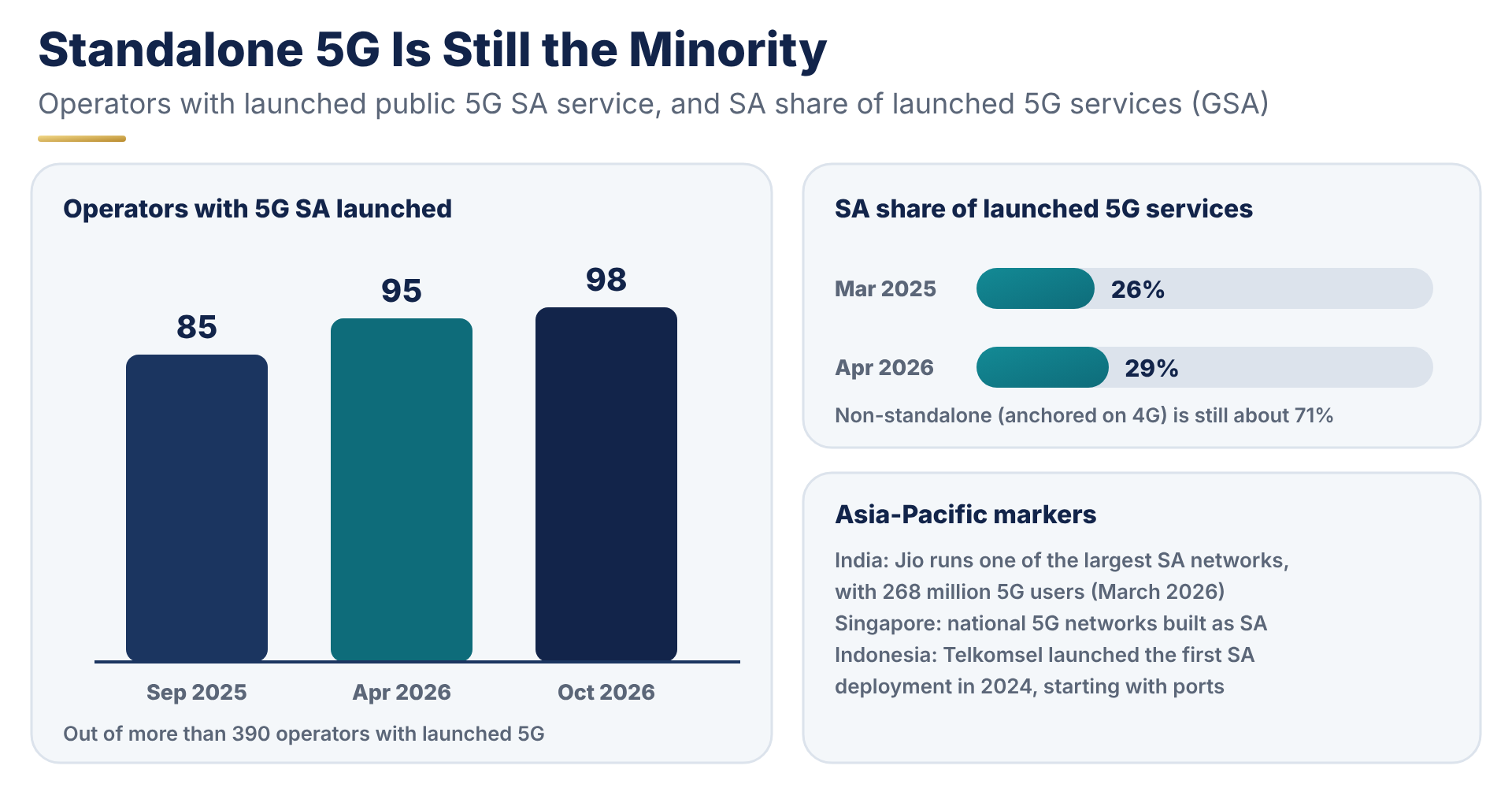
The Global mobile Suppliers Association counted 98 operators with launched 5G SA service by October 2026, out of more than 390 operators with launched 5G. In April 2026, SA accounted for about 29% of launched 5G services. The reasons for the slow pace are mostly commercial: SA needs a new core, more integration, and newer devices, while operators struggle to show that SA features earn extra revenue.
Asia-Pacific
- India. Reliance Jio built its 5G on a standalone architecture and had 268 million 5G subscribers by March 2026, making it one of the largest SA networks in the world. It plans to move its entire customer base to 5G by 2030.
- China. All three operators run SA at national scale, and China Telecom and China Unicom share one of the world’s largest SA networks.
- Singapore. The national 5G networks were licensed as standalone from the start, which helped Singapore become an early leader in services built on SA features.
- Indonesia. Telkomsel launched the country’s first SA deployment with Huawei in 2024, aimed first at port operations, and has run SA private networks for manufacturers. With Ericsson, it is trialling far-edge core functions on a cloud-native platform.
What Comes Next
The core is becoming more distributed and more automated. User plane functions move toward the edge for low-latency and AI applications, and operators are adding AI agents to run and heal the core, a topic covered on the Autonomous Networks page. Work on the 6G core has started in 3GPP, with an emphasis on simpler architecture, native AI, and better exposure to developers. The 6G page describes the wider roadmap.
References
- 3GPP TS 23.501, System architecture for the 5G System; TS 23.502, Procedures for the 5G System.
- GSA, 5G Standalone key data, April 2026; Light Reading, “5G SA still a subset of 5G,” October 2026.
- Heavy Reading (Omdia), 5G Core Operator Survey, 2025 edition.
- IEEE ComSoc Technology Blog on 5G core and public cloud, 2024–2025; Nokia, 5G Core on hybrid cloud case studies.
- Reliance Industries and Jio Platforms, FY26 results and Jio Factsheet 2026.
- Telkomsel press releases on 5G SA, 2024–2026; Bisnis.com on Telkomsel’s 5G rollout, 2026.