
New Fibre: Hollow Core, Multicore and Beyond
Why the glass itself is changing after forty years, what hollow-core and multicore fibres offer, and where they are being deployed.
- Hollow core
- DNANF
- Multicore
- SDM
- Records
For four decades, the optical fibre itself barely changed. Standard single-mode fibre, a solid silica core inside a 125-micrometre cladding, carried every generation of transmission technology, while capacity grew through better lasers, amplifiers, and signal processing. That approach is reaching its limits. A single core can only carry so much before nonlinear effects distort the signal, and light in glass travels about a third slower than in air. Two new designs answer these limits from different directions: hollow-core fibre, which guides light through air, and multicore fibre, which packs several cores into one strand.
Three Kinds of Fibre
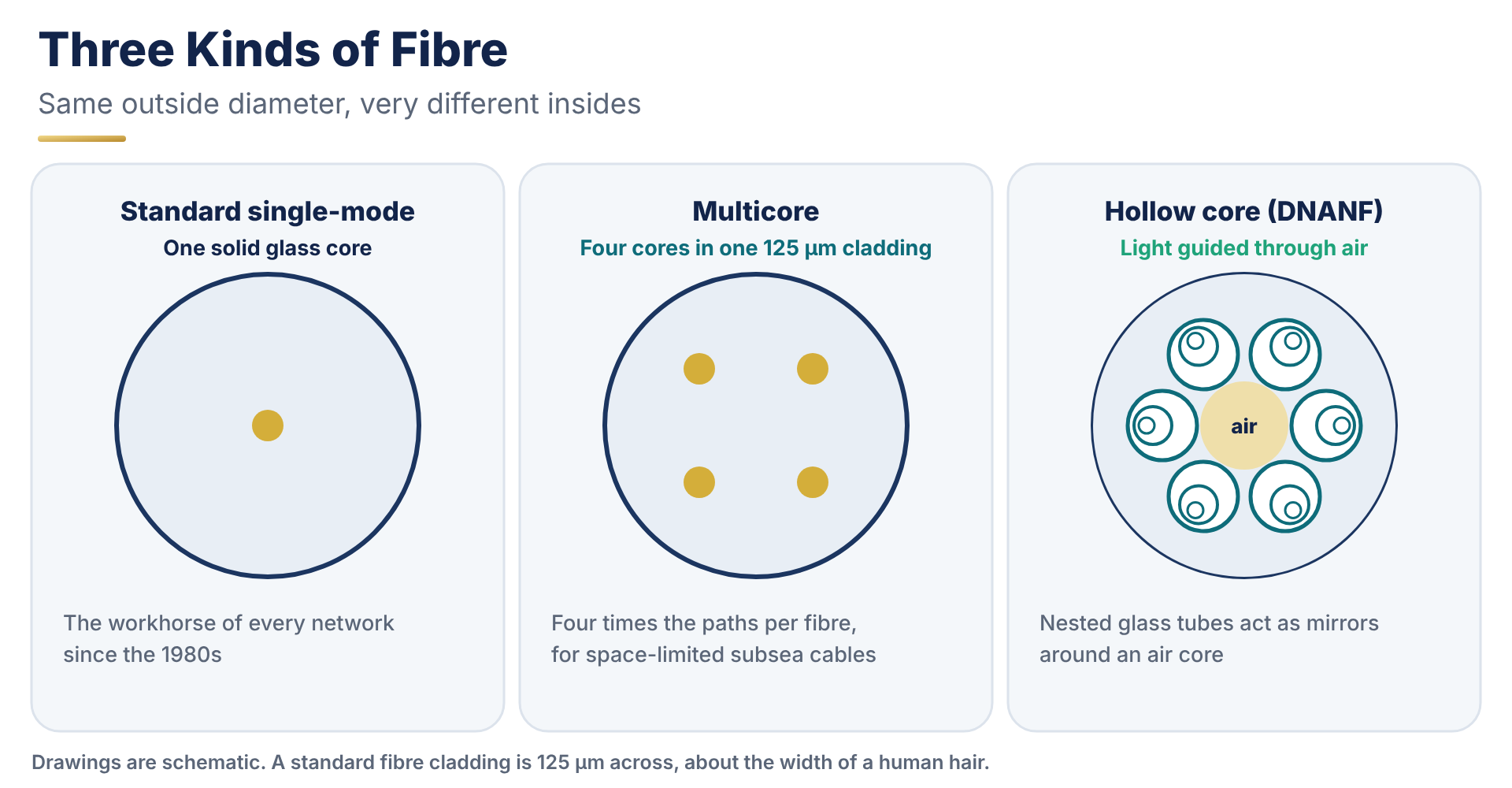
| Fibre | Main Advantage | Main Challenge |
|---|---|---|
| Standard single-mode | Cheap, universal, and mature | Capacity and latency limits |
| Multicore | Several independent paths in the same diameter | New connectors, splices, and amplifiers |
| Hollow core | Lower latency, lower loss, wider bandwidth | Manufacturing scale, connectors, and standards |
Hollow Core
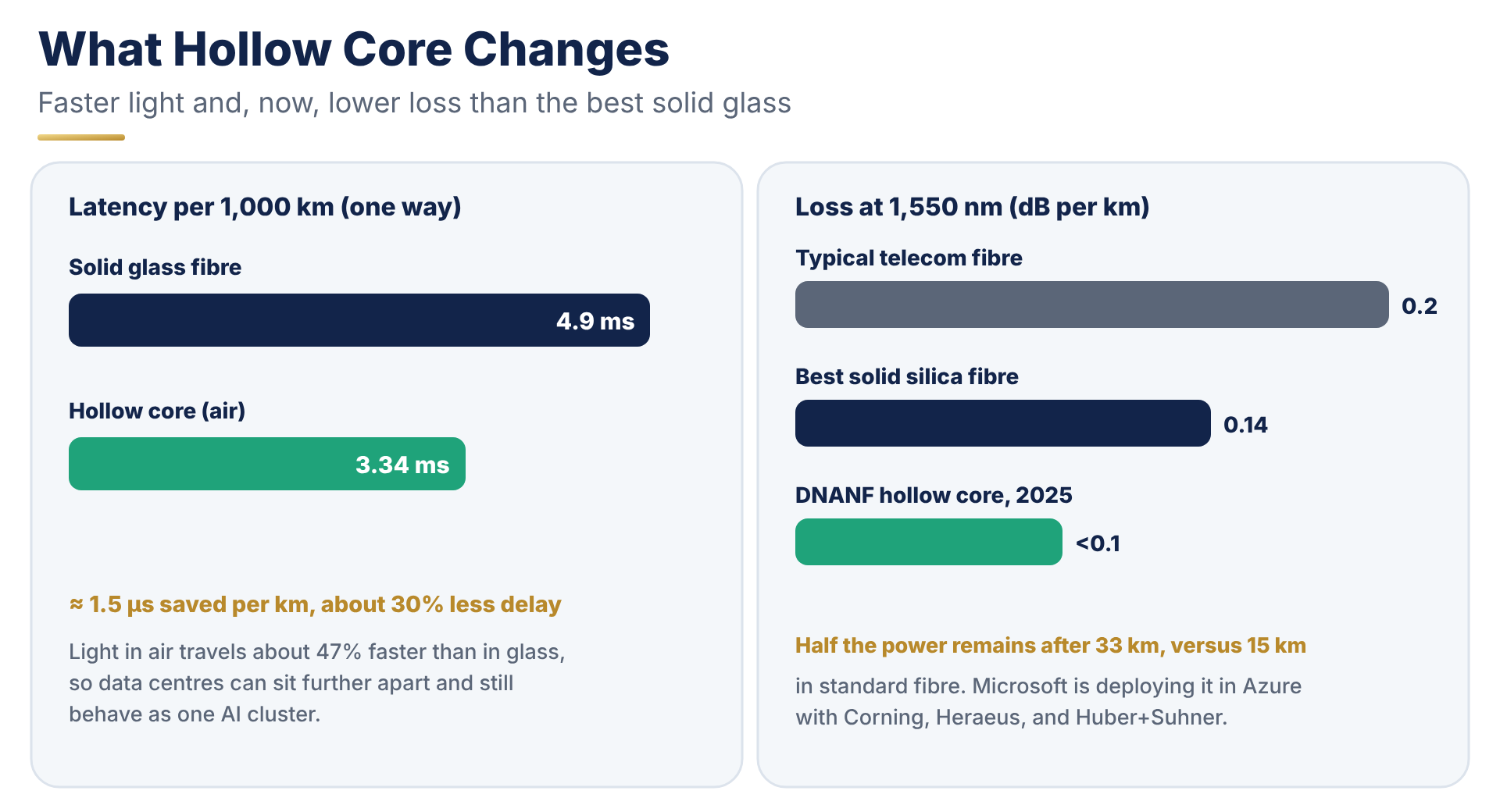
Hollow-core fibre surrounds an air core with microscopic glass membranes that reflect light back toward the centre. Early designs lost too much light to be useful beyond short links, with losses above 1 dB/km. The double nested antiresonant nodeless fibre (DNANF), developed by the University of Southampton and Microsoft, changed that. Results published in Nature Photonics in 2025 showed loss below 0.1 dB/km, lower than the 0.14 dB/km of the best solid silica fibre. Half the light remains after 33 km, compared with 15 km in standard telecom fibre.
- Latency. Light in air travels about 47% faster than in glass, which saves about 1.5 microseconds per kilometre. For AI clusters split across data centres and for financial trading, that matters.
- Bandwidth and power. Hollow core can carry a wider range of wavelengths and much higher launch power without distortion, which may reduce the need for amplifiers.
- Deployment. Microsoft has made hollow core a large-scale commercial reality in its Azure network and in 2025–2026 brought in Corning, Heraeus, and Huber+Suhner to manufacture fibre, preforms, and connectors at scale.
Multicore
Multicore fibre puts several cores into one standard-diameter cladding. Each core is an independent path, so a cable can carry several times the capacity without becoming thicker. That matters most where space is the constraint, above all in subsea cables, where the diameter is limited by the need to survive depths of up to 8,000 metres and the power available to repeaters.
Japan leads in this field. In March 2026, NTT announced a 192-core submarine cable system built from 48 four-core fibres, offering four times the capacity of a conventional design without changing the cable system. Earlier, NEC demonstrated that multicore fibre could raise the capacity of a 3,000 km Asia-Pacific-class submarine system to about 1.7 Pb/s, seven times existing designs. Multicore fibre also features in NTT’s IOWN all-photonics vision. The subsea side is covered on the Subsea page.
Records
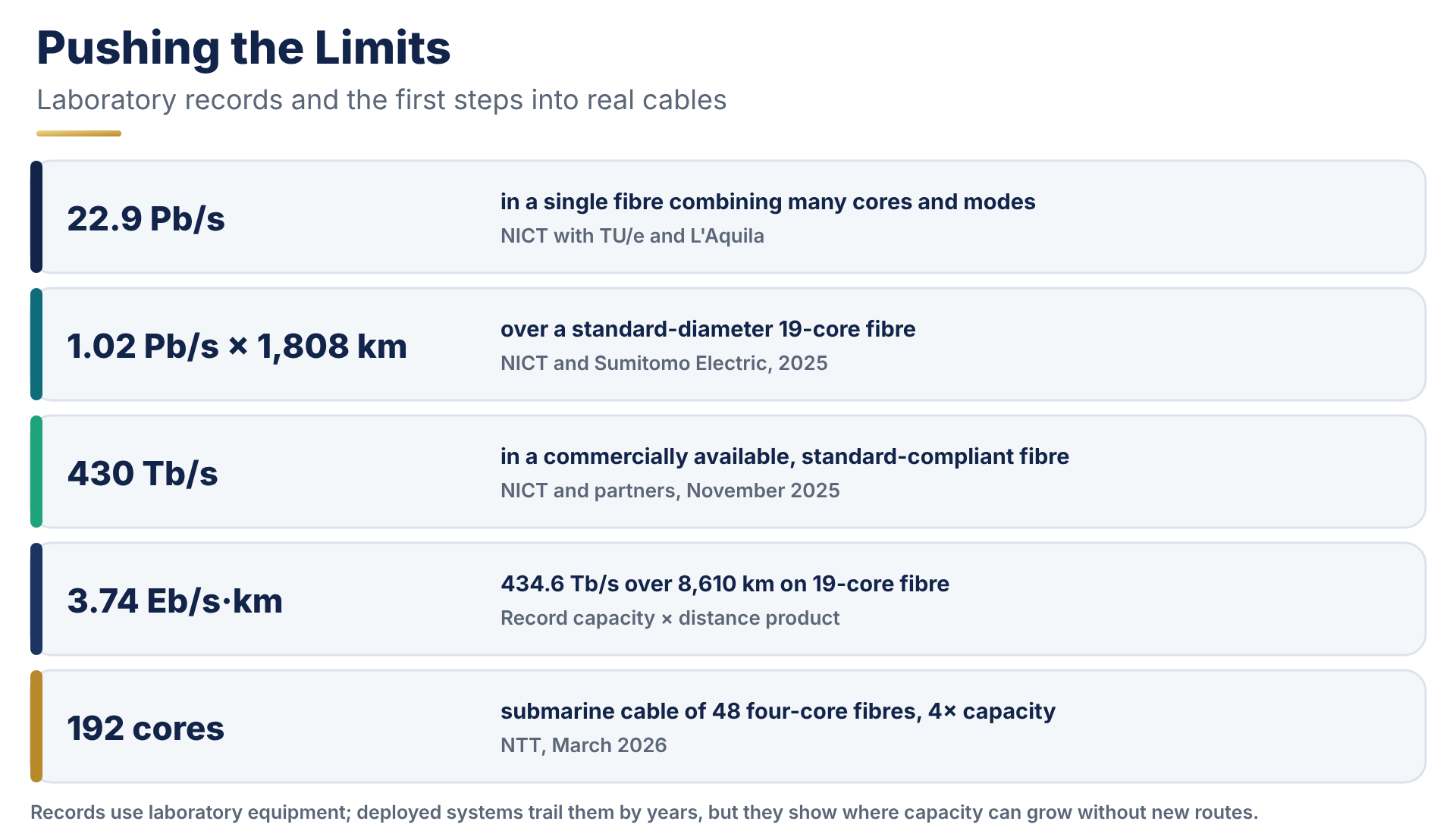
These records combine several techniques under the umbrella of space-division multiplexing: multiple cores, multiple modes in each core, and very wide wavelength bands. Japan’s NICT appears in most of them, working with Sumitomo Electric and partners in Europe. The November 2025 record of 430 Tb/s is notable because it used commercially available fibre compliant with international standards, showing that some of this capacity can be unlocked without replacing installed glass.
What Comes Next
Hollow core is likely to spread first in data centre interconnect and AI networks, where latency is valuable and distances are short enough to manage new splicing and connector requirements. Multicore will appear first in new subsea systems and in dense terrestrial cables. Standard single-mode fibre will remain the bulk of the world’s installed base for decades, made more productive by the coherent technology on the Coherent Optics page.
References
- University of Southampton and Microsoft, DNANF results in Nature Photonics, September 2025; IEEE Spectrum and Tom’s Hardware coverage.
- Microsoft Azure Networking Blog, “Microsoft Azure scales Hollow Core Fiber production,” September 2025; Huber+Suhner, April 2026.
- K. Borzycki, “Recent Progress in Development of Hollow-Core Fibers for Telecommunications,” preprint, February 2026.
- NTT, 192-core submarine cable system using multicore fibre, March 2026; NEC, multicore submarine cable demonstration, March 2022.
- NICT press releases on 22.9 Pb/s, 1.02 Pb/s over 1,808 km (May 2025), and 430 Tb/s (November 2025).