
Laser Links: Optical Communication in Space
Why satellites are switching from radio to light, how laser terminals find each other, where the technology is used, and what Asia-Pacific is building.
- Inter-Satellite
- Space-to-Ground
- Pointing
- Optical Mesh
- Deep Space
For sixty years, satellites have talked by radio. Over the past decade, they have started talking by light. Laser terminals now link thousands of satellites into a mesh that carries traffic around the planet, relay Earth-observation data from low orbit through geostationary satellites, and, in April 2026, brought high-definition video back from a crewed mission around the Moon. Optical links are becoming the backbone of the space network that the LEO and Direct-to-Device pages describe.
Why Lasers
The advantage of light comes from its wavelength. Infrared light at 1,550 nanometres, the same wavelength used in undersea fibre, has a wavelength about 20,000 times shorter than a 30 GHz radio wave. Because a beam spreads in proportion to wavelength divided by aperture, a small telescope can form a beam thousands of times narrower than a radio dish of similar size.
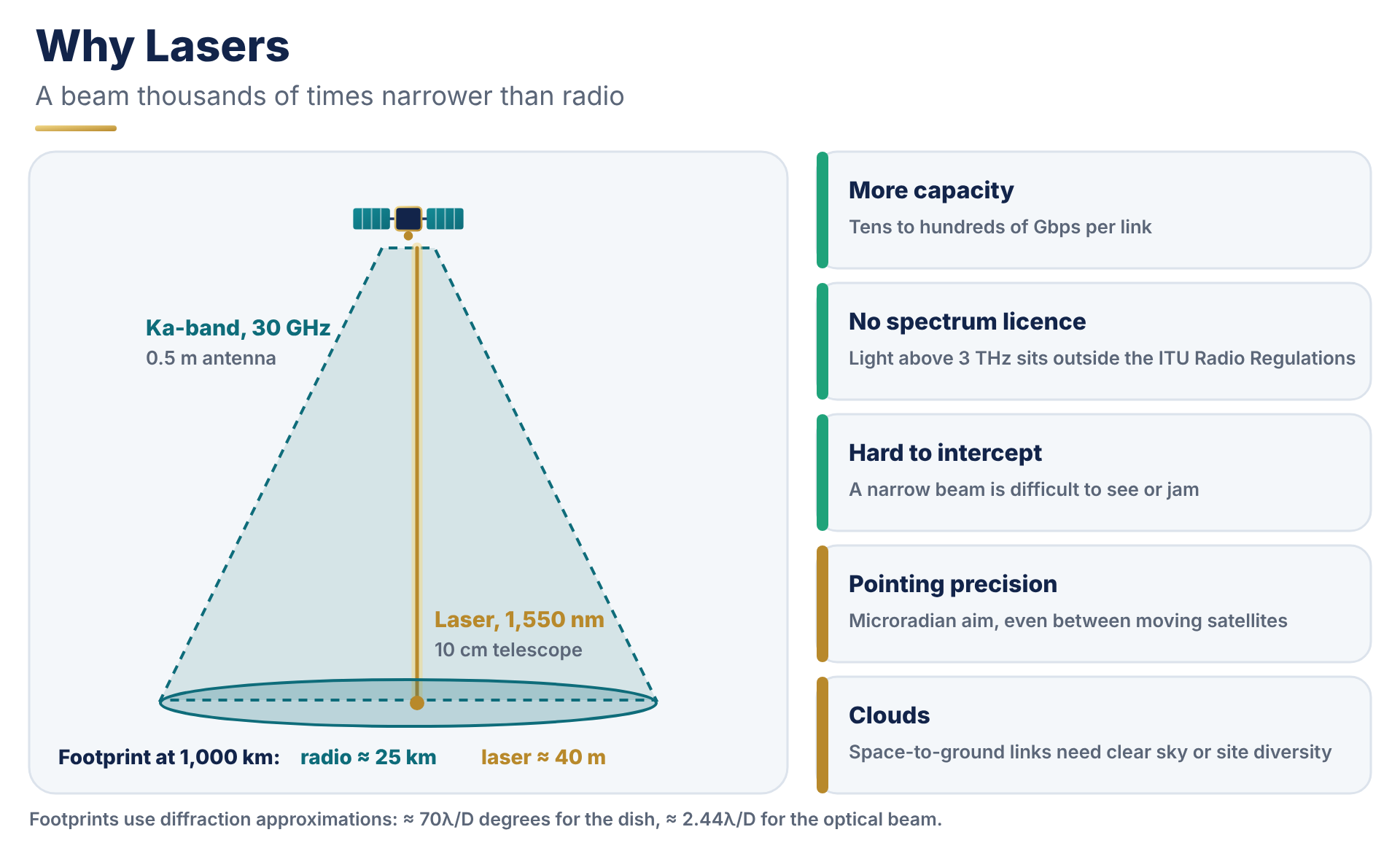
- Capacity. Concentrated power and very wide optical bandwidth support links of tens to hundreds of gigabits per second.
- No spectrum licence. The ITU Radio Regulations cover frequencies up to 3,000 GHz. Optical links lie far above that, so they need no frequency assignment and cause no radio interference.
- Security. A beam a few metres wide at long range is very difficult to intercept or jam.
- Size, weight, and power. Optical terminals can be smaller and use less power per bit than radio links of similar capacity.
The price is precision. Two satellites moving at several kilometres per second must aim at each other to within microradians, and links that pass through the atmosphere are blocked by cloud.
Three Kinds of Links
| Link | What It Does | Examples |
|---|---|---|
| Between satellites in the same constellation | Routes traffic across a mesh without touching the ground | Starlink; US Space Development Agency; Telesat Lightspeed; Amazon Leo |
| Low orbit to relay satellite | Sends data from a low satellite to a geostationary relay that stays in view of a ground station | European Data Relay System; Japan’s JDRS with LUCAS terminals |
| Space to ground | Brings large volumes of data down to optical ground stations | NASA TBIRD; China’s AIRSAT-02; commercial terminals such as Astrolight |
| Deep space | Carries data from the Moon and beyond | NASA’s DSOC; Artemis II O2O |
Light also carries quantum signals. Satellite-based quantum key distribution, pioneered by China’s Micius satellite in 2016, uses the same pointing and tracking technology, as described on the Quantum Networking page.
Finding Each Other
The hardest part of a laser link is not sending data but making contact. This process is called pointing, acquisition, and tracking, or PAT.
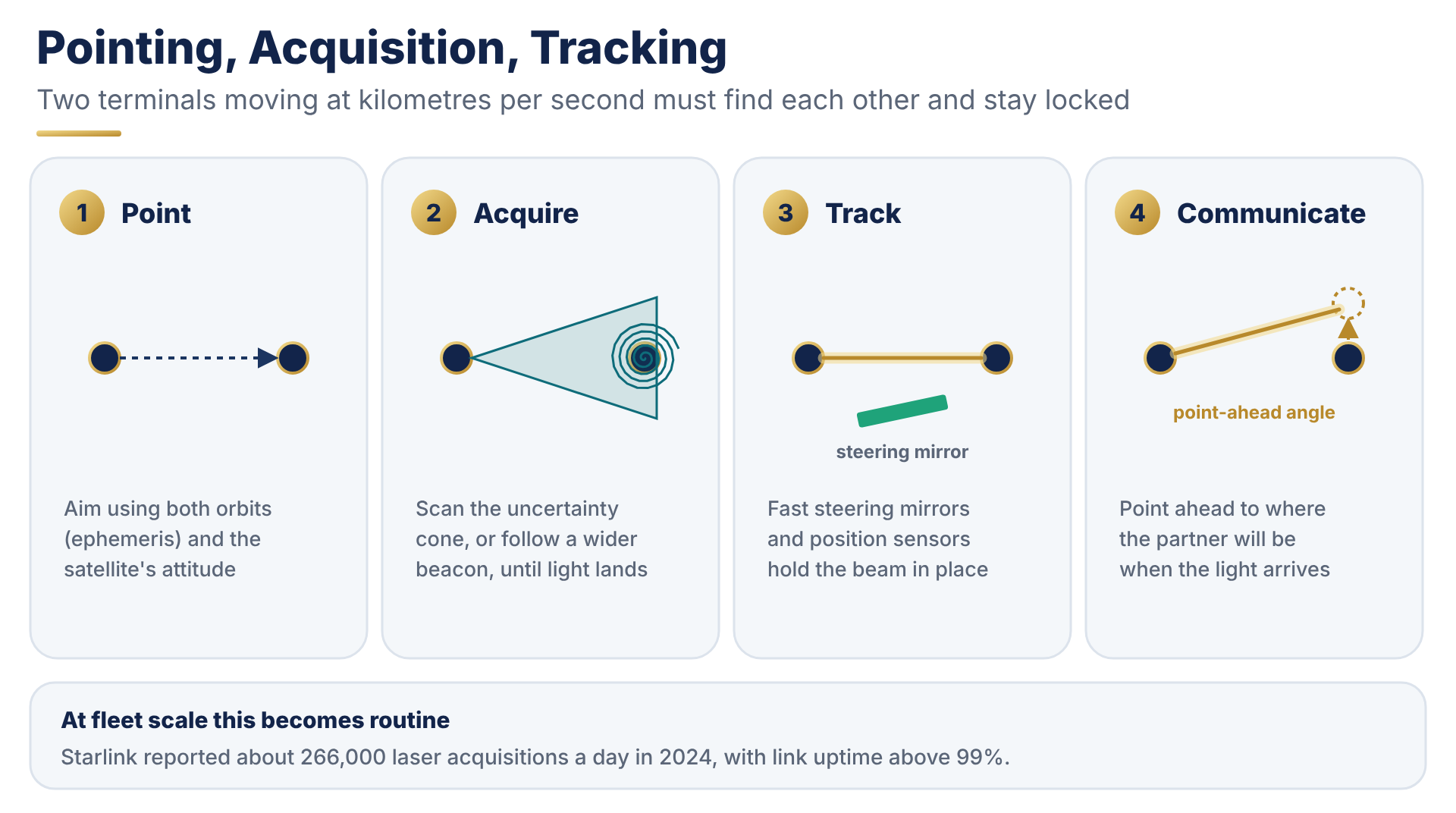
Each terminal first points using the known orbits of both satellites and its own attitude. Because that estimate is never perfect, it then searches an uncertainty cone, either by scanning or by following a wider beacon, until the partner’s light lands on its detector. Fast steering mirrors and position sensors then hold the beam steady against vibration and motion. Finally, because light takes time to travel, each terminal aims slightly ahead of where its partner appears to be, at the point it will occupy when the light arrives.
At fleet scale this has become routine. In 2024, SpaceX reported about 266,000 laser acquisitions a day across Starlink, with link uptime above 99%, and some links lasting for weeks.
Mesh Networks
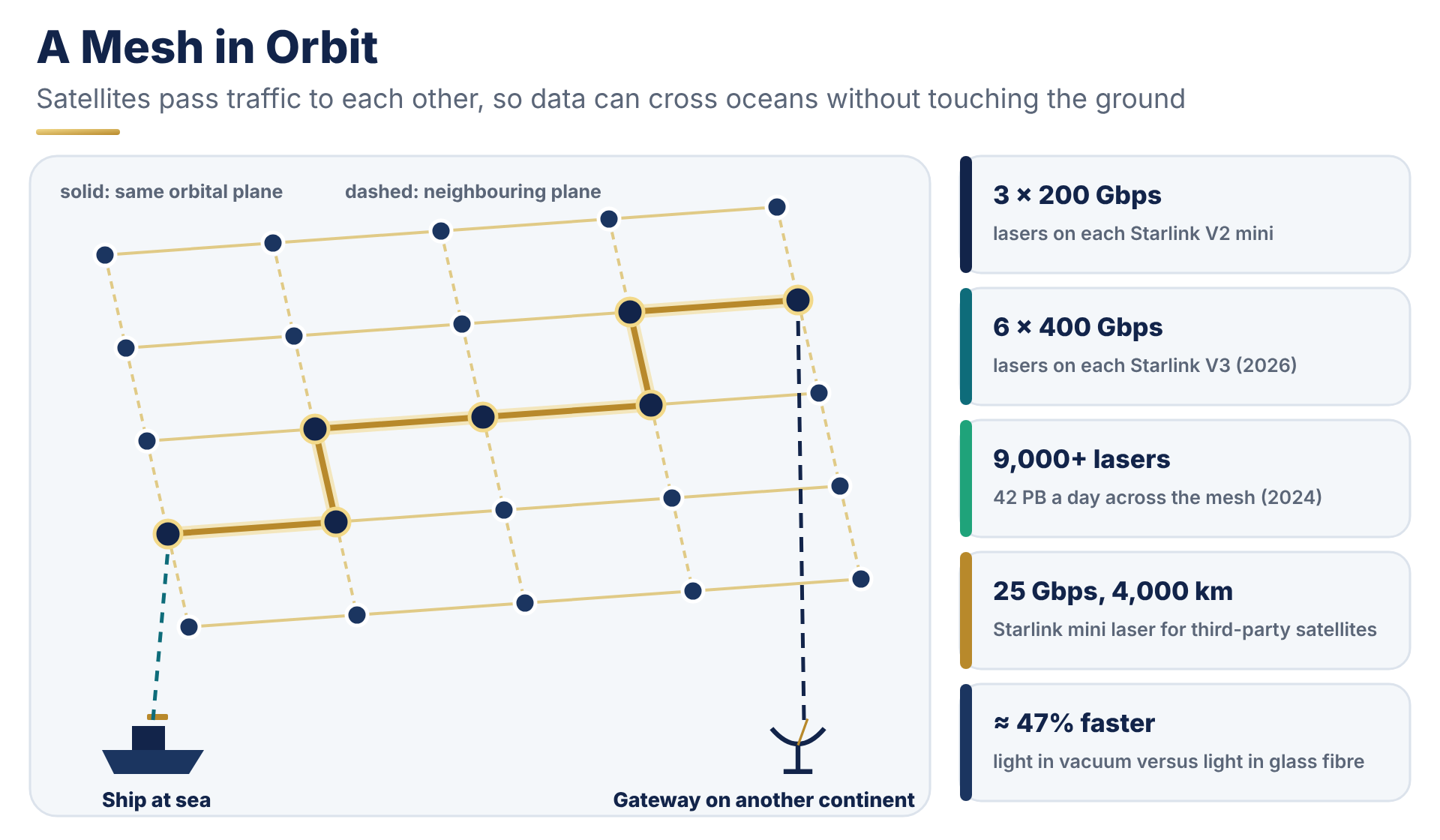
Each Starlink satellite of the current generation carries three laser terminals operating at up to 200 Gbps, linking it to neighbours in its own orbital plane and in adjacent planes. The third-generation satellites carry six terminals of 400 Gbps each. In 2024, the mesh already moved about 42 petabytes of customer data a day across more than 9,000 lasers.
A mesh in orbit has an advantage that is easy to overlook: light travels about 47% faster in vacuum than in glass fibre. Over very long distances, a route through space can therefore beat a terrestrial cable on latency, even though it climbs hundreds of kilometres up and back down.
| Development | Why It Matters |
|---|---|
| Starlink mini laser | A 25 Gbps terminal, tested over 4,000 km in 2025, lets third-party satellites join Starlink’s mesh; the first customers plan to fly from 2027 |
| SDA optical standard | The US Space Development Agency’s terminal standard is becoming a reference for interoperable commercial terminals |
| SDA Tranche 1 Transport Layer | 126 satellites linked by optical terminals, launched in batches from September 2025, with regional coverage planned first for the Indo-Pacific |
| ITU-R studies | Work has begun on how optical inter-satellite links can interoperate across national networks |
Down to Earth
Links that pass through the atmosphere face clouds, turbulence, and haze. Operators respond with networks of optical ground stations in dry locations, so that at least one station is clear when a satellite passes, and with adaptive optics that correct the distortion caused by turbulence, the same technique astronomers use.
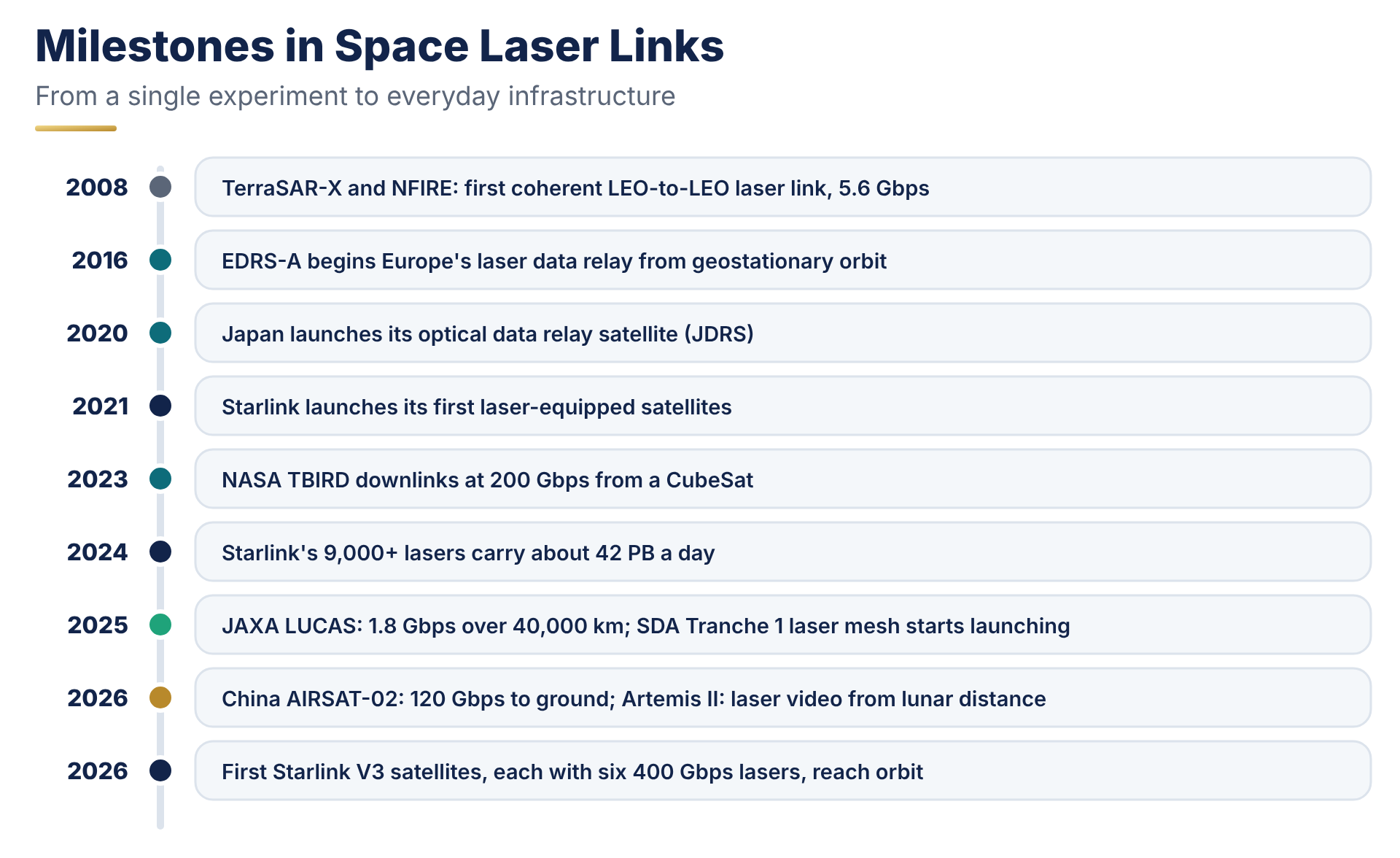
- Records keep rising. NASA’s TBIRD CubeSat downlinked at 200 Gbps in 2023. In January 2026, the Chinese Academy of Sciences reported 120 Gbps from its AIRSAT-02 satellite to the ground, doubling its earlier rate through a software update in orbit.
- From the Moon. During Artemis II in April 2026, the O2O terminal on Orion sent nearly half a terabyte at up to 260 Mbps, including high-definition video, the first use of laser communication on a crewed mission at lunar distance. A ground station in Australia supported more than 15 hours of dual-stream video.
- Becoming routine. In October 2026, Astrolight reported autonomous daily space-to-ground links for customers at 1 Gbps, including daytime and low-elevation passes.
Asia-Pacific
Asia-Pacific is home to some of the longest-running optical space programmes and some of the newest ventures.
| Country | Work in Optical Links |
|---|---|
| Japan | JAXA and NEC have worked on optical space communication since the 1990s. In January 2025, their LUCAS system transmitted Earth-observation data at 1.8 Gbps from the DAICHI-4 satellite to a geostationary relay about 40,000 km away. A consortium of NICT, SoftBank, ArkEdge Space, and Kiyohara Optics plans a 10 Gbps optical link between a LEO satellite and a high-altitude platform station in 2027. |
| China | The Aerospace Information Research Institute has raised space-to-ground rates from 10 Gbps in 2023 to 60 Gbps in 2025 and 120 Gbps in 2026. Researchers have also reported a 1 Gbps downlink from geostationary orbit to the Lijiang observatory using a 2-watt laser. |
| Singapore | Transcelestial, which builds terrestrial laser links, has flown a demonstration payload toward space-to-ground service. |
| Australia | Optical ground stations supported Artemis II, and the dry continent is well suited to clear-sky ground networks. |
What Comes Next
Three trends stand out. First, capacity per terminal keeps rising, from hundreds of gigabits toward terabits. Second, meshes are opening to outside users, as Starlink sells access to its lasers and military standards spread to commercial terminals, which could turn constellations into a shared optical backbone for Earth-observation satellites and even orbital data centres. Third, deep-space missions are adopting lasers for routine operations after Artemis II showed what they can do.
References
- Starlink, technology pages; SpaceX presentation at SPIE Photonics West, January 2024, as reported by PCMag and others.
- Converge Digest, “Starlink V3 Boosts Per-Satellite Downlink Capacity to 1 Tbps,” July 2026; GCN on the Starlink mini laser, September 2026.
- Breaking Defense, DefenseScoop and Air & Space Forces Magazine on SDA Tranche 1, 2025 to 2026.
- NASA and MIT Lincoln Laboratory, Artemis II O2O reports, April to June 2026.
- JAXA and NEC, LUCAS press release, January 2025; NICT and SoftBank, LEO–HAPS optical demonstration agreement, October 2025.
- Xinhua and Chinese Academy of Sciences on AIRSAT-02, January 2026; IEEE Spectrum on Transcelestial.
- Astrolight, ATLAS-1 operational announcement, October 2026; ITU-R studies on optical inter-satellite links.