
LEO Broadband Constellations
How low Earth orbit became a broadband network, who is building the constellations, and what it means for Asia-Pacific.
- Starlink
- Amazon Leo
- OneWeb
- Guowang
- Qianfan
For most of the satellite era, broadband from space meant a dish pointed at a geostationary satellite 36,000 kilometres away: useful where nothing else reached, but slow to respond and expensive. Since about 2019, a different design has taken over. Thousands of smaller satellites circle a few hundred kilometres above the Earth, hand users from one to the next, and pass traffic between themselves by laser. In 2026, low Earth orbit broadband has more than 13 million subscribers, carries airline and maritime traffic, backhauls mobile sites, and is starting to reach ordinary phones. This page explains how it works and how the market is taking shape, with a closer look at Asia-Pacific.
Why Low Orbit
Altitude decides almost everything about a satellite system. A geostationary satellite appears fixed in the sky, so a simple dish can stay pointed at it, and three satellites can cover most of the inhabited world. The price is distance: a signal that travels from a user to the satellite, down to a gateway, and back again covers more than 140,000 kilometres, which takes almost half a second even at the speed of light.
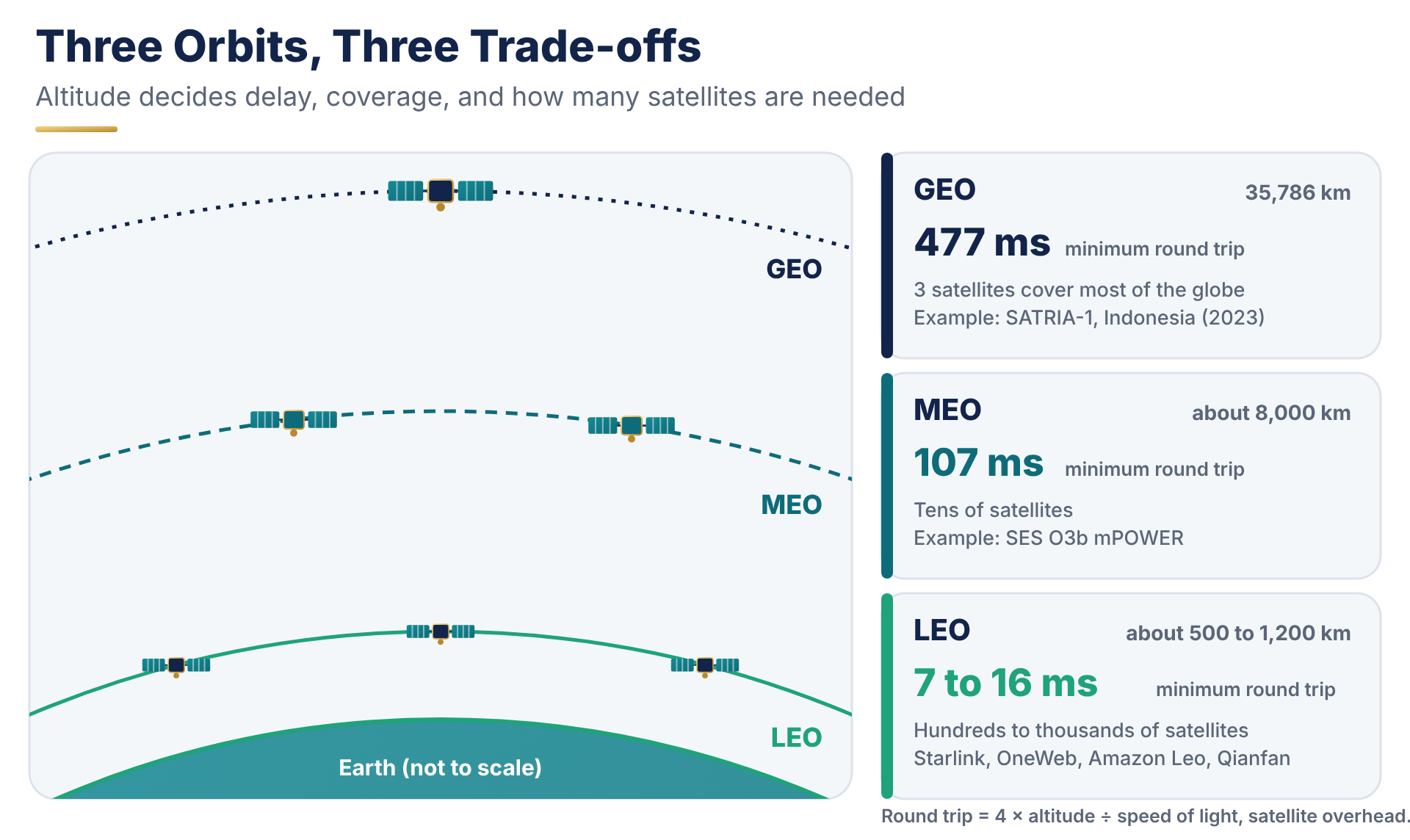
In low Earth orbit, the same round trip takes a few milliseconds of travel time, so latency comes close to that of terrestrial networks. Low orbit has its own costs. Each satellite sees only a small patch of the Earth and crosses the sky in a few minutes, so continuous coverage needs hundreds or thousands of satellites, terminals that can follow them, and a network that hands users from one satellite to the next. Satellites at these altitudes also last only about five years, so the fleet must be replenished continuously.
The idea is not new; Iridium and Globalstar flew LEO constellations in the 1990s. What changed after 2015 was cost. Reusable rockets cut the price of reaching orbit, satellites moved to production lines, and electronically steered antennas became cheap enough for consumers. Together they turned a concept that bankrupted its first generation into a profitable business.
How It Works
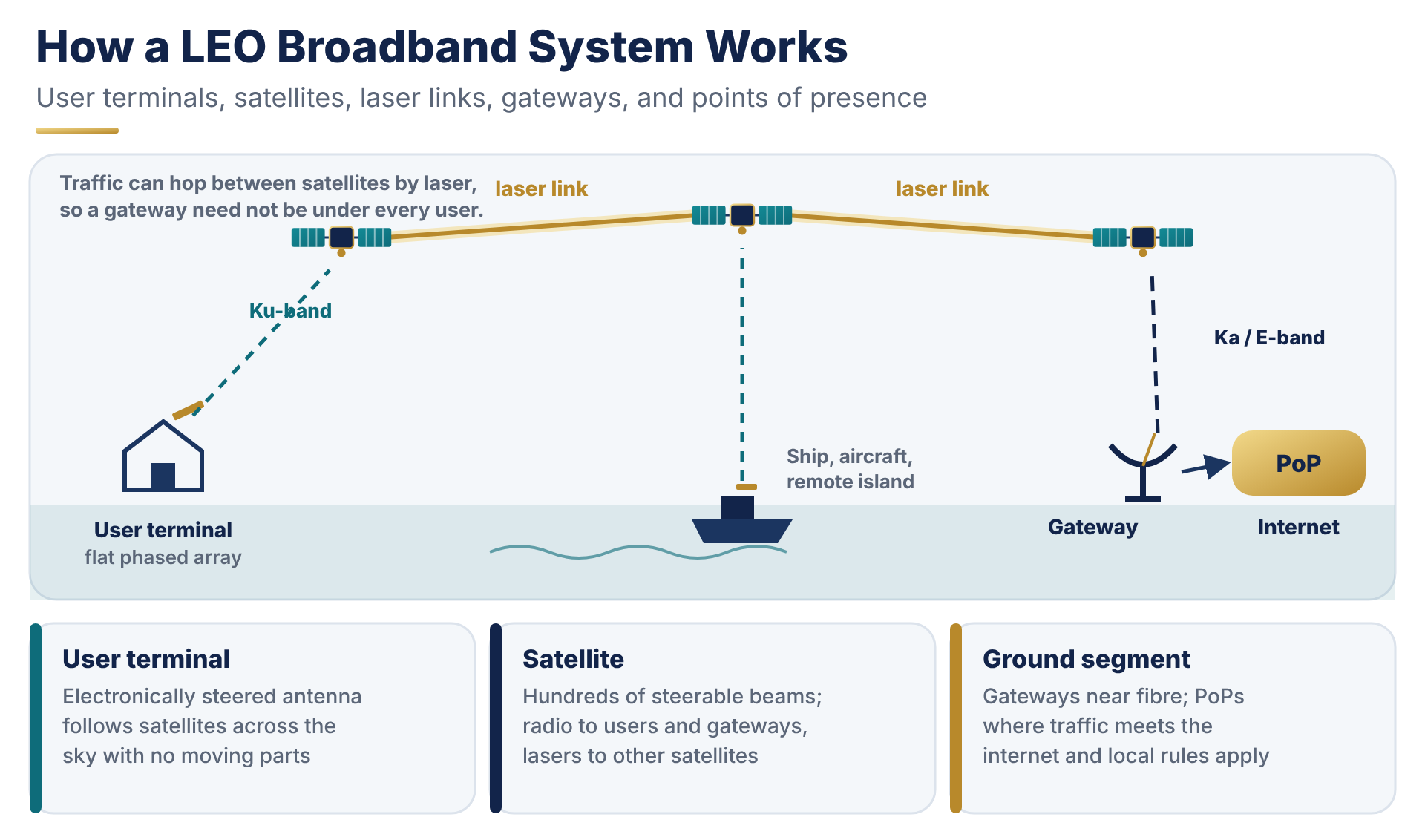
- User terminals are flat phased-array antennas that steer their beam electronically, following each satellite across the sky and switching to the next one without moving parts.
- Satellites form hundreds of beams towards users and gateways. Newer designs process signals digitally on board and carry laser terminals for links to neighbouring satellites.
- Laser links let traffic hop across the constellation, so ships, aircraft, and remote islands can be served far from any gateway. They are covered in detail under Laser Links.
- Gateways and points of presence connect the constellation to terrestrial fibre. They are also where national rules apply: lawful interception, data handling, and the requirement in many countries to land traffic locally.
Capacity is shared within each beam, so the experience depends on how many users sit under the same cell. This is why operators keep adding satellites even after coverage is complete. SpaceX’s third-generation Starlink satellites are designed for about 1 Tbps of downlink capacity each. The first 26 reached orbit on 28 September 2026, on the first Starship flight to reach orbit.
The Constellations
One operator dominates the market, and several others are racing to build alternatives, many of them backed by governments that do not want to depend on a single foreign provider.
| System | Status at the end of 2026 |
|---|---|
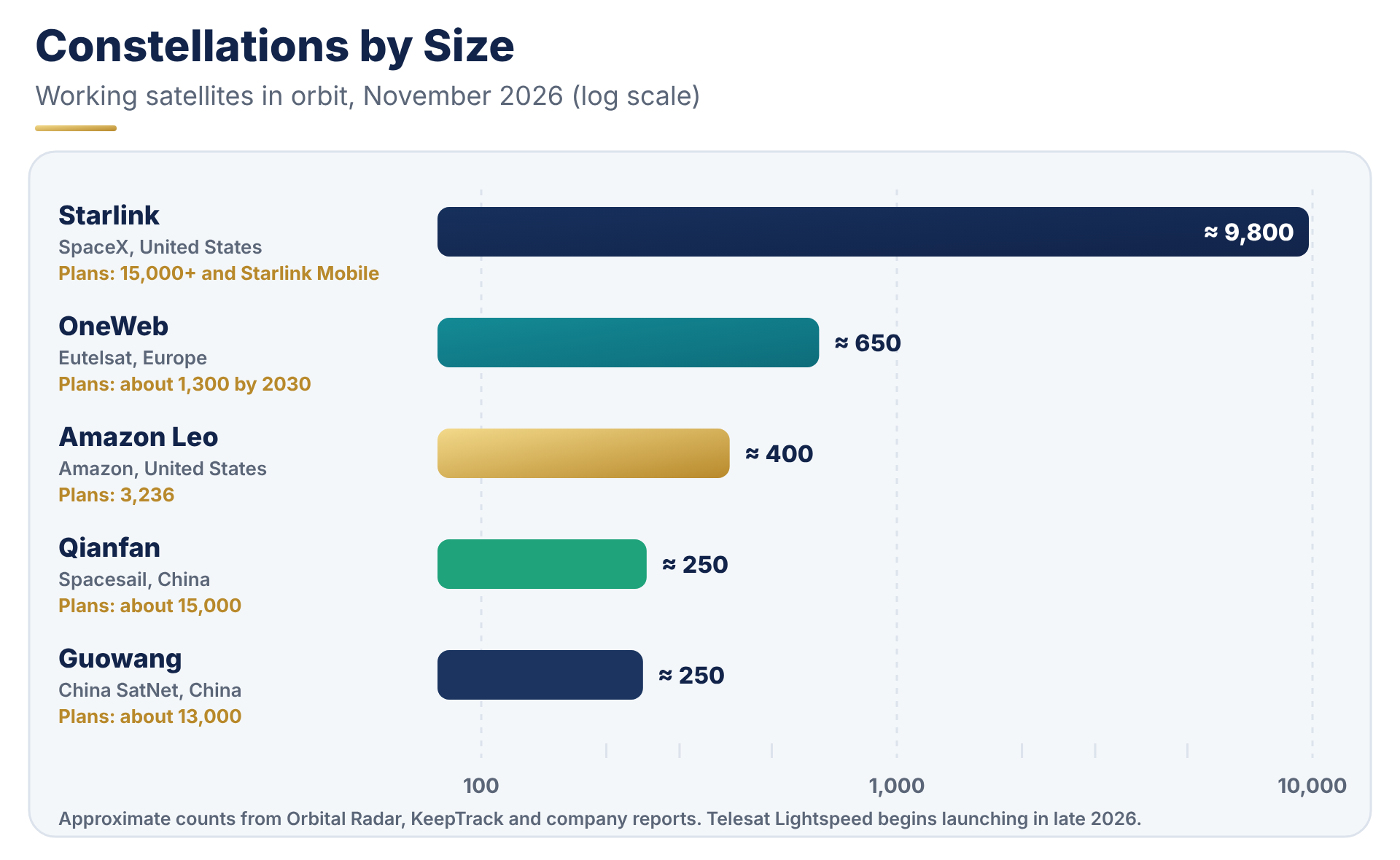
| Starlink (SpaceX) | About 9,800 working satellites. 13.6 million consumer subscribers in 174 countries and markets at the end of September 2026. Lowering its main shell from about 550 to about 480 km to speed up the decay of failed satellites. |
| Amazon Leo | Formerly Project Kuiper, renamed in November 2025. About 400 satellites operational. Enterprise preview from late 2025 and beta from April 2026, with first service planned in the United States, Canada, the United Kingdom, France, and Germany. Agreed in April 2026 to buy Globalstar. |
| OneWeb (Eutelsat) | About 650 satellites at 1,200 km, serving enterprises, governments, airlines, and ships. Airbus is building 669 replacement and additional satellites, with about 1,300 in orbit targeted by 2030 before the move to Europe’s IRIS². |
| Guowang (China SatNet) | China’s state constellation, with about 13,000 satellites filed at the ITU and roughly 250 in orbit, launched at an accelerating pace through 2026. |
| Qianfan (Spacesail) | Shanghai-backed constellation, also called Thousand Sails, with about 15,000 satellites planned and roughly 250 in orbit. Actively seeking partners abroad. |
| Telesat Lightspeed | Canadian enterprise and government network of 198 optically linked satellites built by MDA. Pathfinders in late 2026, service from 2027. |
The gap is not only in numbers. SpaceX launches its own satellites on its own rockets, and an analyst estimated in April 2026 that it was building about 340 satellites a month, while its competitors depend on launch capacity bought from others, often from SpaceX itself.
Asia-Pacific
Asia-Pacific shows every possible approach to LEO broadband, from open licensing to tightly controlled pilots and domestic alternatives.
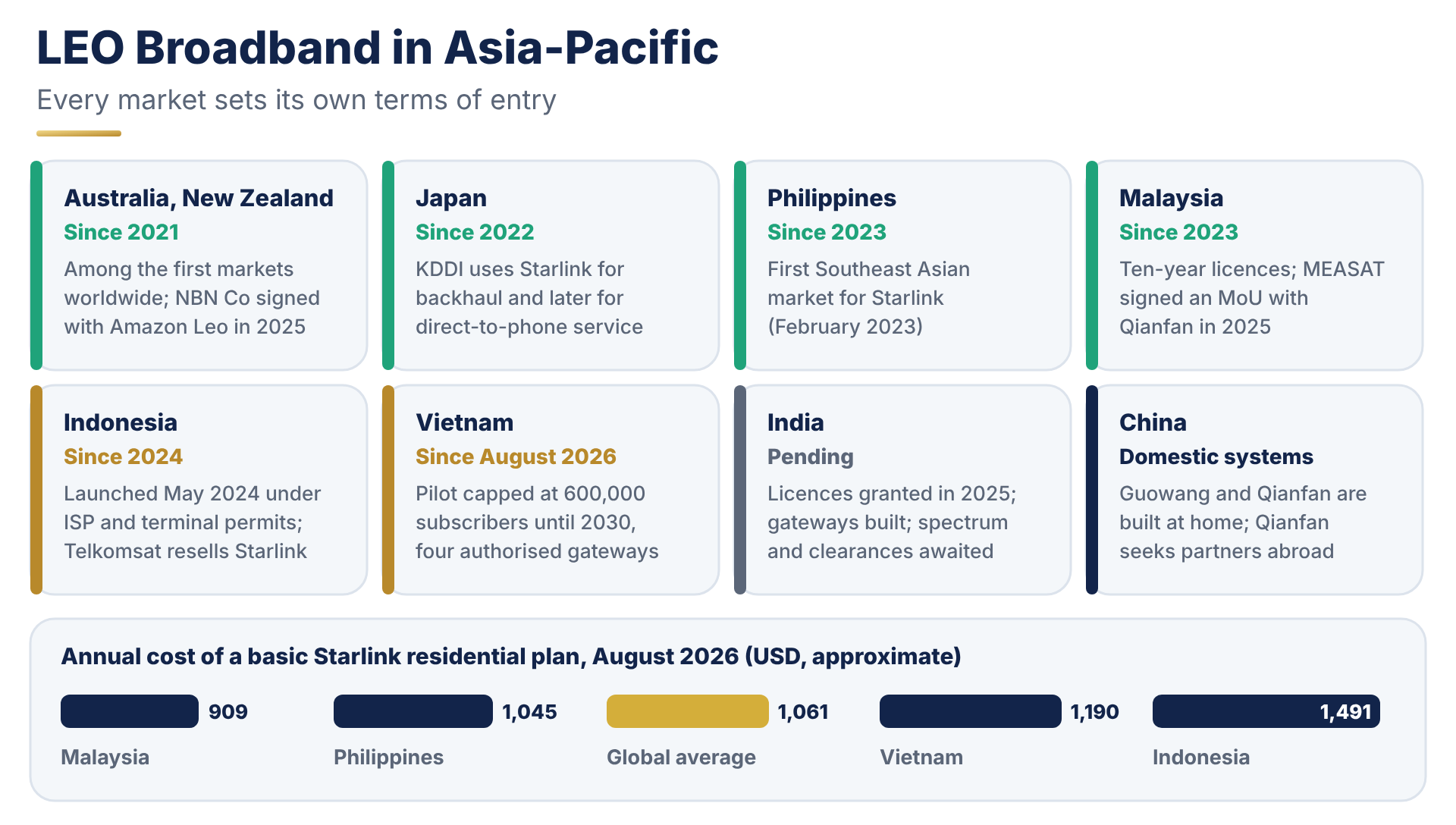
- Open licensing. The Philippines became Starlink’s first Southeast Asian market in February 2023, followed by Malaysia under ten-year licences. Australia, New Zealand, and Japan were among the earliest markets anywhere.
- Partner models. In Indonesia, Starlink launched in May 2024 with permits and local cooperation, and Telkom’s satellite arm, Telkomsat, resells the service. Telkomsat reports that its revenue is shifting towards LEO-based connectivity.
- Controlled entry. Vietnam opened orders in August 2026 under a pilot that caps subscribers at 600,000 until 2030 and authorises four gateways in the country.
- Pending. India granted Starlink its licences in 2025, and Starlink says more than 20 gateway sites are ready, but spectrum assignment and security clearances were still awaited in late 2026.
- Domestic systems. China builds its own constellations, and Qianfan signed an agreement with Malaysia’s MEASAT in 2025 covering broadband, direct-to-device, and IoT services.
Price remains a barrier. In August 2026, a year of Starlink’s basic residential service cost about USD 900 in Malaysia and almost USD 1,500 in Indonesia, before the terminal. For many households in the region, that is a large share of annual income, which is why LEO capacity often reaches people indirectly: through village Wi-Fi, schools, health centres, and mobile base stations backhauled by satellite.
Open Questions
| Issue | Why It Matters |
|---|---|
| Space safety | Tens of thousands of satellites raise collision risk and the amount of debris. Lower orbits help failed satellites re-enter quickly, and the main operators now manoeuvre routinely to avoid conjunctions. |
| Astronomy | Bright satellites streak optical images, and their emissions can affect radio telescopes. Operators have reduced brightness, but the number of satellites keeps rising. |
| Concentration | Starlink satellites make up about half of all active satellites in orbit, which gives one company great influence over a critical service. |
| Spectrum sharing | Non-geostationary systems must protect geostationary ones; the limits that govern this are being re-examined at the ITU as constellations grow. |
| Local rules | Landing rights, gateway location, lawful interception, and taxes vary by country, and shape where and how service is offered. |
| Affordability | Terminal and subscription costs keep most direct consumer use in higher-income households unless subsidised or shared. |
What Comes Next
The next two years will test whether LEO broadband becomes a competitive market or remains a near-monopoly. Starlink’s third-generation satellites and Starship could multiply its capacity. Amazon Leo must turn about 400 satellites into a commercial service and keep launching to meet its licence milestones. China’s two constellations must sustain a much faster launch cadence to reach their targets. Meanwhile, the boundary between satellite and mobile networks is fading, as constellations begin to serve phones directly and as 3GPP builds satellites into the mobile standard itself.
References
- SpaceX, third-quarter 2026 results as reported by Broadband Breakfast and Fierce Network, October 2026; Starlink technology pages.
- Orbital Radar and KeepTrack constellation counts, October and November 2026.
- Amazon, Amazon Leo mission updates and announcements, 2025 to 2026; Amazon and Globalstar merger announcement, April 2026.
- Eutelsat and Airbus, OneWeb and IRIS² announcements, August and September 2026.
- China Daily, CASC and AIAA reports on Guowang and Qianfan launches, 2026.
- Telesat, “2025: A Year of Strong Execution”; SpaceNews on Lightspeed launch contracts.
- Light Reading, The Next Web, Entrepreneur Asia Pacific and Reuters on Starlink in Vietnam, August 2026; Beebom and Business Standard on Starlink in India, 2026.