
Spectrum: Upper 6 GHz, 7–15 GHz, WRC-27
Why the next decade of mobile depends on the mid-band, how WRC-27 decisions are prepared, and how Asia-Pacific is approaching upper 6 GHz and beyond.
- WRC-27
- Upper 6 GHz
- 7–8 GHz
- Direct-to-Device
- APT
Spectrum is the one input a mobile network cannot manufacture. Every generation has needed a new band: 3.5 GHz carried 5G, and the upper mid-band is expected to carry 6G. The decisions that make those bands available are taken years in advance, globally at the ITU’s World Radiocommunication Conferences and nationally by regulators who must balance mobile against Wi-Fi, satellites, aviation, defence, and science.
Why Mid-Band
Radio physics imposes a trade-off. Lower frequencies travel further and penetrate buildings better, but offer little bandwidth. Higher frequencies offer wide channels but reach shorter distances. Mobile networks therefore use layers, each with its own job.
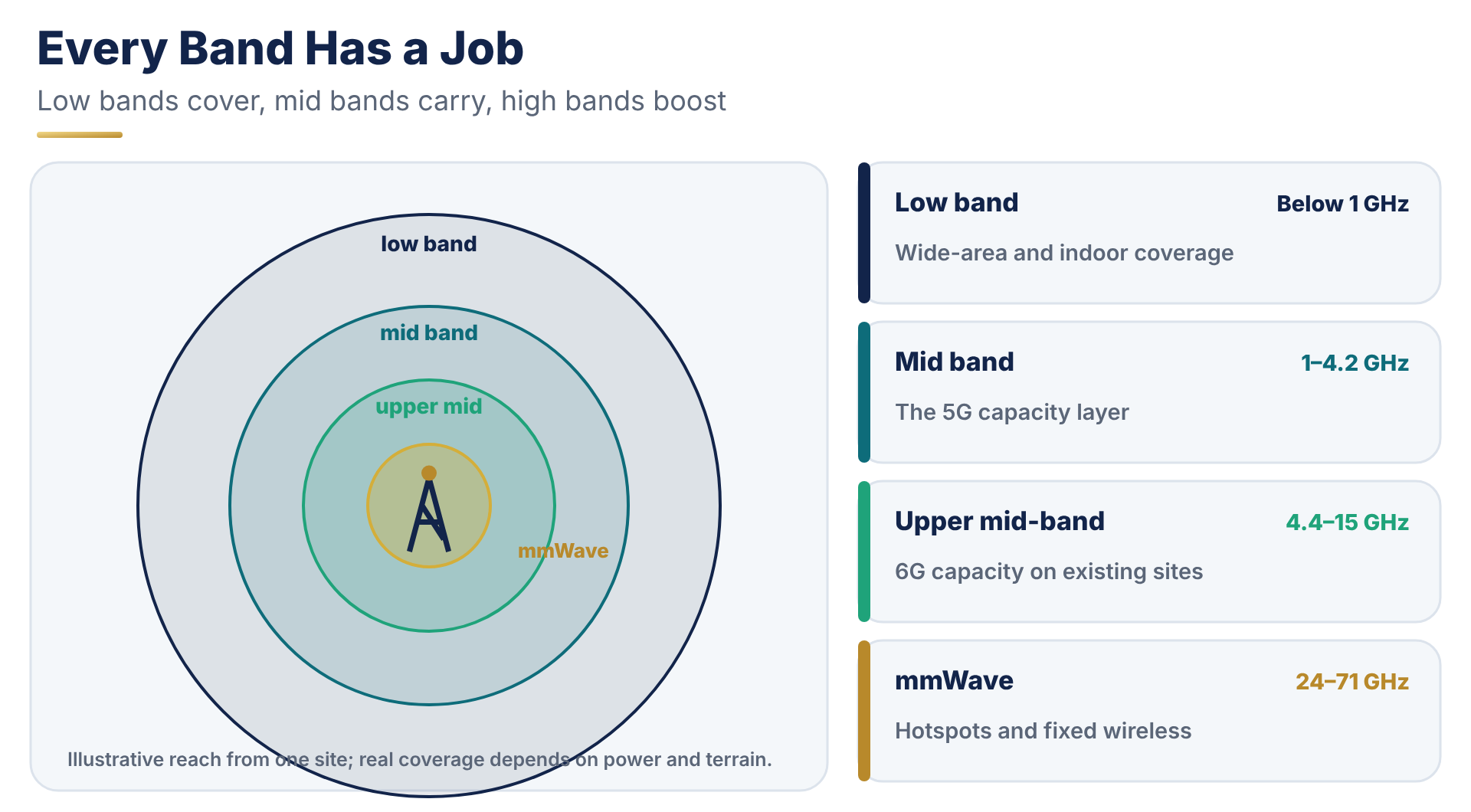
Mid-band has been the workhorse of 5G because it balances the two. Traffic keeps growing, and the 5G mid-band is filling up in the busiest cities, so the industry is looking for the next block of wide channels that can still be deployed on existing sites. That is why the range from about 6 to 15 GHz, the upper mid-band, has become the focus of the next WRC.
How Decisions Are Made
The international Radio Regulations are revised at World Radiocommunication Conferences, held roughly every four years. Each conference sets the agenda for the next one, the ITU’s working parties carry out sharing and compatibility studies in between, and regional groups build common positions. For Asia-Pacific, that group is the Asia-Pacific Telecommunity (APT), with 38 member administrations, whose preparatory group for WRC-27 met for the third time in Sapporo in July 2026.
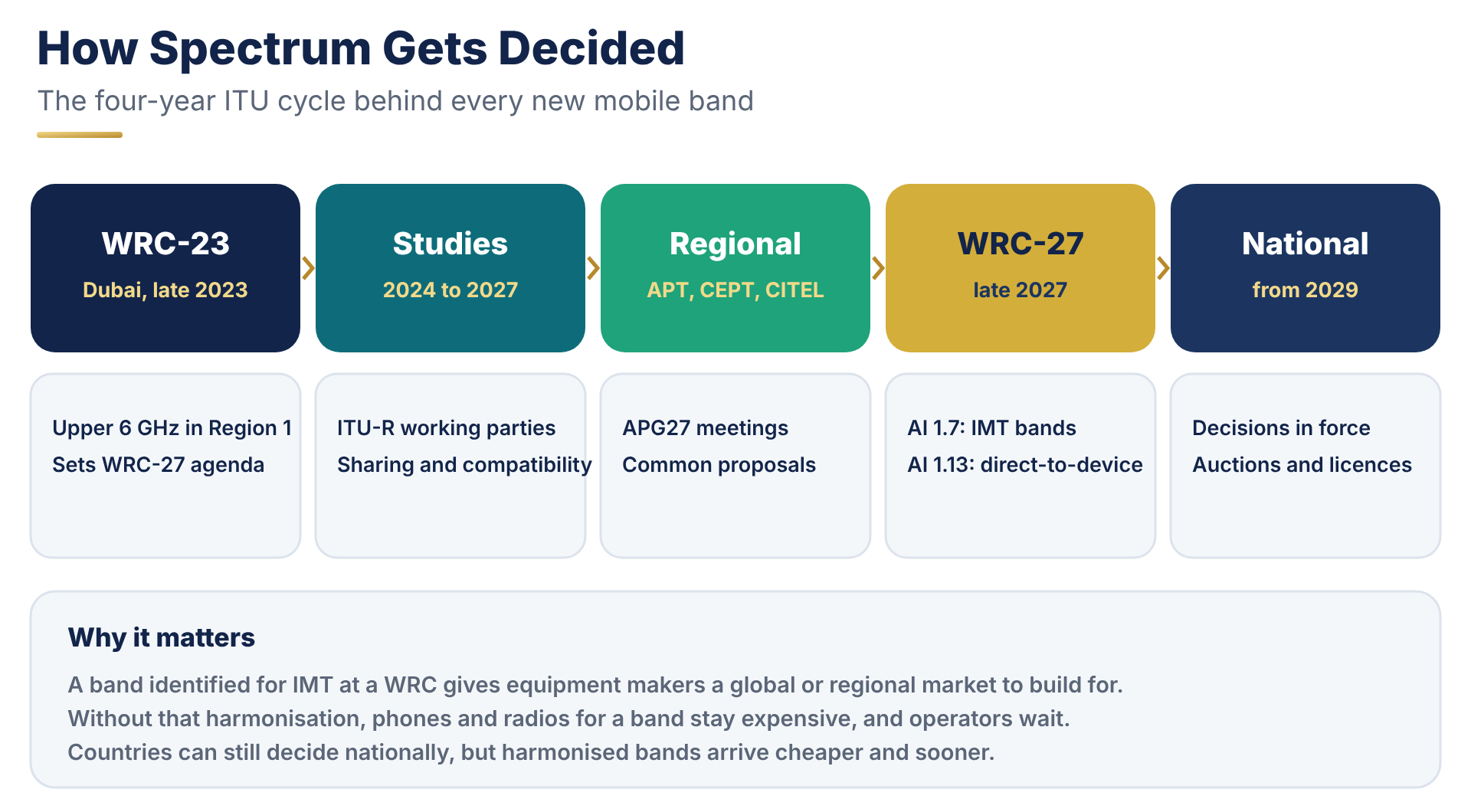
An identification for IMT does not oblige any country to use a band for mobile. It signals to manufacturers that a large market will exist, which is what makes equipment affordable. WRC-27 takes place in late 2027, and its decisions take effect in January 2029, just in time for the first 6G deployments.
Upper 6 GHz
The 6 GHz band, from 5925 to 7125 MHz, is the most contested spectrum of the decade. Wi-Fi wants all of it for Wi-Fi 6E, 7, and beyond; mobile operators want the upper 700 MHz for capacity. WRC-23 identified 6425–7125 MHz for IMT across Region 1. In Asia-Pacific, Region 3, it identified only 7025–7125 MHz, with the full upper band identified in three countries: Cambodia, Laos, and the Maldives.
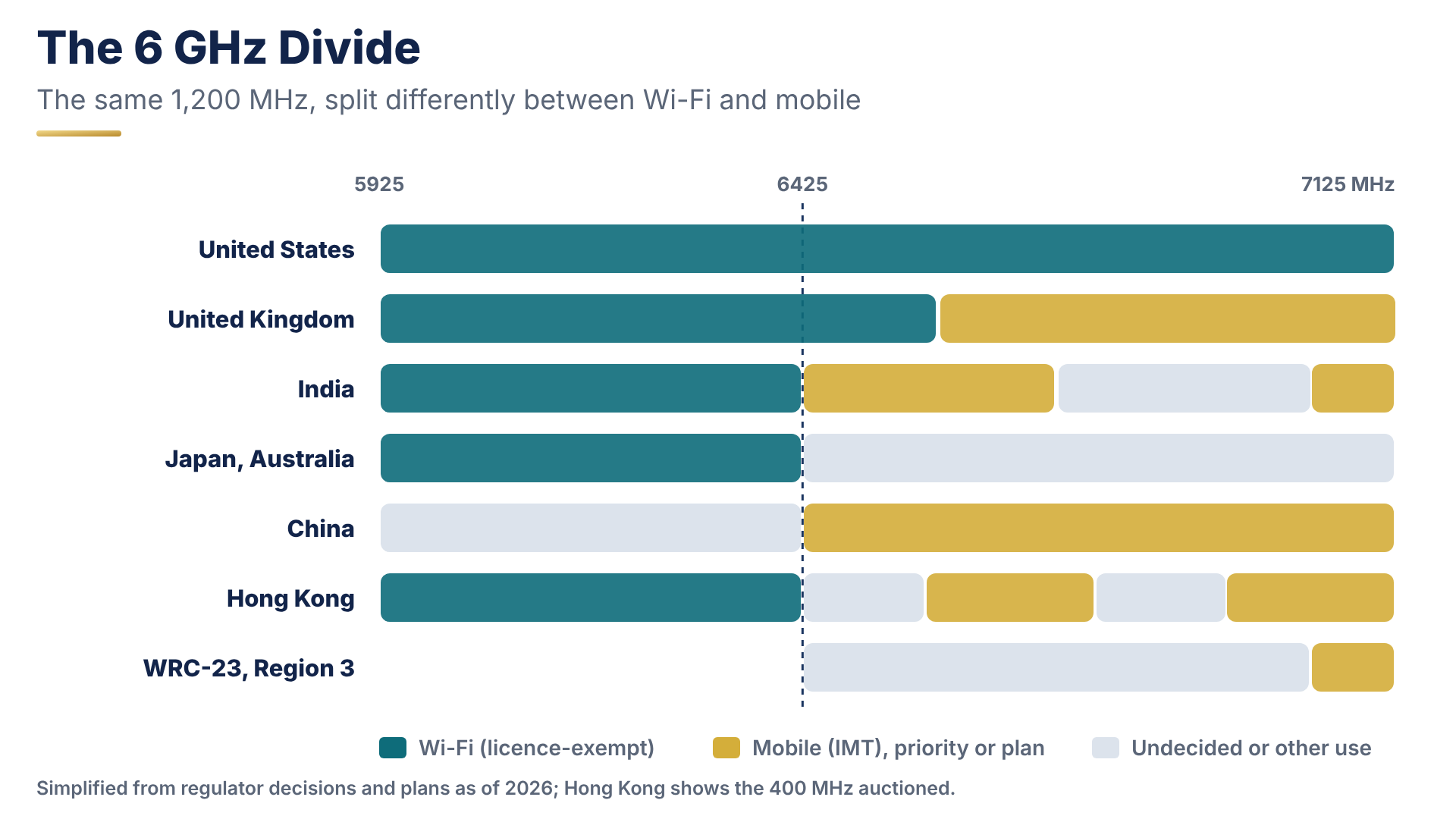
Asia-Pacific shows every possible answer:
- China added an IMT identification for upper 6 GHz to its national frequency table in 2023, and in May 2026 granted a 6G trial frequency permit in the band.
- Hong Kong held the world’s first auction of the band, offering 400 MHz in twenty 20 MHz blocks.
- India opened the lower 6 GHz band to licence-exempt use and has designated 6425–6725 MHz and 7025–7125 MHz for IMT.
- Japan and Australia opened the lower band to Wi-Fi and have so far kept their options open on the upper part.
- Indonesia, Thailand, Sri Lanka, Bangladesh, and Cambodia have placed upper 6 GHz on their spectrum roadmaps.
Elsewhere, regulators are trying to split the difference. In July 2026, the United Kingdom’s Ofcom decided on a shared framework, with a Wi-Fi priority portion in the lower 160 MHz of the upper band and a mobile priority portion in the remaining 540 MHz, while the UAE assigned the whole upper band to its operators.
WRC-27 Bands
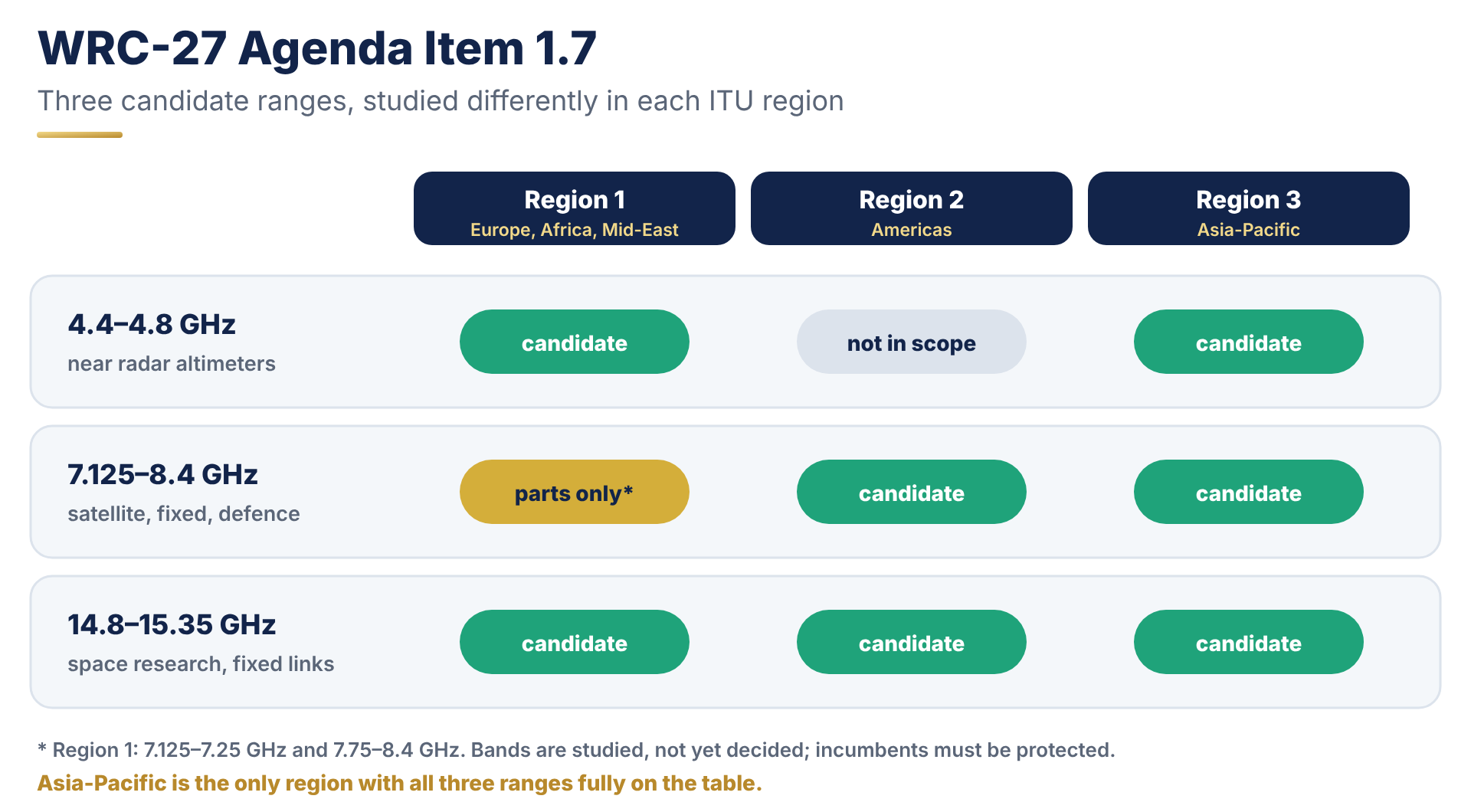
Agenda item 1.7 of WRC-27, set by Resolution 256 of WRC-23, asks whether three ranges can be identified for IMT: 4.4–4.8 GHz, 7.125–8.4 GHz, and 14.8–15.35 GHz. The scope differs by region, and Asia-Pacific is the only region where all three are fully on the table.
| Band | Main Incumbents | Key Concern |
|---|---|---|
| 4.4–4.8 GHz | Military and fixed links; radar altimeters in the adjacent 4.2–4.4 GHz | Aviation safety; new altimeter designs are not expected before the mid-2030s |
| 7.125–8.4 GHz | Satellite, fixed, and defence systems; science services near 8.4 GHz | Sharing with satellites and protection of Earth observation |
| 14.8–15.35 GHz | Space research and fixed links | Shorter range makes this a capacity band rather than a coverage band |
Positions are still forming. The GSMA supports IMT identification of 4.4–4.8 GHz and of spectrum within 7.125–8.4 GHz. The aviation community, through ICAO, regards agenda item 1.7 as a major concern. In the United States, the FCC’s advisory working group could not reach consensus and forwarded two views. APT members support the ITU-R studies and note that the draft conference text still reflects several different methods.
Satellites in Mobile Bands
A second WRC-27 item may matter just as much. Agenda item 1.13 studies new mobile-satellite allocations so that satellites can connect directly to ordinary phones in IMT bands between 694/698 MHz and 2.7 GHz. Today, such direct-to-device services rely on national permissions and partnerships between satellite and mobile operators. A global framework would set rules for interference across borders and for protecting terrestrial networks.
Views differ on how strong that new satellite status should be. Some administrations favour a secondary allocation, used only with the agreement of the mobile operators that hold the licences. The commercial stakes are high, as shown when SpaceX paid about USD 17 billion in 2025 for EchoStar spectrum to expand its direct-to-cell service. The service side of this story is told in When the Sky Becomes the Cell Tower.
What to Watch
| When | What | Why It Matters |
|---|---|---|
| 2027 | Final APT preparatory meeting and common proposals | Asia-Pacific speaks with one voice at WRC-27 only if positions converge |
| Late 2027 | WRC-27 | Decides on 4.4–4.8, 7.125–8.4 and 14.8–15.35 GHz, and on direct-to-device |
| 2026–2028 | National upper 6 GHz decisions | Shapes whether early 6G in the region starts at 6 GHz or at 7 GHz |
| From 2029 | Decisions take effect | Licensing and auctions for the first 6G networks |
| Longer term | Sub-terahertz | Studied for future conferences, not part of the first 6G wave |
References
- ITU, Resolution 256 (WRC-23) and Resolution 253 (WRC-23); ITU-R preparatory studies for WRC-27.
- APT, Trends and Spectrum Developments for IMT Usage in 2025–2030 in Asia-Pacific Region, APT/AWG/REP-136, 2026; APT preliminary views, APG27-3, July 2026.
- CEPT, draft brief on WRC-27 agenda item 1.7, 2025; FCC WRC-27 Advisory Committee documents, 2026.
- GSMA, WRC-27 Public Policy Paper and 6 GHz in APAC, October 2026.
- Ofcom, Expanding access to the 6 GHz band for commercial mobile and Wi-Fi services, statement, 20 July 2026.
- Nokia, “Spectrum decisions shaping the road to 6G”; ABI Research and PolicyTracker analyses of 6 GHz policy, 2025–2026.
- ICAO, positions and workshop materials on WRC-27 agenda items 1.7 and 1.13, 2026.