
Integrated Sensing and Communication
How mobile networks learn to see: the physics behind it, the sensing modes, the use cases, the standards, and the privacy questions that come with them.
- Sensing Modes
- Low-Altitude
- Release 19 and 20
- 6G Native
- Privacy
Radar and radio communication rest on the same physics. Every base station already fills the air with radio waves, and those waves bounce off cars, drones, buildings, and people. Integrated sensing and communication, or ISAC, turns those echoes into information, so that one network can both connect devices and perceive its surroundings. The ITU lists it as one of three new usage scenarios for 6G, and the first steps are already being taken in 5G-Advanced.
How It Works
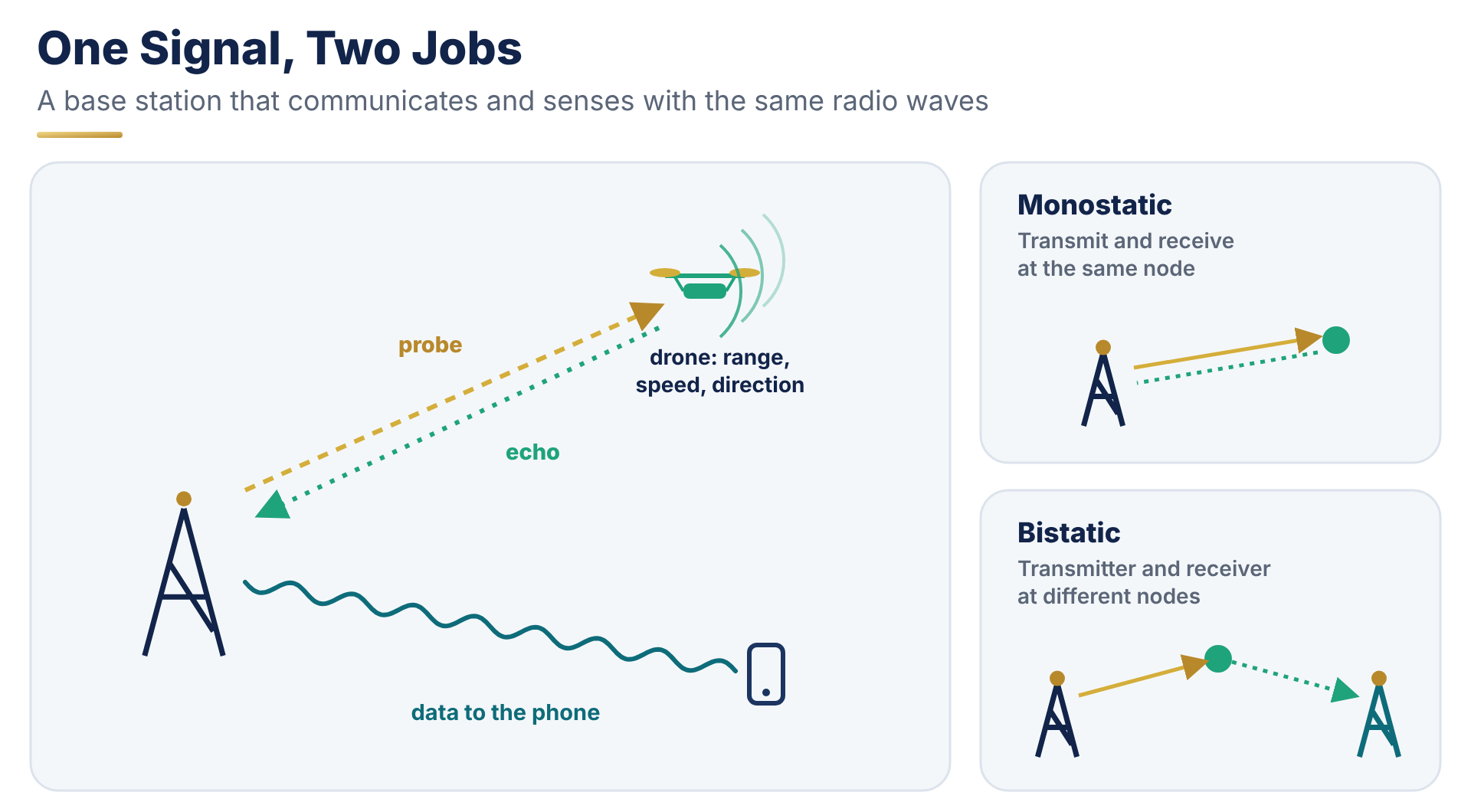
A sensing base station sends a signal whose shape it knows, listens for the reflections, and compares the two. The time delay of an echo gives the distance to the object, the Doppler shift gives its speed, and an antenna array gives its direction. Track those values over time and the network can follow a moving target.
Bandwidth sets the sharpness of the picture. Range resolution is roughly the speed of light divided by twice the bandwidth: with 100 MHz, two objects about 1.5 metres apart can be told apart, and with 400 MHz, about 0.4 metres. This is one reason ISAC fits naturally with the wide channels planned for 6G. More antennas sharpen the angle, and higher frequencies allow more antennas in the same space.
The difficulties are practical. A base station that transmits and listens at the same time must cope with its own powerful signal leaking into its receiver, the same problem that subband full duplex faces in 5G-Advanced. Echoes from the target compete with clutter from everything else, and when transmitter and receiver sit in different places, their clocks must be tightly synchronised.
Sensing Modes
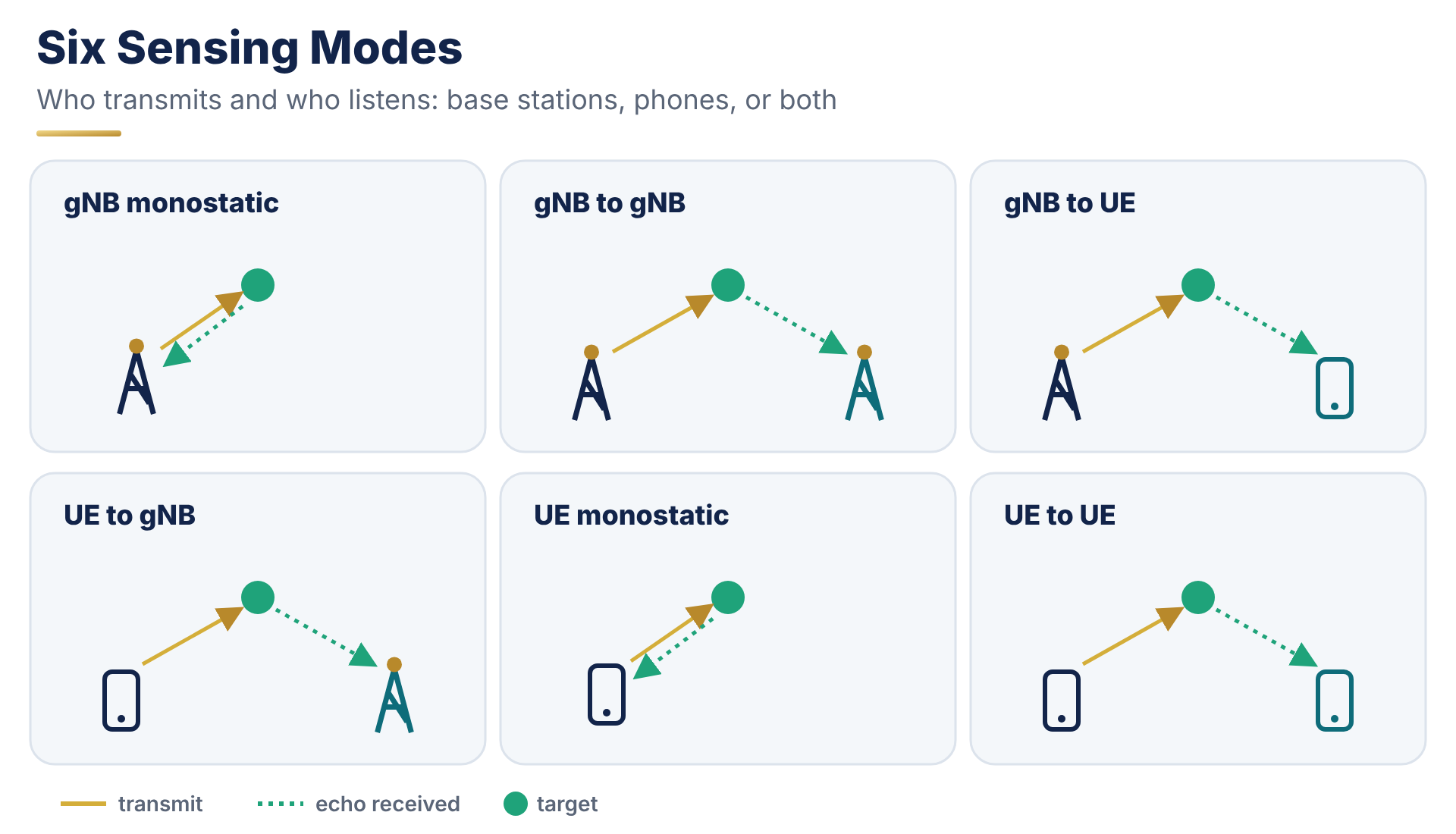
Sensing can be monostatic, with the transmitter and receiver at the same node, or bistatic, with them at different nodes. Combining base stations and user devices gives six modes, which both 3GPP and ETSI use as a common vocabulary.
| Mode | Strength | Challenge |
|---|---|---|
| Base station monostatic | One node, no synchronisation needed, wide coverage | Self-interference between transmitter and receiver |
| Base station to base station | No self-interference; uses the existing grid | Tight timing between sites |
| Base station and device | The device may sit close to the target | Device battery and coordination |
| Device monostatic or device to device | Very local sensing, for example inside a car or a room | Power, privacy, and limited antennas |
The first commercial work concentrates on the simplest case. Release 20 of 5G-Advanced studies base-station monostatic sensing, using existing 5G waveforms and reference signals, with drones as the main target.
Use Cases
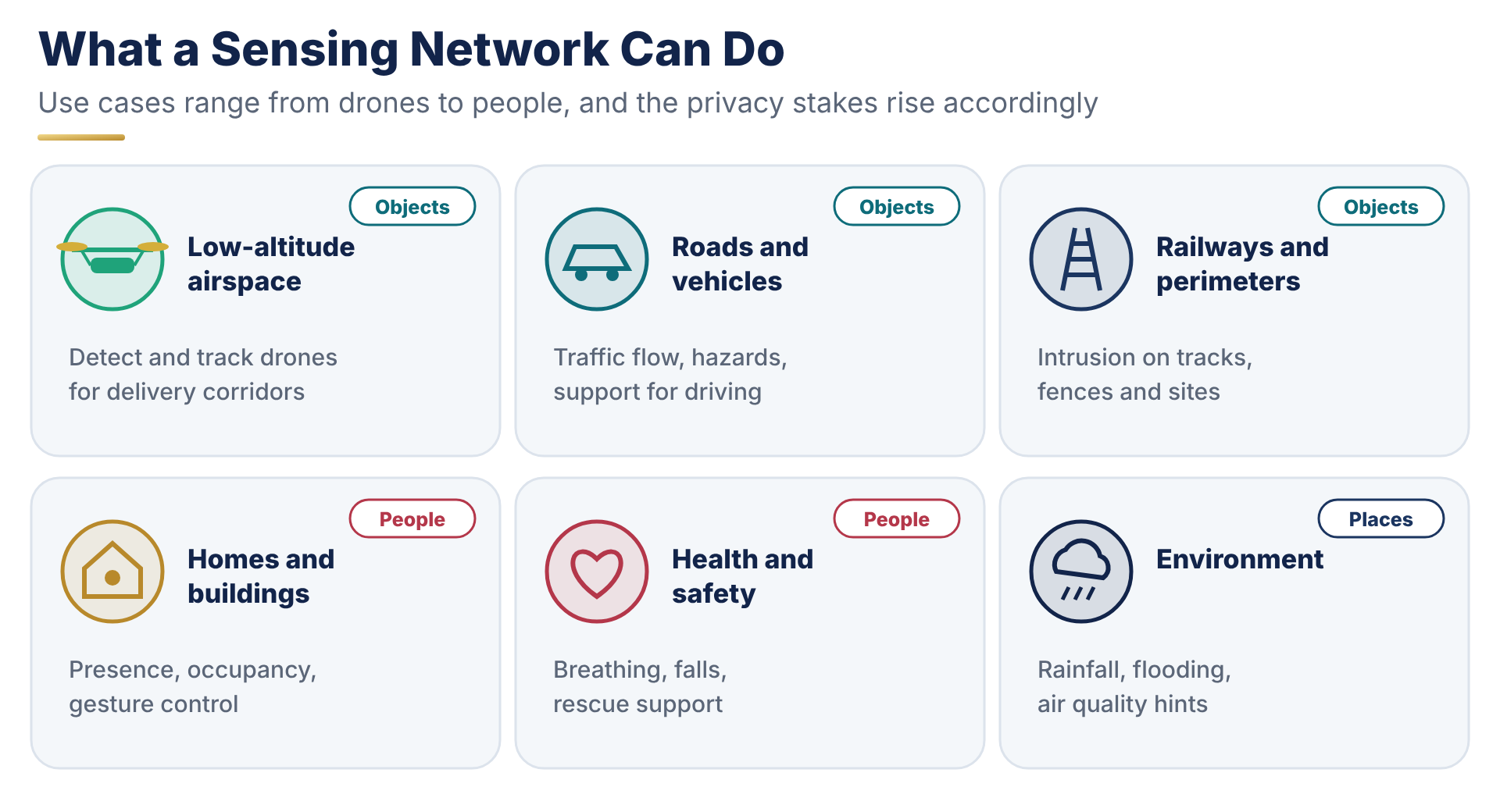
3GPP’s first study catalogued 32 use cases, and ETSI’s first report added 18 advanced ones for 6G. They fall into three broad families: sensing objects, sensing places, and sensing people.
The Low-Altitude Economy
The strongest commercial pull today comes from drones. China’s operators are testing 5G-Advanced base stations that act as distributed radar to support drone delivery, with China Mobile running trials in Shenzhen. In February 2026, Chinese authorities issued guidelines requiring network upgrades for three-dimensional surveillance of low-altitude airspace. The economics are still daunting: one estimate puts the cost of a 5G-Advanced base station equipped for low-altitude coverage at more than USD 143,000, and coverage requires dense deployment.
For other Asia-Pacific markets with drone delivery, inspection, and emergency-response ambitions, the question is less whether the technology works than who pays for dense sensing coverage, and which agency is responsible for the airspace picture it produces.
Standards
| Step | What Was Done |
|---|---|
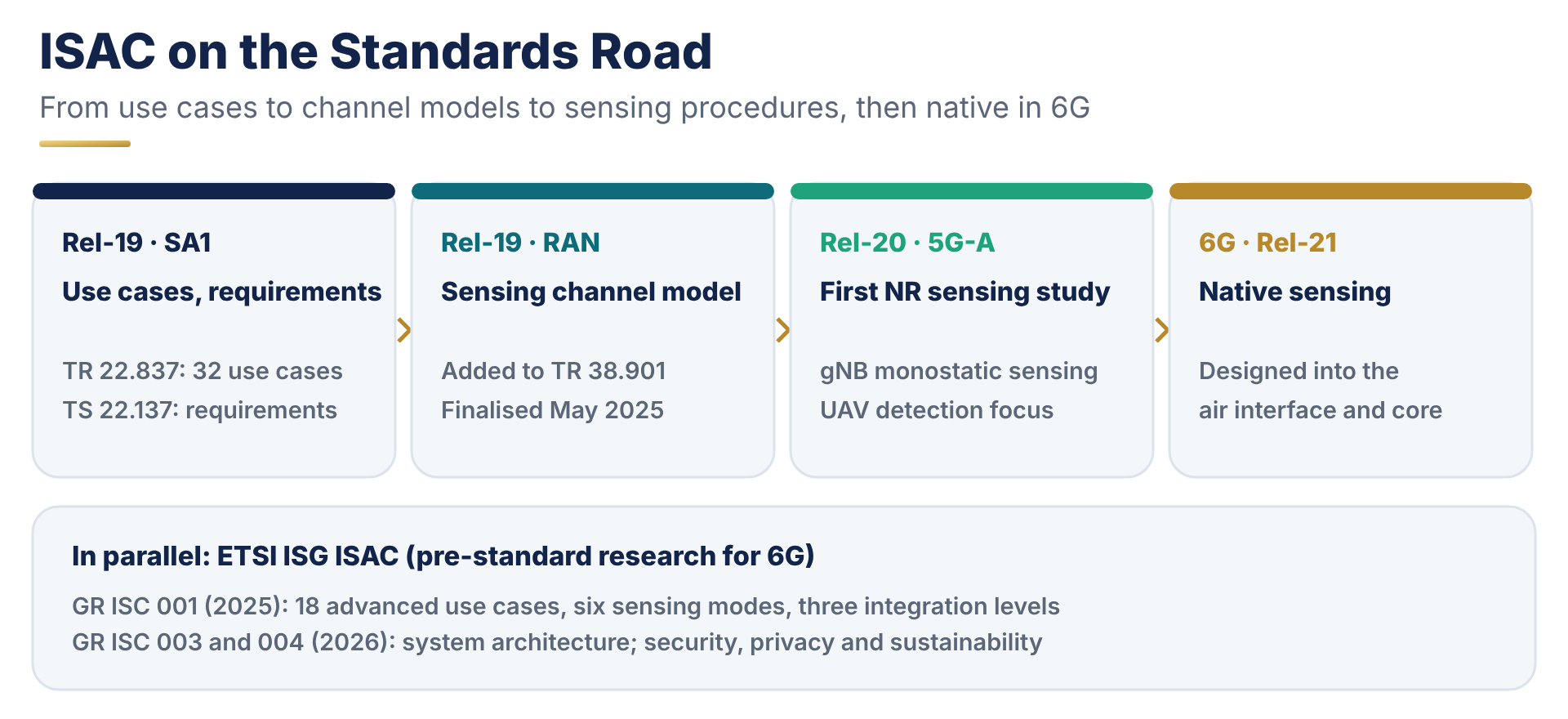
| Release 19, SA1 | Feasibility study TR 22.837 identified 32 use cases; TS 22.137 set service requirements |
| Release 19, RAN | A sensing channel model, studied from December 2023, was finalised in May 2025 and added to TR 38.901 |
| Release 20, 5G-Advanced | Study on NR sensing (TR 38.765), focused on base-station monostatic sensing of drones; architecture study for sensing services in the core |
| 6G | Sensing expected to be designed into the air interface and core from the start |
| ETSI ISG ISAC | GR ISC 001 (2025) on use cases; GR ISC 003 (2026) on architectures; GR ISC 004 (2026) on security, privacy, and sustainability |
Release 19’s channel model is a quiet but essential step. Before engineers can compare sensing designs, they need agreed models of how targets such as drones, vehicles, and people reflect radio waves and how the background environment behaves. With that in place, Release 20 can measure real performance rather than argue over assumptions.
Privacy and Trust
Sensing changes the relationship between a network and the people around it. A phone user chooses to connect; a person walking past a sensing base station does not. ETSI’s 2025 report noted that nine of its eighteen use cases aim to sense humans directly and six more operate in their presence. Its 2026 report on security and privacy identified nineteen key issues, fifteen of them about security and privacy, including unauthorised sensing, data confidentiality, and protection of personal information.
- Who may sense, and what? Rules will need to separate objects, such as drones and vehicles, from people.
- Who receives the results? Sensing data exposed to third parties needs the same discipline as location data, or stricter.
- How long is it kept? Raw sensing data can reveal far more than its original purpose required.
Outlook
ISAC is likely to reach the market in stages. Drone detection and airspace awareness come first, because they meet a clear public-safety need and fit base-station monostatic sensing. Perimeter protection, rail safety, and traffic monitoring follow. Sensing people in homes and public spaces comes last, and only where regulation allows.
For operators, ISAC offers something rare: a new product built on assets they already own. The obstacles are cost per site, the need for regulatory clarity, and finding customers, often public agencies, who will pay for a sensing service rather than simply expect it.
Continue in MobileSpectrum: Upper 6 GHz, 7–15 GHz, WRC-27→References
- 3GPP TR 22.837, Feasibility Study on Integrated Sensing and Communication, and TS 22.137, Release 19.
- 3GPP TR 38.901 (Release 19 ISAC channel model) and draft TR 38.765, Study on ISAC for NR, Release 20.
- Y. Liu et al., “A Comprehensive Survey of 3GPP Release 19 ISAC Channel Modeling,” arXiv:2512.03506.
- ETSI GR ISC 001 (April 2025), GR ISC 003 and GR ISC 004 (February 2026).
- Caixin Global, “Beijing orders telecom overhaul to track drones in lower skies,” February 2026.
- RCR Wireless and China Daily, reports on China Mobile 5G-Advanced sensing trials, June 2025.