
AI-Native Air Interface and AI-RAN
How artificial intelligence moves into the radio itself, onto the same hardware as the radio, and out to the edge of the network.
- AI-for-RAN
- AI-and-RAN
- AI-on-RAN
- 3GPP AI/ML
- Accelerated RAN
Two stories are converging. In 3GPP, engineers are writing machine learning into the air interface, the most tightly specified part of a mobile network. In industry, vendors and operators are rebuilding the radio access network on accelerated computing so that the same hardware can run both the radio and AI workloads. Together they form what is now called AI-RAN. For the business angle, see Cell Sites That Think.
Three Pillars
The AI-RAN Alliance launched in February 2024, founded by SoftBank with ten other companies from telecommunications and AI and one academic institution. Its chair, Alex Jinsung Choi, previously chaired the O-RAN Alliance. Unlike 3GPP or O-RAN, the Alliance is not a standards body; it focuses on real-world applications and publishes findings that can inform the standards. By MWC 2026 it counted more than 130 members. Its three working groups define the vocabulary most of the industry now uses.
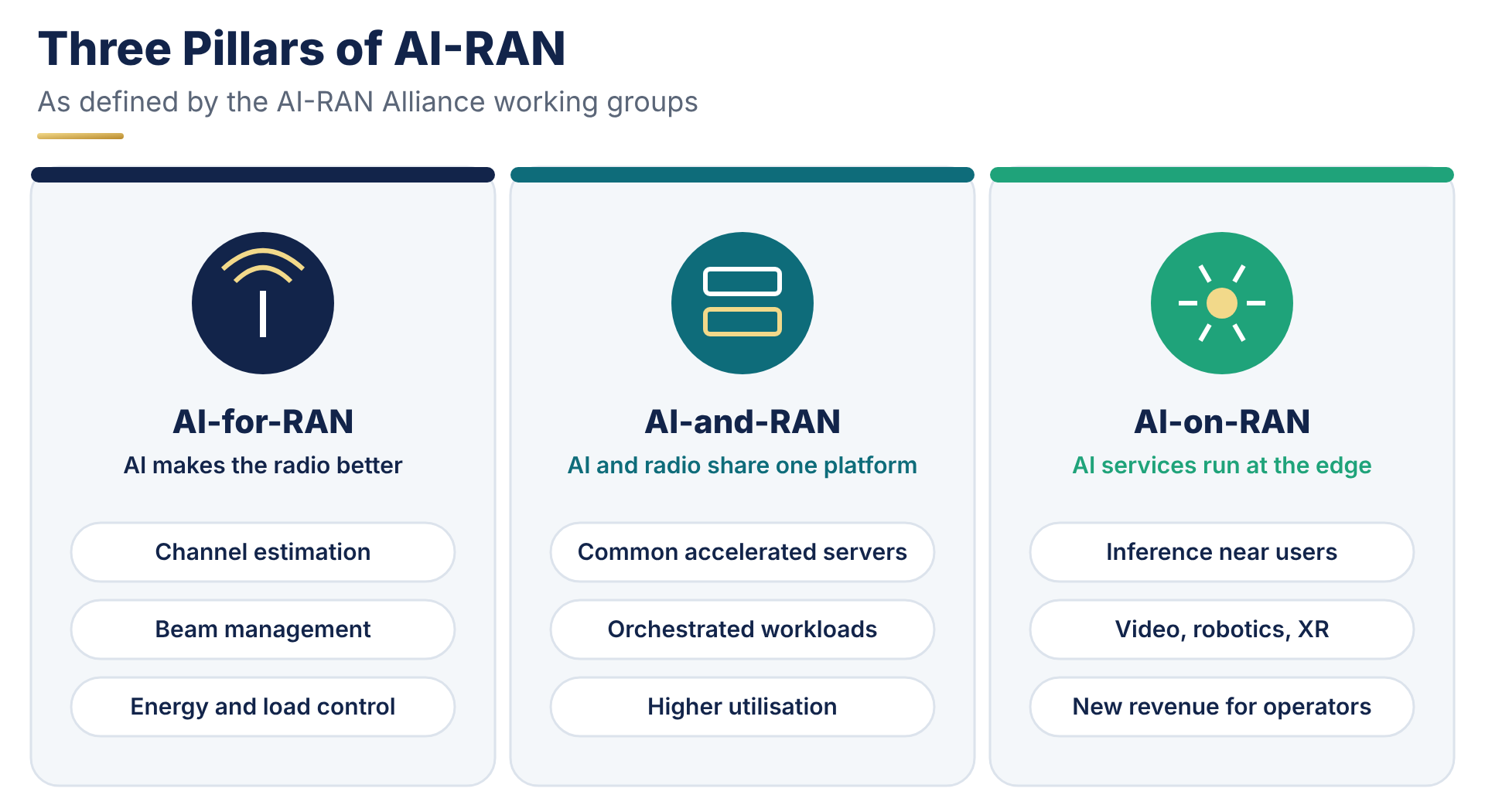
- AI-for-RAN uses AI to make the radio itself work better: channel estimation, beam management, interference handling, energy saving, and load balancing.
- AI-and-RAN lets AI applications and radio software share one computing platform, orchestrated so that both can run without harming each other.
- AI-on-RAN uses the network as a place to deliver AI services: inference close to users for video analytics, robotics, XR, and industrial control.
AI in the Air Interface
The physical layer is full of estimation problems that machine learning handles well. A base station must know the state of the radio channel to steer its beams, but measuring and reporting that channel costs overhead. A phone sweeping many beams to find the best one wastes time and energy. Positioning in a factory full of reflections defeats simple geometric methods. In each case, a model trained on real channel data can predict rather than measure, or compress rather than report in full.
| Release | What Was Done |
|---|---|
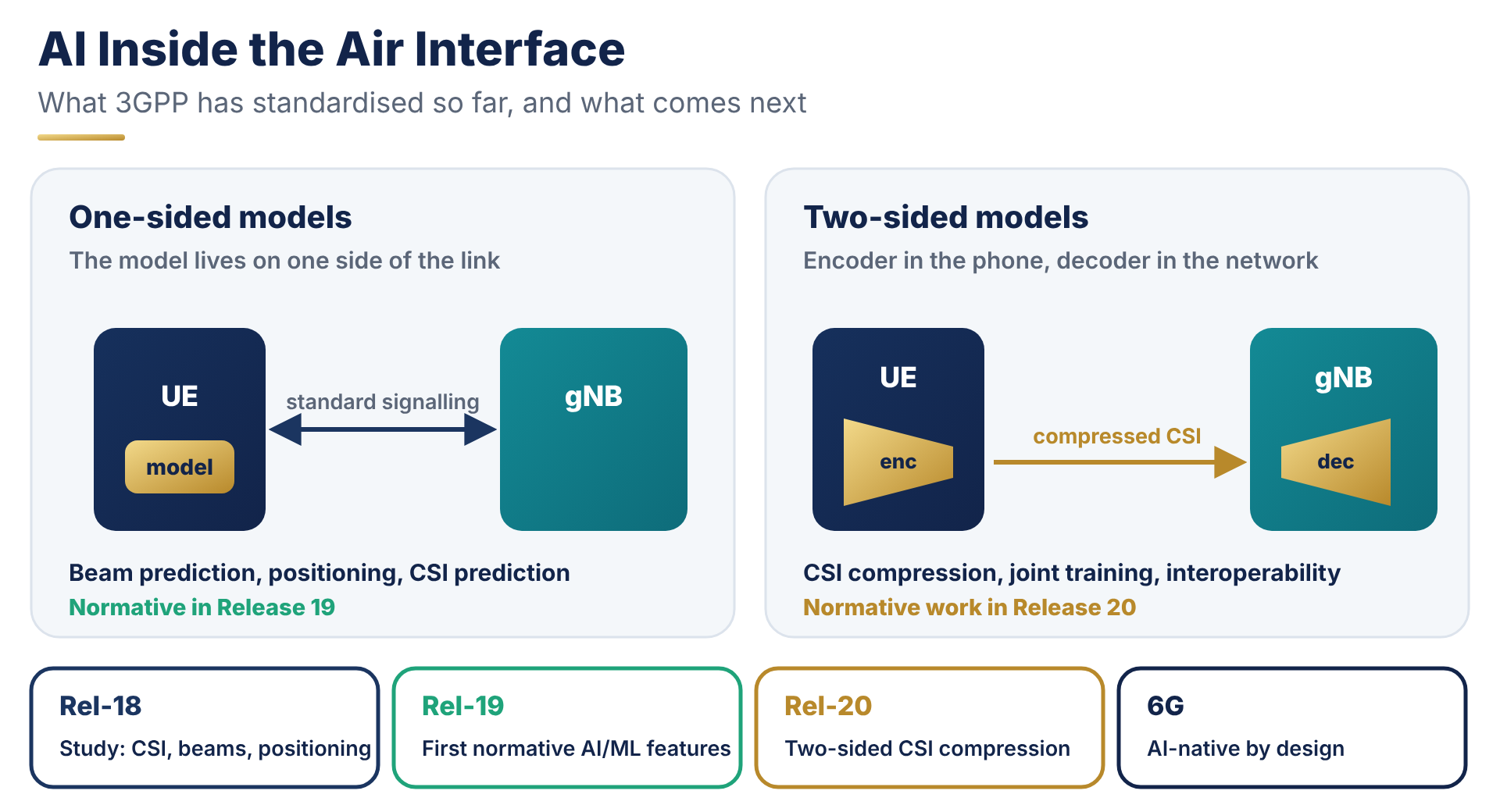
| Release 18 | Study of AI/ML for the NR air interface (TR 38.843): CSI feedback, beam management, and positioning, plus a life-cycle management framework |
| Release 19 | First normative support: a general AI/ML framework, beam management and positioning with UE-side or network-side models, and UE-side CSI prediction |
| Release 20 | Normative two-sided models for CSI compression, with an encoder in the phone and a decoder in the network, and standards-based data collection |
| 6G | AI/ML use cases collected across the physical layer during the Release 20 study, aiming for an AI-native air interface |
Standardising AI is different from standardising a formula. 3GPP does not specify the model itself. It specifies how models are identified, how data is collected, how performance is monitored, and how a device falls back to conventional methods when a model misbehaves. Two-sided models are the hardest case, because an encoder in one vendor’s phone must work with a decoder in another vendor’s base station, which raises questions of joint training, interoperability, and testing.
The Platform Shift
For most of mobile history, baseband processing ran on purpose-built silicon designed for one job. Virtualised RAN moved that software onto general-purpose servers. AI-RAN takes the next step: put accelerated computing, typically GPUs, at the cell site or in a nearby hub, run the radio software on it, and use whatever capacity is left over for AI.
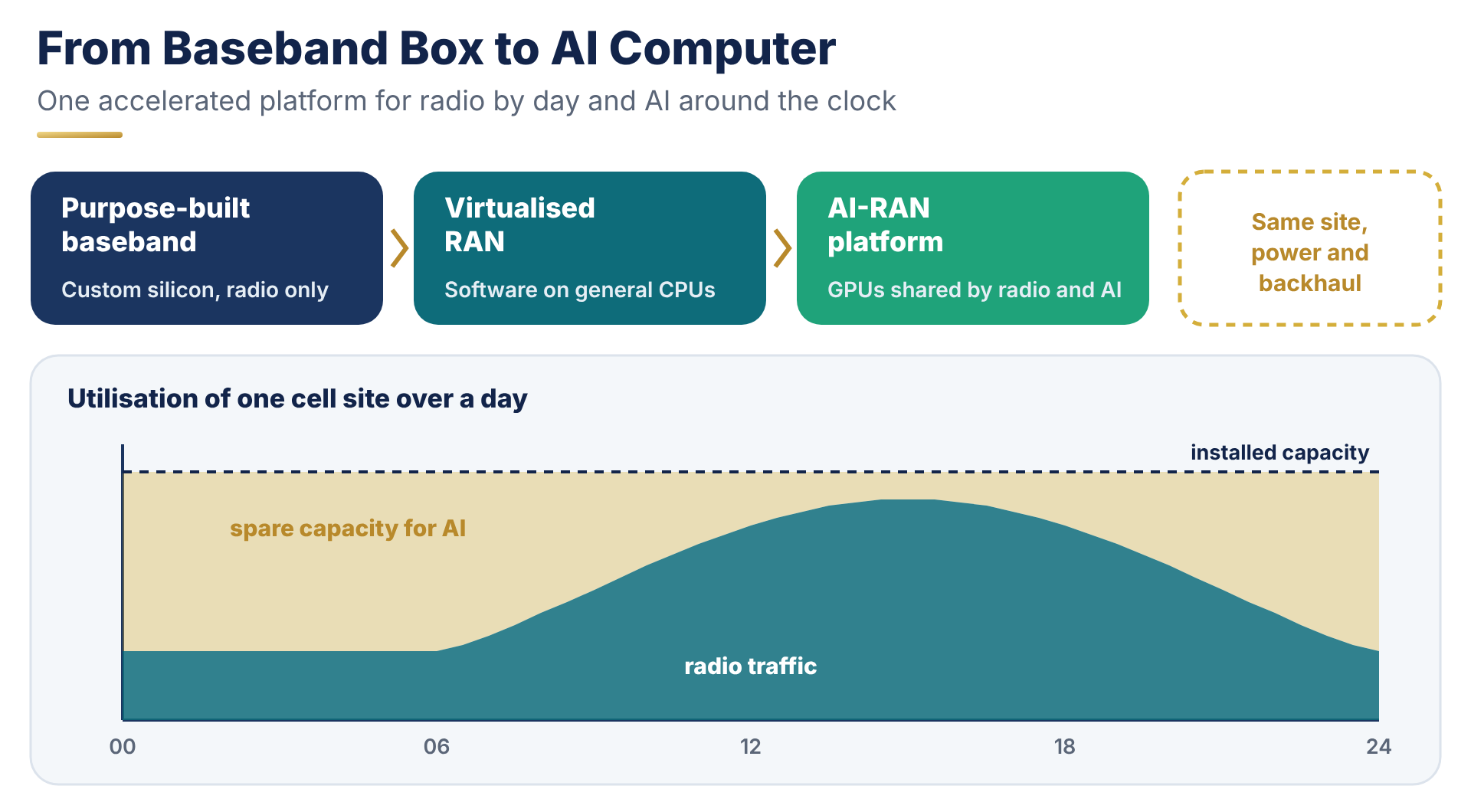
The economic argument rests on utilisation. A radio network is dimensioned for the busiest hour, so for much of the day a large share of its processing capacity is idle. If that idle capacity can serve paying AI workloads, the site earns money around the clock. The engineering argument is that the same accelerators that run AI models can also run AI-based signal processing, which makes AI-for-RAN cheaper to deploy.
Who Is Building It
The most visible push comes from NVIDIA and Nokia. In October 2025, NVIDIA announced a USD 1 billion equity investment in Nokia to accelerate AI-RAN, built on NVIDIA’s 6G-ready Aerial RAN computer platform, with T-Mobile US working with both companies to test AI-RAN as part of its 6G development. Since then, operators in Europe, Asia, and the Middle East have run proofs of concept and live trials, and by October 2026 nearly twenty operators had announced AI-RAN collaborations.
Not everyone is betting on the same hardware. Other vendors favour adding AI acceleration to their own baseband silicon or running AI on general-purpose processors, arguing that dedicated chips remain more power-efficient for everyday radio work. Analysts are nonetheless optimistic: Dell’Oro Group has projected that AI-RAN could account for about a third of the RAN market by 2029.
Hard Questions
| Question | Why It Matters |
|---|---|
| Power | GPUs must match purpose-built silicon on watts per bit for routine radio processing, not only in demos |
| Isolation | An AI workload must never degrade the radio service that is the operator’s core business |
| Demand | Edge AI is real, but much of it may land in metro data centres rather than at the cell site |
| Interoperability | Two-sided AI models need phone and network vendors to agree on training and testing |
| Data | Training needs channel data from live networks, which raises questions of ownership and privacy |
References
- AI-RAN Alliance, Vision and Mission White Paper, and working group descriptions, ai-ran.org.
- SoftBank, “AI-RAN Alliance: Leading companies and academic institution in the AI and telecom fields unite,” 2024.
- 3GPP TR 38.843, Study on Artificial Intelligence/Machine Learning for NR air interface, Release 18.
- IEEE 802.11-25/1478r1, “AI/ML activities in 3GPP,” September 2025.
- NVIDIA, “NVIDIA and Nokia to Pioneer the AI Platform for 6G,” 28 October 2025.
- “Beyond Connectivity: An Open Architecture for AI-RAN Convergence in 6G,” arXiv:2507.06911.