
5G-Advanced
The second half of the 5G era: what Releases 18, 19 and 20 add, why they matter to operators, and how they prepare the road to 6G.
- Release 18
- Release 19
- Release 20
- AI/ML
- Energy Saving
When the first 5G networks went live in 2019, the specifications behind them, Releases 15 to 17, were built around three promises: faster mobile broadband, lower latency, and connections for billions of machines. 5G-Advanced is the name 3GPP gives to everything that comes after, starting with Release 18. It does not need a new generation of spectrum or a new logo on the phone. It upgrades the same networks, mostly through software and new device capabilities, and it doubles as the bridge to 6G.
What 5G-Advanced Is
3GPP writes mobile standards in numbered releases, each a frozen package of features that vendors can implement and operators can deploy. Releases 15, 16 and 17 form the first wave of 5G. Releases 18, 19 and 20 form 5G-Advanced. Release 21 is where 6G begins.
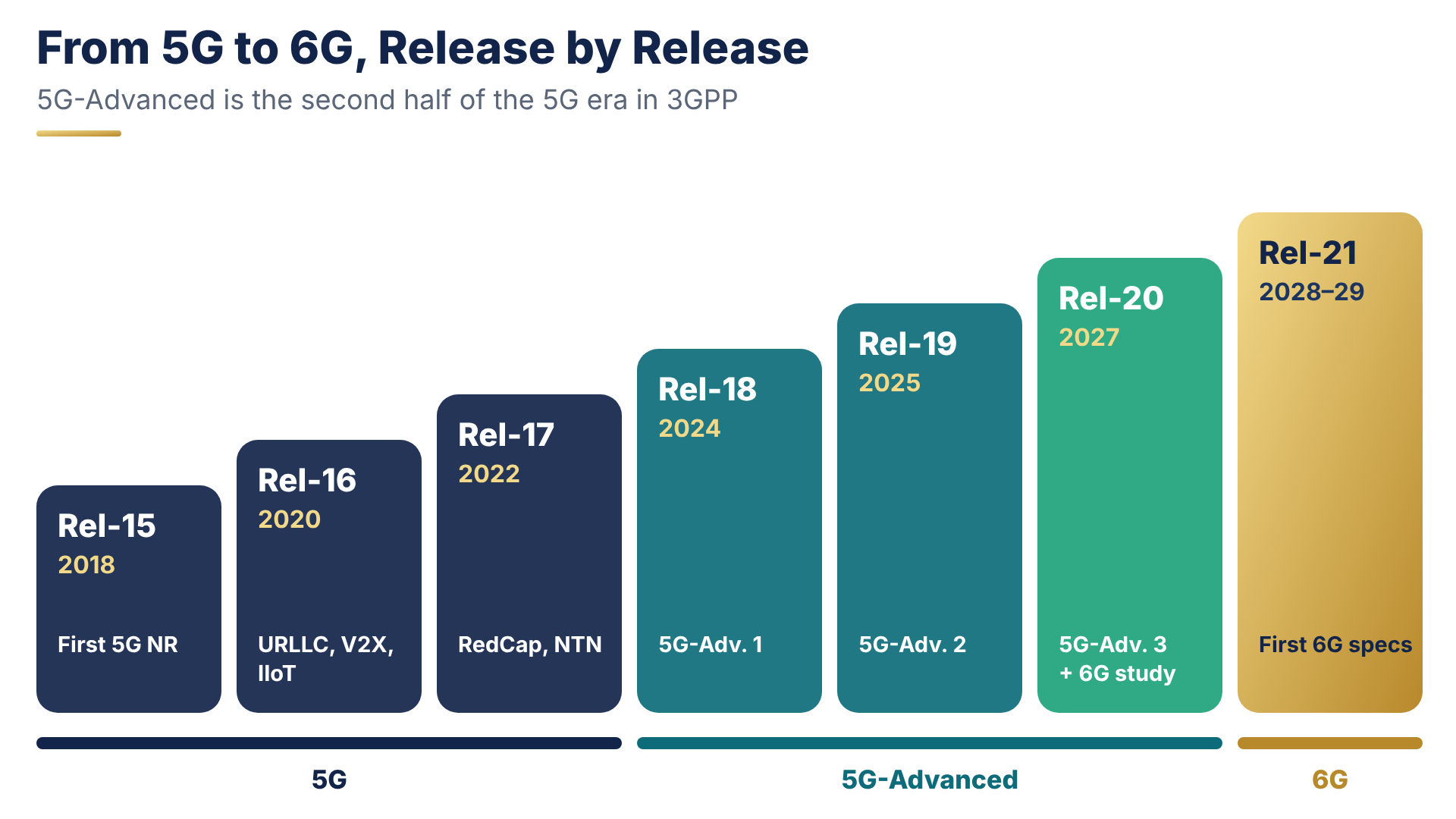
Release 18 opened the 5G-Advanced era in 2024. Release 19 completed its features in September 2025 and became stable for implementation when 3GPP froze it at the Baltimore plenary in December 2025. Release 20 is the third and final 5G-Advanced release. It runs alongside the 6G study, with its 5G-Advanced protocol work targeted for completion in 2027.
Six Directions
Across its three releases, 5G-Advanced moves in six broad directions. Each one answers a lesson operators learned from the first years of 5G.
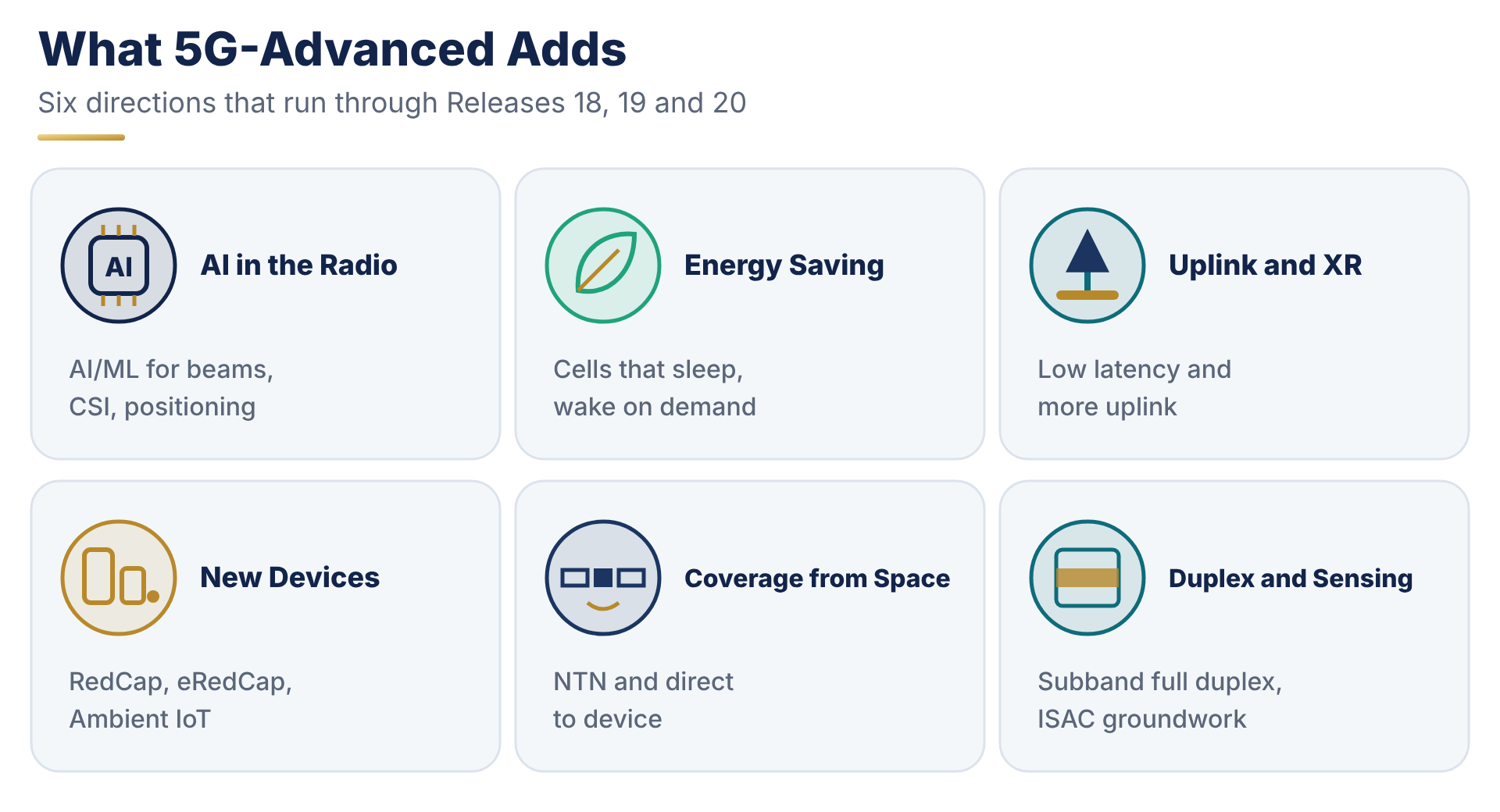
- AI in the radio. Release 18 added data collection and signalling so that the RAN can use AI for energy saving, load balancing, and mobility optimisation. It also studied AI inside the air interface itself. Release 19 made the first of those features normative, for beam management, positioning, and CSI prediction, and Release 20 adds two-sided models for CSI compression. The full story is on the AI-RAN page.
- Energy saving. Networks are dimensioned for the busiest hour but spend most of the day lightly loaded. Release 18 lets cells reduce or pause transmissions when traffic is low and introduced a barring mechanism so that older phones do not camp on cells that are saving energy. Release 19 continues this work, including low-power wake-up signalling for devices.
- Uplink and extended reality. XR, live video, and cloud gaming need steady uplink and tight latency. Release 18 made the network aware of XR traffic patterns and improved power saving and capacity for such services, and Release 19 extended this further.
- New device classes. Not every device needs a smartphone modem. RedCap (Release 17) and enhanced RedCap (Release 18) serve wearables and industrial sensors, while Ambient IoT (Release 19) brings battery-free tags that harvest energy from radio waves into the 3GPP family.
- Coverage from space. Non-terrestrial networks, first specified in Release 17, keep improving, including support for satellites that carry base-station functions on board. The commercial side of this story is in When the Sky Becomes the Cell Tower.
- Duplex and sensing. Subband full duplex lets a base station receive uplink in part of a downlink slot, and Release 19 channel modelling for integrated sensing and communication lays groundwork that 6G will build on.
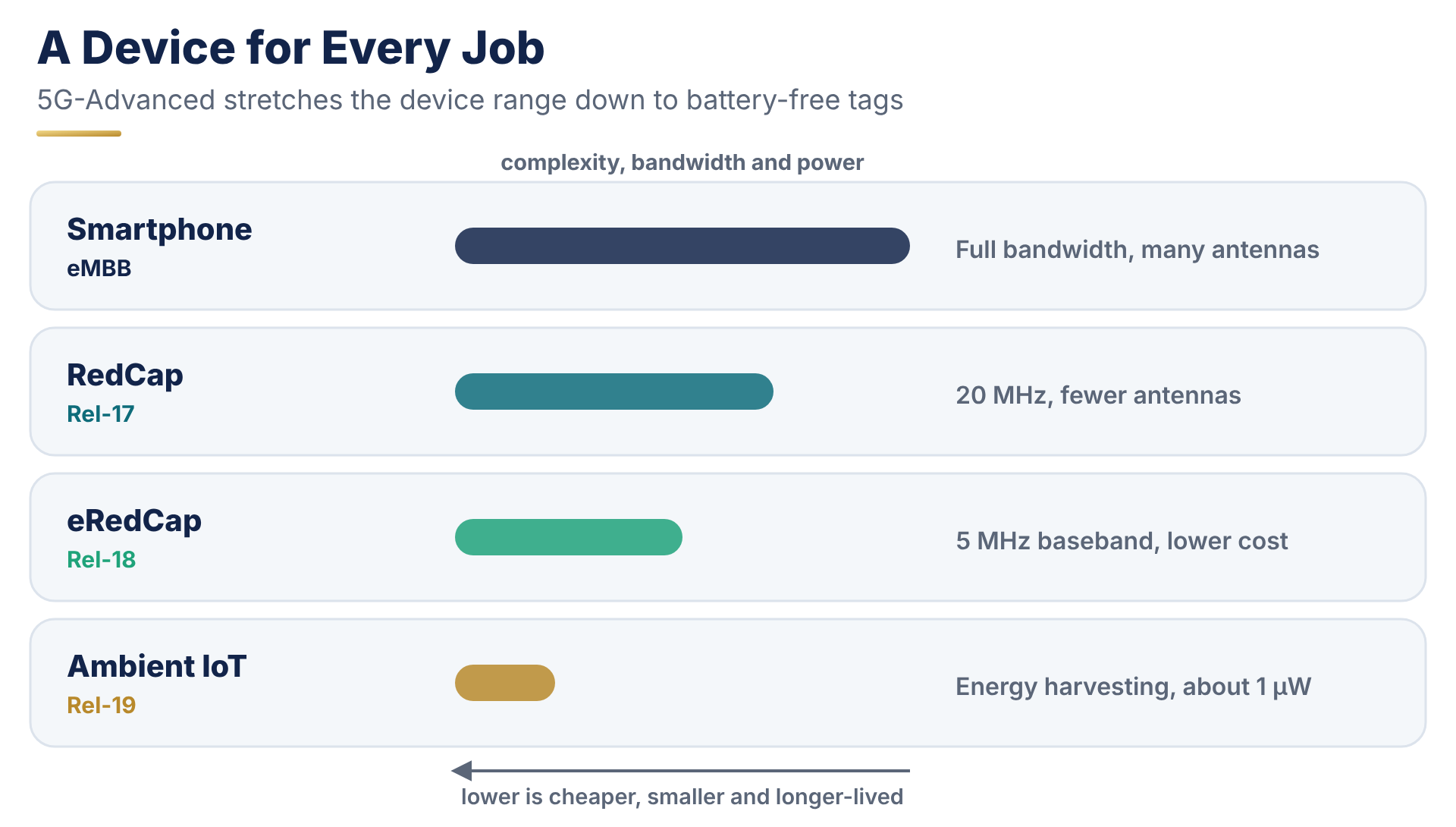
Ambient IoT deserves a closer look because it changes what a mobile network can count and track. The first Release 19 devices draw on the order of a microwatt, store harvested energy, and use a simple envelope-detection receiver. The initial focus is indoor inventory and command, which in practice means warehouses, factories, and retail shelves where barcodes and RFID readers are used today.
Subband Full Duplex
Time-division duplex networks alternate between downlink and uplink slots. With a typical pattern, a phone may wait several slots before it can transmit, which costs latency and limits uplink coverage at the cell edge. Subband full duplex reserves a slice of the carrier inside downlink slots for uplink, so the base station can listen and talk at the same time on different frequencies.
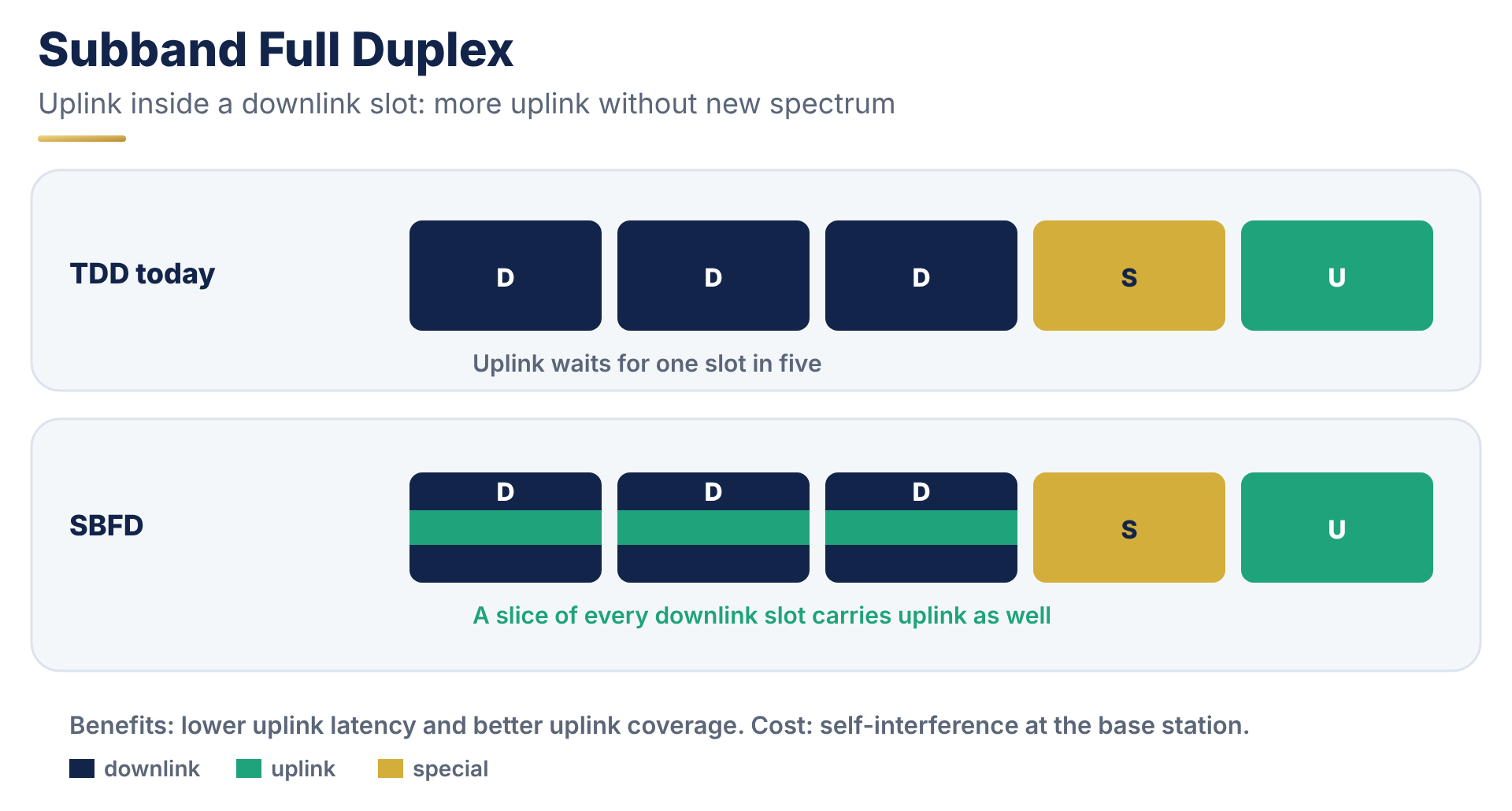
The catch is self-interference: a base station transmitting at full power must still hear a weak signal from a distant phone a few megahertz away. Making that work requires careful antenna isolation, filtering, and interference cancellation, which is why the feature arrived only after years of study.
Release by Release
| Release | Status | Highlights |
|---|---|---|
| Release 18 | Frozen in 2024 | AI/ML for NG-RAN; AI/ML air-interface study; network energy saving; XR enhancements; enhanced RedCap; NTN improvements; Layer 1 and Layer 2 triggered mobility; network-controlled repeaters |
| Release 19 | Frozen in December 2025 | Normative AI/ML for beam management, positioning and CSI prediction; MIMO evolution; subband full duplex; Ambient IoT; further energy saving and mobility; NTN evolution; XR evolution; channel modelling for sensing |
| Release 20 | 5G-Advanced work due in 2027 | Two-sided AI/ML for CSI compression and standardised data collection; Ambient IoT extensions; final 5G-Advanced refinements, alongside the 6G study |
Release 20 also introduced a discipline worth noting: no 5G-Advanced study may stretch across the whole release, so everything started must be finished within it. 3GPP is deliberately closing the 5G-Advanced chapter rather than letting it drift into the 6G years.
In the Field
China has moved fastest. By the end of 2025, 5G-Advanced service covered more than 330 cities in mainland China, with commercial launches by China Mobile, China Telecom, and China Unicom, as well as operators in Hong Kong and Macau. By the first half of 2026, China Mobile said its 5G-Advanced network entitlements had served more than 160 million users, of whom over 22 million had bought 5G-Advanced add-on packages.
The more interesting part is how operators try to earn money from it, because faster peak speeds alone did not pay for 5G:
| Approach | Example | Logic |
|---|---|---|
| Premium tiers | 5G-Advanced add-on packages | Sell a better experience, not a bigger data bucket |
| Uplink services | China Telecom Shanghai: more than 5,000 upgraded sites, up to 1 Gbps uplink | Live streaming and AI apps upload more than they download |
| Experience on the move | China Mobile on the Beijing–Shanghai high-speed railway | Guaranteed quality where users suffer most |
| Dynamic slicing | China Mobile Guangdong commercial trial in Shenzhen, October 2026 | Per-user quality on demand |
| New devices | Ambient IoT and RedCap | Revenue from things, not only people |
Not everyone is convinced. Even in China, 5G-Advanced users are still a small share of the subscriber base, and outside China most features are arriving quietly through software upgrades rather than as a branded service. That is not necessarily a weakness: an energy-saving feature that cuts the power bill pays off whether or not customers ever hear its name.
What It Means
For operators, 5G-Advanced is the most practical generation of features in years. Energy saving lowers operating costs on a network that is already built. Better uplink opens room for new services in a world where phones increasingly send video and AI prompts rather than only receiving content. New device classes widen the addressable market from people to objects.
For markets still extending 5G coverage, the order of priorities is different. Energy efficiency, uplink coverage, and non-terrestrial coverage are likely to matter more than headline speeds, and they can be adopted feature by feature as vendors deliver them.
References
- 3GPP, Highlights newsletters, issues 9 to 11 (2025), on Release 19 completion and Release 20 planning.
- FirstNet Authority via Critical Communications Review, “3GPP freezes Release 19 specifications and advances 6G standardisation efforts,” March 2026.
- X. Lin, “3GPP Evolution from 5G to 6G: A 10-Year Retrospective,” arXiv:2412.21077.
- X. Lin et al., “A Tale of Two Mobile Generations: 5G-Advanced and 6G in 3GPP Release 20,” arXiv:2506.11828.
- Ericsson, “5G Advanced: Evolution towards 6G,” white paper.
- GSMA Intelligence, The Mobile Economy China 2026, June 2026.
- Mobile World Live, reports on China Mobile 5G-Advanced subscriptions and dynamic slicing, 2026.