
Quantum Networking
How networks carry qubits, why they need a new kind of repeater, and what a quantum internet will add to the internet we already have.
- Entanglement
- Teleportation
- QKD
- Quantum Repeater
- Quantum Internet
Part 1 described qubits inside a single machine. The moment we want qubits in different places to work together, whether two quantum computers, two banks exchanging keys, or two telescopes on different continents, we need a network. That network turns out to follow rules quite unlike the ones that govern packets and routers.
What Is Quantum Networking?
A quantum network connects quantum devices so that they can share quantum states, and above all entanglement. It does not make the internet faster, and it will not replace it. It adds capabilities the classical internet cannot offer: correlations that no eavesdropper can share, and links that let separate quantum processors behave as one larger machine.
The engineering rules are different from packet networking. A qubit cannot be copied, so there is no buffering by duplication, no retransmission of the same qubit, and no optical amplifier. Reading a qubit disturbs it, so there is no inspection along the way. Photons are still lost in fibre, as they always have been. Every quantum network therefore runs on two planes at once: a quantum plane of photons and memories, and a classical plane that carries control messages, success signals, and measurement results.
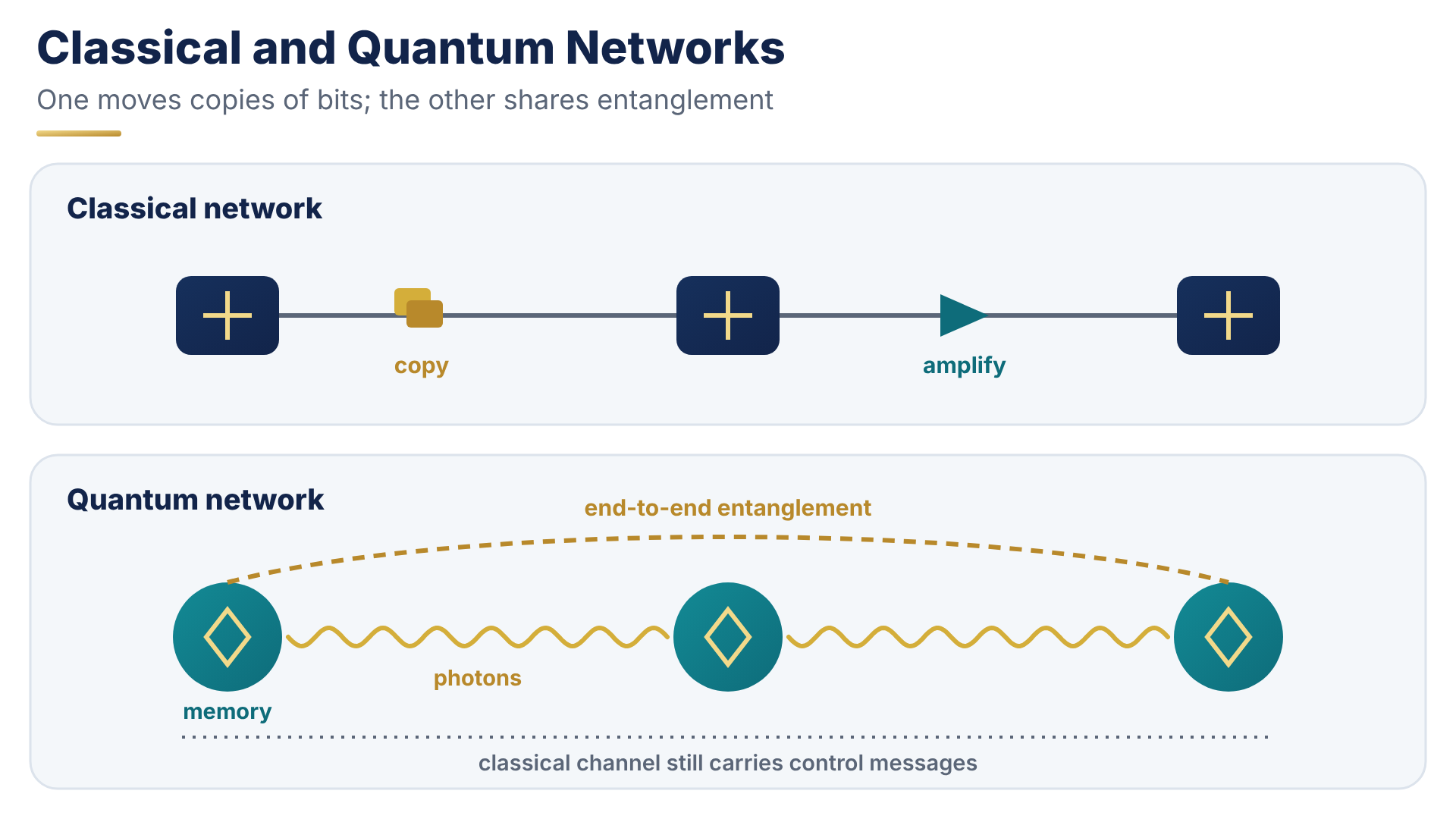
| Aspect | Classical Internet | Quantum Network |
|---|---|---|
| Carries | Bits in packets | Qubits, mostly as entangled pairs |
| Copy or amplify | Routine | Forbidden by physics |
| Handling loss | Retransmit, amplify, regenerate | Herald success, store in memory, retry |
| Delivers | Data | Shared entanglement, consumed by applications |
| Main uses | Everything digital | Secure keys, linked quantum computers, sensing, timing |
How It Works
Flying Qubits and Stationary Qubits
Photons are the only practical way to move quantum information over distance, so they act as flying qubits. For fibre, they need to sit in the telecom bands around 1,310 or 1,550 nanometres, where loss is lowest, which often requires converting their frequency on the way in and out. At each node, information is handed to stationary qubits: trapped atoms or ions, defects in diamond, or rare-earth crystals that can hold a quantum state long enough for the rest of the network to catch up.
Heralded Entanglement
Two nodes each emit a photon entangled with their own memory and send it towards a station in the middle. When the two photons meet and the detectors click in the right pattern, the memories at the two ends become entangled with each other, even though they never interacted directly. Most attempts fail because photons are lost, but the click heralds every success, so the nodes know exactly when they hold a usable pair.
Teleportation
Once two nodes share an entangled pair, they can move any qubit between them without sending the qubit itself. The sender performs a joint measurement, called a Bell measurement, on the qubit and on her half of the pair, then sends the two-bit result over an ordinary classical channel. The receiver applies one of four corrections and ends up with the original state.
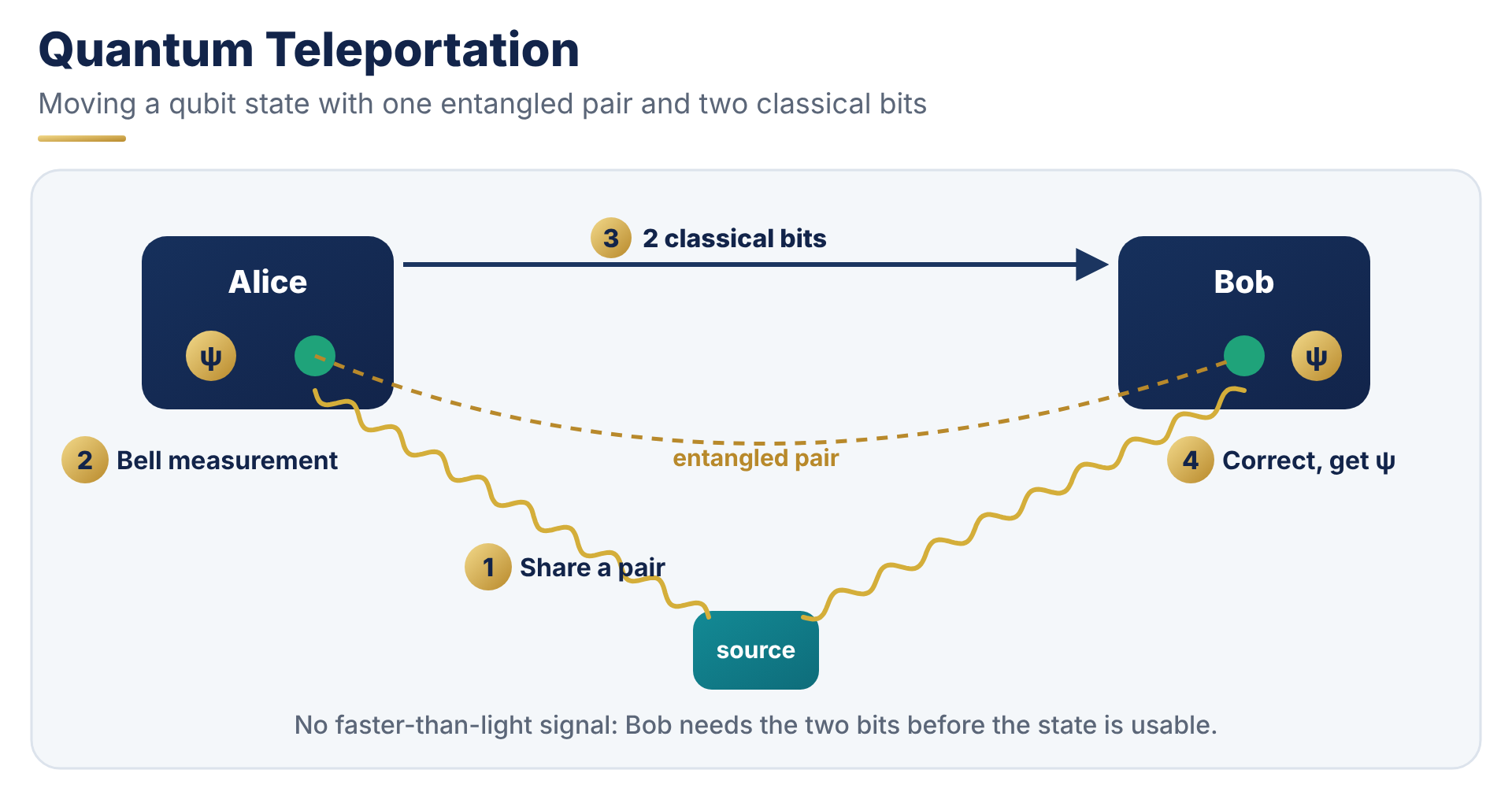
Two details keep teleportation honest. Nothing travels faster than light, because the receiver cannot use the state until the two classical bits arrive. And the original is destroyed in the process, which is exactly what the no-cloning theorem demands. Seen this way, a quantum network is really a machine for producing high-quality entanglement on demand, with teleportation as the universal way to spend it.
Quantum Key Distribution
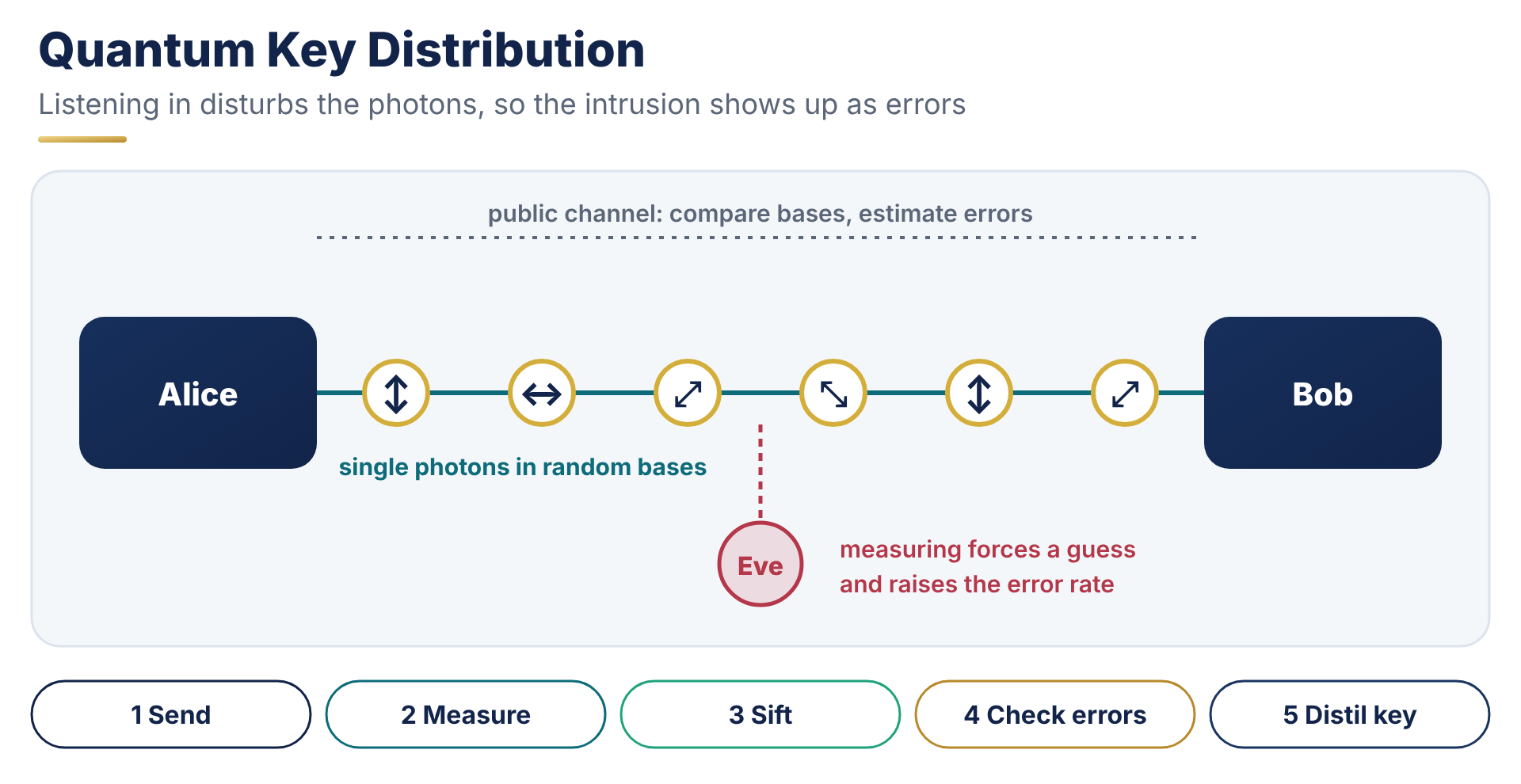
The first quantum network application to reach the field is quantum key distribution (QKD). In the BB84 protocol, proposed by Charles Bennett and Gilles Brassard in 1984, the sender encodes random bits in single photons using randomly chosen bases. The receiver measures in random bases too, and the two then compare, over a public channel, which bases they used, never the bit values. Anyone who intercepts the photons must guess the basis, and every wrong guess introduces errors that the two parties can detect. If the error rate is low enough, they distil a shared secret key.
QKD is already deployed. China operates a Beijing–Shanghai backbone of about 2,000 kilometres with 32 trusted nodes. Its Micius satellite linked China and Austria across 7,600 kilometres in 2017, and in March 2025 the Jinan-1 microsatellite set a record of 12,900 kilometres between China and South Africa, generating 1.07 million secure bits during a single pass over Stellenbosch. A stronger variant, device-independent QKD, which does not even require trusting the equipment, was demonstrated over 11 kilometres of fibre in 2026.
Quantum Repeaters
Good telecom fibre loses about 0.2 dB per kilometre at 1,550 nanometres. Over 100 kilometres, only one photon in a hundred survives. Over 1,000 kilometres, the figure drops to one in 1020: a source emitting ten billion photons per second would deliver roughly one photon every three centuries. Classical networks solved this a century ago with amplifiers and regenerators, but amplifying a qubit would mean copying it, and physics forbids that.
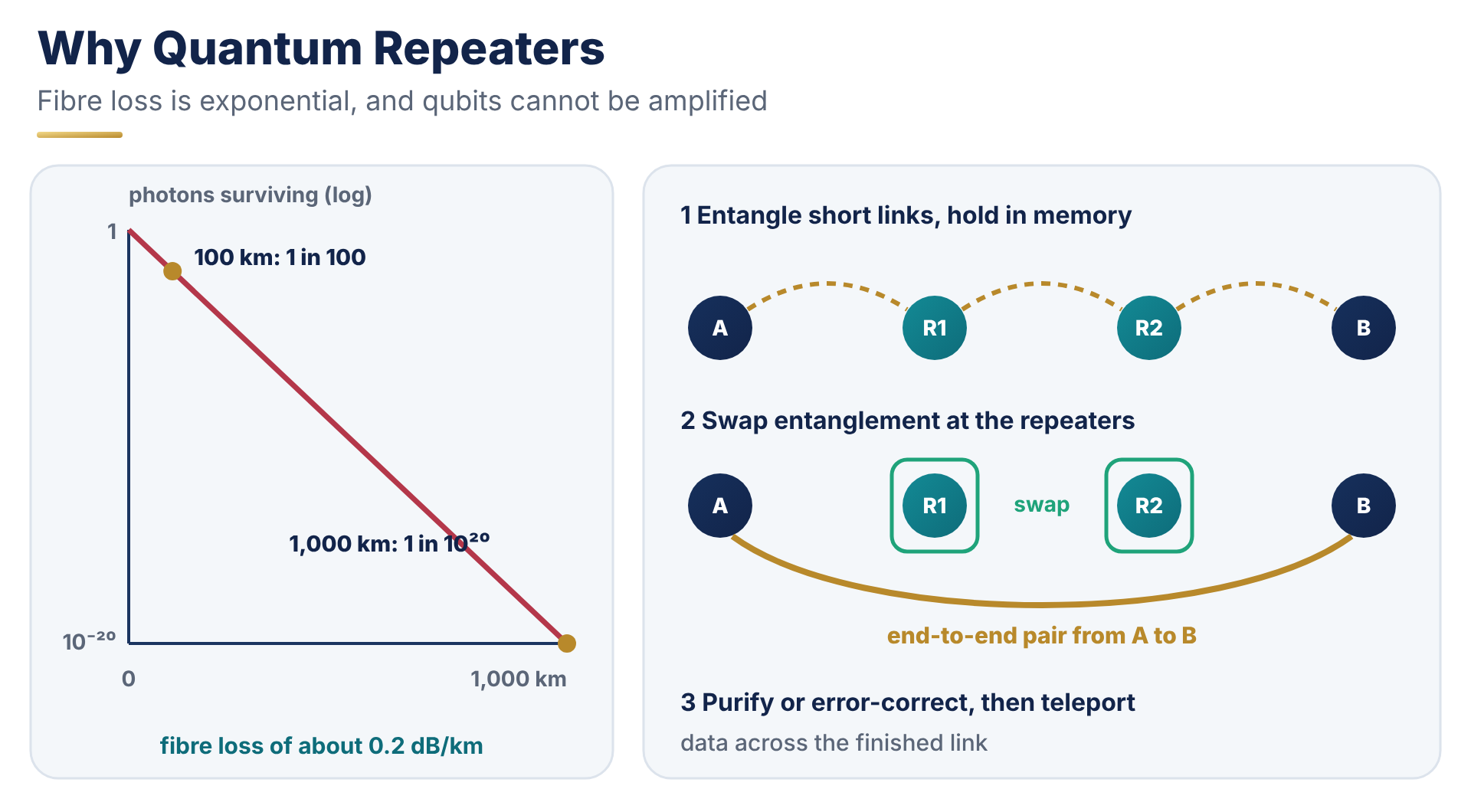
A quantum repeater solves the problem in three steps. First, it creates entanglement across short links, each well within the reach of a photon, and stores each half in a quantum memory until its neighbours are ready. Second, it performs entanglement swapping: a Bell measurement on the two memories it holds turns two short pairs into one longer pair, without any qubit travelling the whole distance. Third, because every swap adds noise, it purifies or error-corrects the pairs to restore their quality. The finished end-to-end pair can then carry a teleported qubit or a key.
Researchers describe three generations. The first uses heralded entanglement and purification, and needs two-way classical signalling between nodes. The second adds error correction to the transmitted qubits. The third is fully error-corrected and works one way, much like a classical relay, at the cost of far more demanding hardware. A trusted node in today’s QKD networks is not a quantum repeater: it decrypts and re-encrypts the key, so it must be trusted, whereas a true repeater never learns the secret.
| Year | Who and Where | What Was Shown |
|---|---|---|
| 2024 | QuTech, Delft and The Hague | Heralded entanglement between diamond-spin quantum processors 10 km apart, over 25 km of deployed fibre (Science Advances). |
| 2024 | Harvard and AWS, Boston | Entanglement of two silicon-vacancy memory nodes through a 35 km fibre loop under the city, with storage lasting about a second (Nature). |
| 2025 | University of Oxford | First distributed quantum algorithm: a logic gate teleported between two ion-trap modules linked by photons (Nature). |
| 2026 | Cisco and Qunnect, New York | Entanglement swapping across 17.6 km of standard telecom fibre beneath the city, synchronised with White Rabbit timing. |
| 2026 | USTC, China | A multi-mode quantum relay network entangling two solid-state memories 14.5 km apart, with 78.6% fidelity (Nature Photonics). |
| 2026 | Trapped-ion repeater node | A single repeater node spanning 17 km of city fibre, reaching 81.6% Bell-state fidelity (preprint, October 2026). |
The Quantum Internet
A quantum internet is the long-term destination: a network that can deliver entanglement between any two quantum devices on Earth, on demand, as easily as today’s internet delivers packets. Stephanie Wehner, David Elkouss, and Ronald Hanson described the path in 2018 as six stages, each of which unlocks new applications without waiting for the final one.
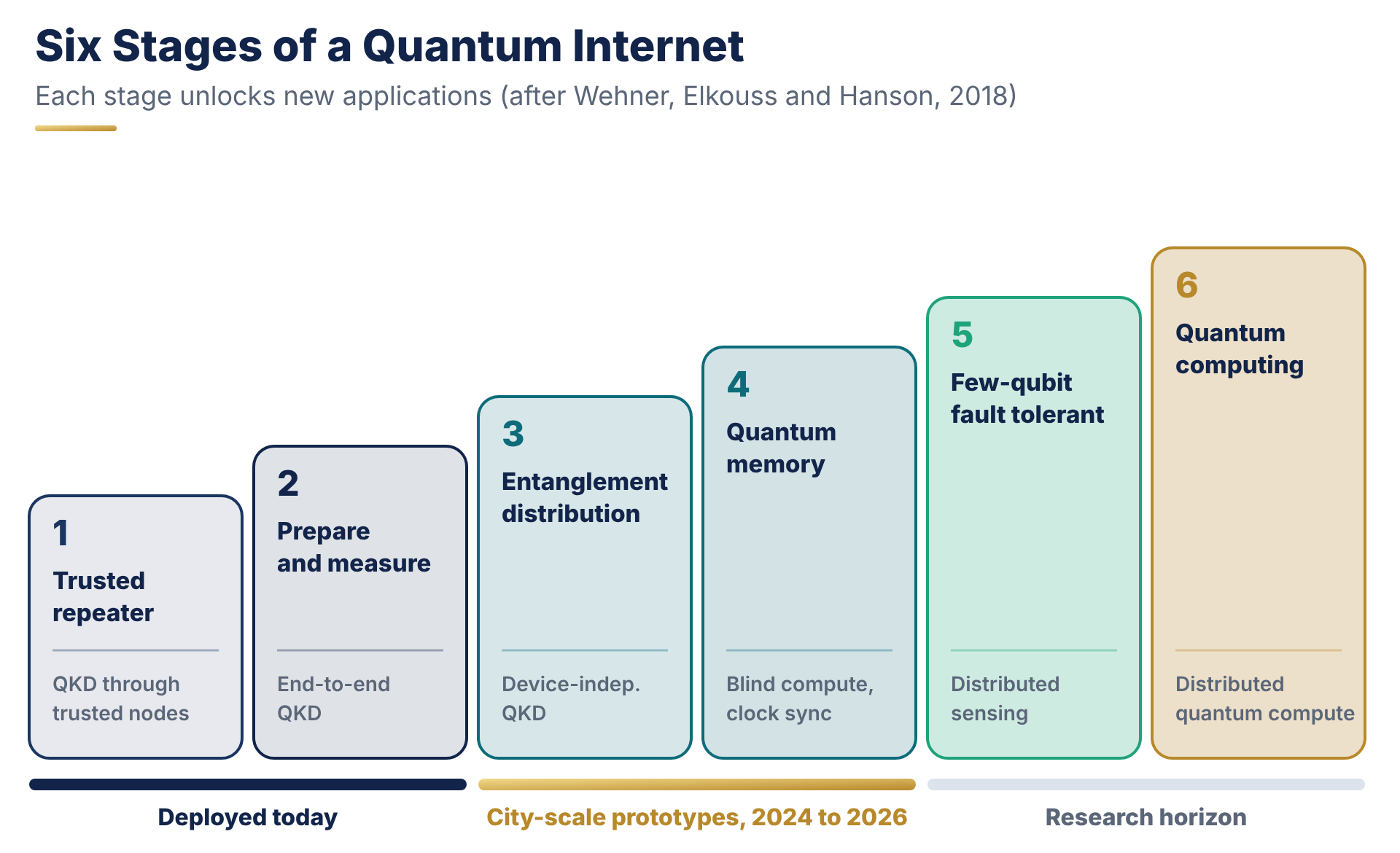
What will it be used for? The best-understood applications are already clear:
- Secure communication with device-independent QKD, where security holds even if the equipment is untrusted.
- Blind quantum computing, in which a user runs a program on a remote quantum server that learns neither the input, the computation, nor the result.
- Distributed quantum computing, linking modest processors into a larger machine. Many in the field expect the largest quantum computers to be built this way, which makes the data-centre interconnect the first real quantum network.
- Clock synchronisation and sensing, using entanglement to compare atomic clocks more precisely or to combine distant telescopes into one instrument with a planet-sized baseline.
The architecture will be hybrid. Fibre will carry entanglement across cities and regions, and satellites will bridge continents and oceans. Above the physics, the familiar questions of network engineering return: addressing, routing, resource scheduling, and a protocol stack. Work on these is under way in the IRTF Quantum Internet Research Group, in Europe’s Quantum Internet Alliance and EuroQCI programme, and in industry efforts such as Cisco’s quantum networking stack.
Examples and Outlook
Concrete examples already span the full range from deployed service to laboratory milestone:
- Government and financial links protected by QKD over metropolitan fibre and trusted-node backbones, with satellite links between distant sites.
- City testbeds in Boston, Delft and The Hague, New York, and Chinese cities, running quantum links over fibre that is already in the ground.
- Modular quantum computers, in which photonic links join separate processors, as Oxford demonstrated in 2025.
- Satellite quantum links, now shrinking from a large research satellite to a fridge-sized microsatellite paired with portable ground stations.
For network operators, the outlook is less distant than it may seem. Low-loss fibre, rights of way, data-centre sites, and precise timing infrastructure are exactly the assets a quantum network needs. For an archipelago spanning thousands of kilometres of sea, the satellite route shown by Jinan-1 is particularly relevant, because it reaches places that fibre-based repeater chains cannot yet reach economically.
Further Reading and References
- R. Van Meter, Quantum Networking, Wiley-ISTE, 2014.
- S. Wehner, D. Elkouss, R. Hanson, “Quantum internet: A vision for the road ahead,” Science 362, 2018.
- S. Muralidharan et al., “Optimal architectures for long distance quantum communication,” Scientific Reports 6, 2016.
- A. J. Stolk et al., “Metropolitan-scale heralded entanglement of solid-state qubits,” Science Advances, October 2024.
- C. M. Knaut et al., “Entanglement of nanophotonic quantum memory nodes in a telecom network,” Nature 629, May 2024.
- D. Main et al., “Distributed quantum computing across an optical network link,” Nature 638, February 2025.
- Y. Li et al., “Microsatellite-based real-time quantum key distribution,” Nature, March 2025.
- Cisco and Qunnect, entanglement swapping over New York City fibre, February 2026; USTC, Xinghan-2 multi-mode quantum relay network, Nature Photonics, 2026.