
Quantum Computing
What a qubit is, how engineers build one, what quantum machines can and cannot do, and why they already matter for security and industry.
- Qubits
- Superposition
- Entanglement
- Error Correction
- Post-Quantum Cryptography
Classical computers carried us from switching exchanges to 5G cores by manipulating bits, billions of times per second. Quantum computers do not replace that machinery. They add a different kind of processor, one that follows the rules of quantum mechanics, and for a narrow but important set of problems those rules work as a shortcut that no amount of classical hardware can match.
This page builds the idea from the ground up and then follows it into hardware, applications, security, and industry. Its companion, Quantum Networking, takes the same ideas onto the network.
Bit vs Qubit
A bit is a switch. At any moment it is either 0 or 1, we can read it without changing it, and we can copy it as often as we like. Every digital system, from a base station to a smartphone, is ultimately an enormous number of such switches working together.
A qubit is a two-level quantum system: the spin of an electron, two energy levels of an atom, or the polarisation of a single photon. Its state is written as |ψ⟩ = α|0⟩ + β|1⟩, where α and β are complex numbers called amplitudes. Before it is measured, the qubit is not secretly 0 or secretly 1. It is in a superposition described by both amplitudes at once. When we measure it, we obtain 0 with probability |α|² or 1 with probability |β|², and the superposition is gone.
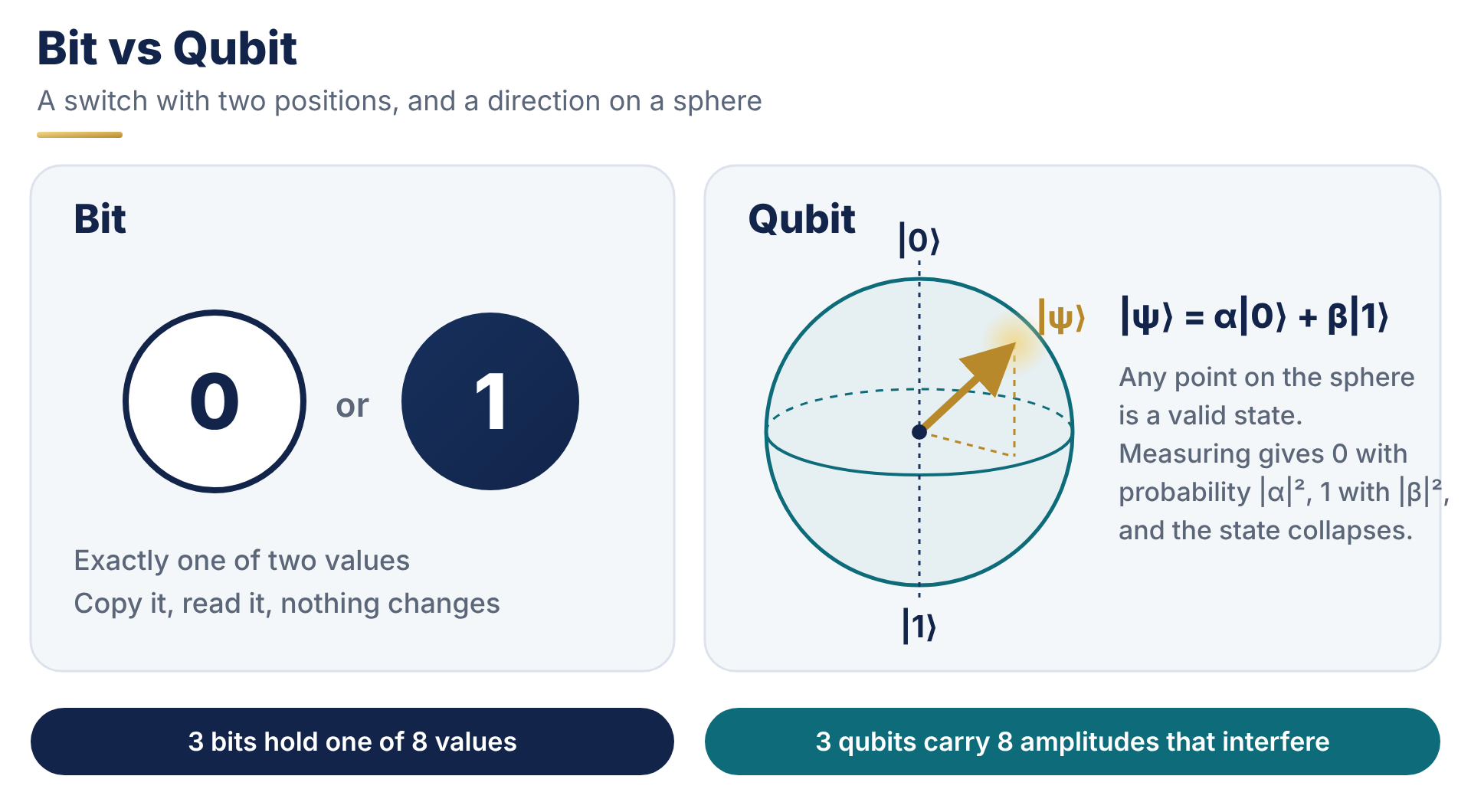
Three properties make qubits useful. None of them amounts to “trying every answer at once,” a popular description that misleads more than it explains.
- Superposition. A register of n qubits is described by 2n amplitudes. Fifty qubits already need about 1015 numbers to describe exactly, and three hundred qubits need more numbers than there are atoms in the observable universe.
- Interference. Amplitudes behave like waves. A quantum algorithm is a carefully designed choreography in which the paths leading to wrong answers cancel out and the paths leading to the right answer reinforce each other.
- Entanglement. Two or more qubits can share a joint state that cannot be described one qubit at a time. Measuring one reveals something about the other, however far apart they are, although this can never be used to send a message faster than light.
There is a price for all of this. Measurement destroys superposition, and the no-cloning theorem forbids making a copy of an unknown quantum state. These two facts make quantum computers difficult to build. As Part 2 explains, they are also exactly what makes quantum communication secure.
| Aspect | Bit | Qubit |
|---|---|---|
| State | 0 or 1 | α|0⟩ + β|1⟩, any point on the Bloch sphere |
| Reading | Does not change the value | Collapses the state to 0 or 1 |
| Copying | Free and unlimited | Impossible for an unknown state (no-cloning) |
| n units describe | One of 2n values | 2n amplitudes that interfere |
| Typical error | Practically negligible in logic | About 1 in 1,000 per two-qubit gate on today’s best hardware |
Making a Qubit
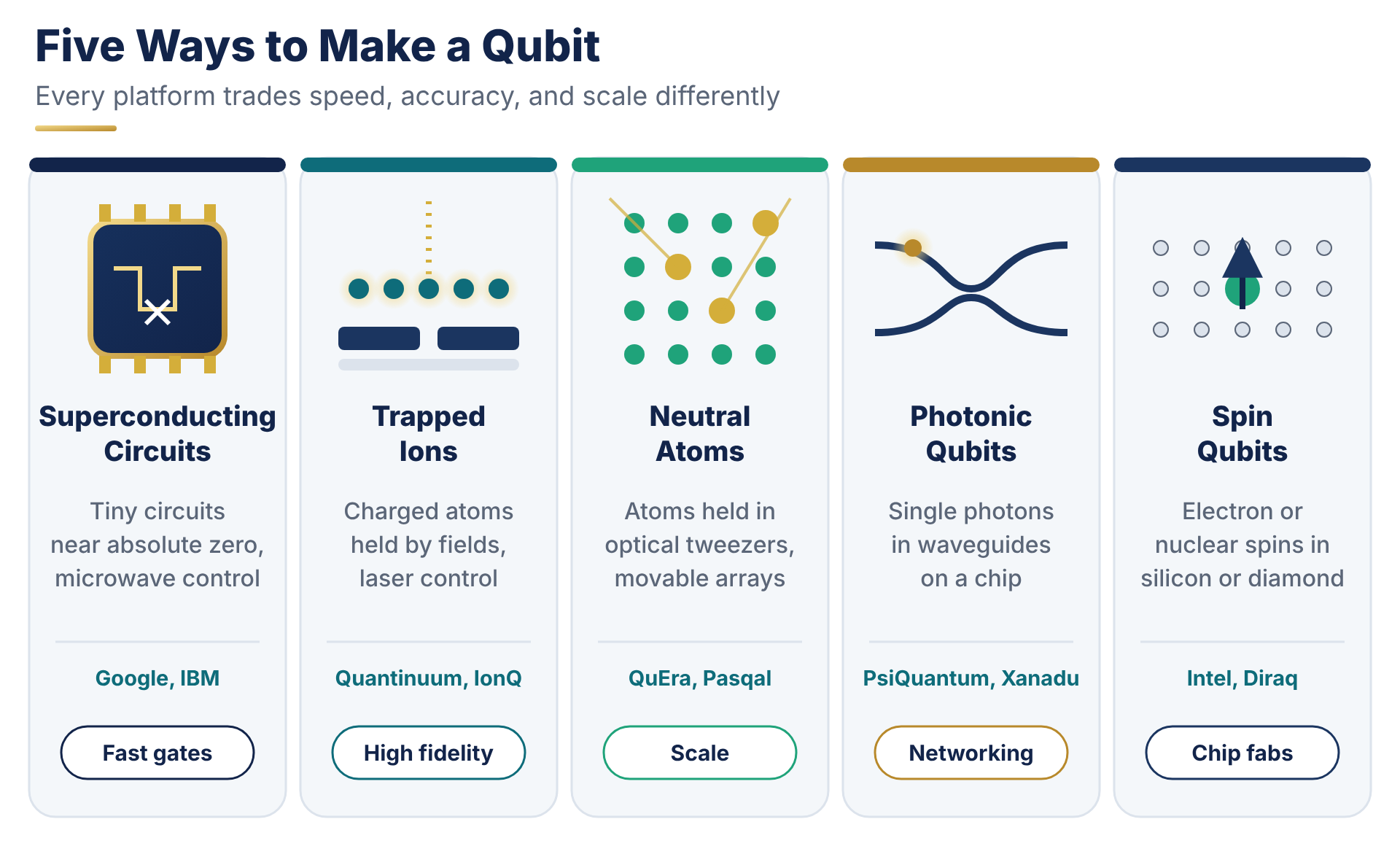
Any physical system with two distinguishable, controllable states can in principle serve as a qubit. In practice an engineer needs five things: qubits that can be initialised, controlled precisely, coupled to one another, kept isolated long enough to finish a computation, and read out reliably. These requirements pull in opposite directions. Isolation protects the qubit from noise, while control and readout require us to touch it. Every hardware platform is a different compromise between the two.
| Platform | How It Works | Recent Milestone |
|---|---|---|
| Superconducting circuits | Tiny aluminium or niobium circuits with Josephson junctions, cooled to about 10 millikelvin in a dilution refrigerator and driven by microwave pulses. | Google’s 105-qubit Willow chip (December 2024) showed errors falling as the error-correcting code grew. IBM plans its first fault-tolerant module, Kookaburra, in 2026. |
| Trapped ions | Single charged atoms held in vacuum by electric fields; lasers or microwaves perform the gates. | Quantinuum’s Helios (November 2025) has 98 barium-ion qubits with 99.921% two-qubit gate fidelity. |
| Neutral atoms | Uncharged atoms held by focused laser beams called optical tweezers, entangled through highly excited Rydberg states, and movable during a computation. | Caltech assembled 6,100 atomic qubits in one array (2025), keeping them in superposition for about 13 seconds. |
| Photonic qubits | Single photons travelling through waveguides, with information carried in path, time, or polarisation. | Natural partners for networking; the engineering challenge is photon loss and probabilistic gates. |
| Spin qubits | The spin of an electron or nucleus in silicon quantum dots or in defects in diamond. | Can reuse semiconductor fabrication; diamond defects are leading candidates for network memories. |
A sixth path, topological qubits, aims to build protection against errors into the physics itself. Microsoft announced its Majorana 1 chip in February 2025, although the scientific community is still debating how far that approach has progressed.
Physical Qubits and Logical Qubits
Even the best physical qubits fail roughly once in every thousand operations, while useful algorithms need billions of operations. The answer is quantum error correction. One logical qubit is spread across many physical qubits, and helper qubits are measured continuously to reveal whether an error has occurred, without ever revealing the data itself.
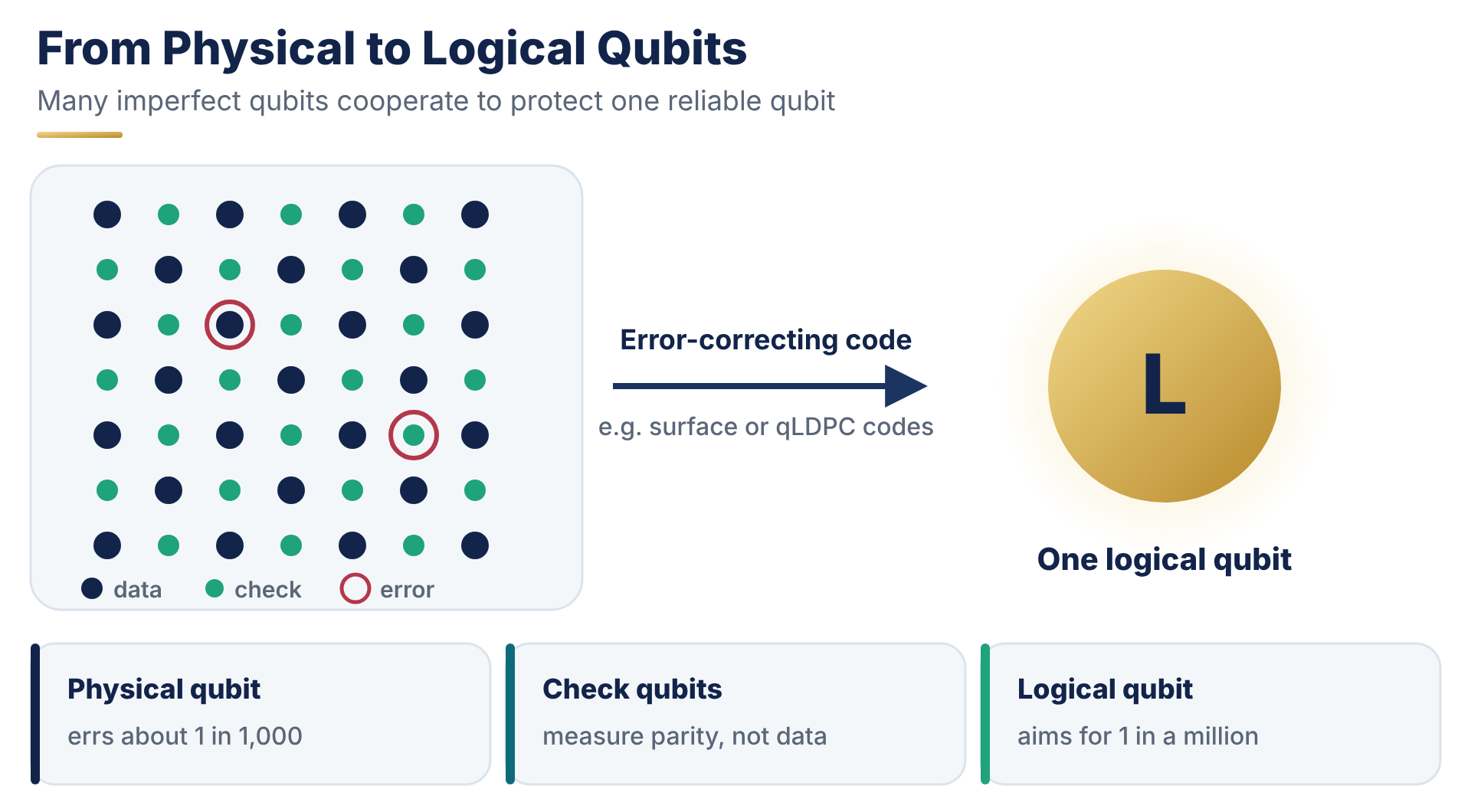
2026 is the year this moved from promise to practice. In July, IBM and the University of Chicago reported a computation on 70 logical qubits, with 2,415 logical two-qubit operations and 468 logical T gates, completed in about fifteen minutes and presented as quantum advantage on error-corrected circuits. In October, Quantinuum reported a logical fidelity of 99.9995% on Helios, with logical errors shrinking by a factor of twelve at each step up in code size. The overhead is also falling: IBM’s quantum LDPC codes aim to cut the number of physical qubits per logical qubit by up to 90% compared with the familiar surface code.
Applications in Technology
A quantum computer is best understood as an accelerator, in the same way a GPU accelerates graphics and AI. The quantum processing unit (QPU) sits beside classical CPUs and GPUs that prepare circuits, optimise parameters, decode error-correction data, and interpret results. Almost every useful workload today is a hybrid loop between the two.
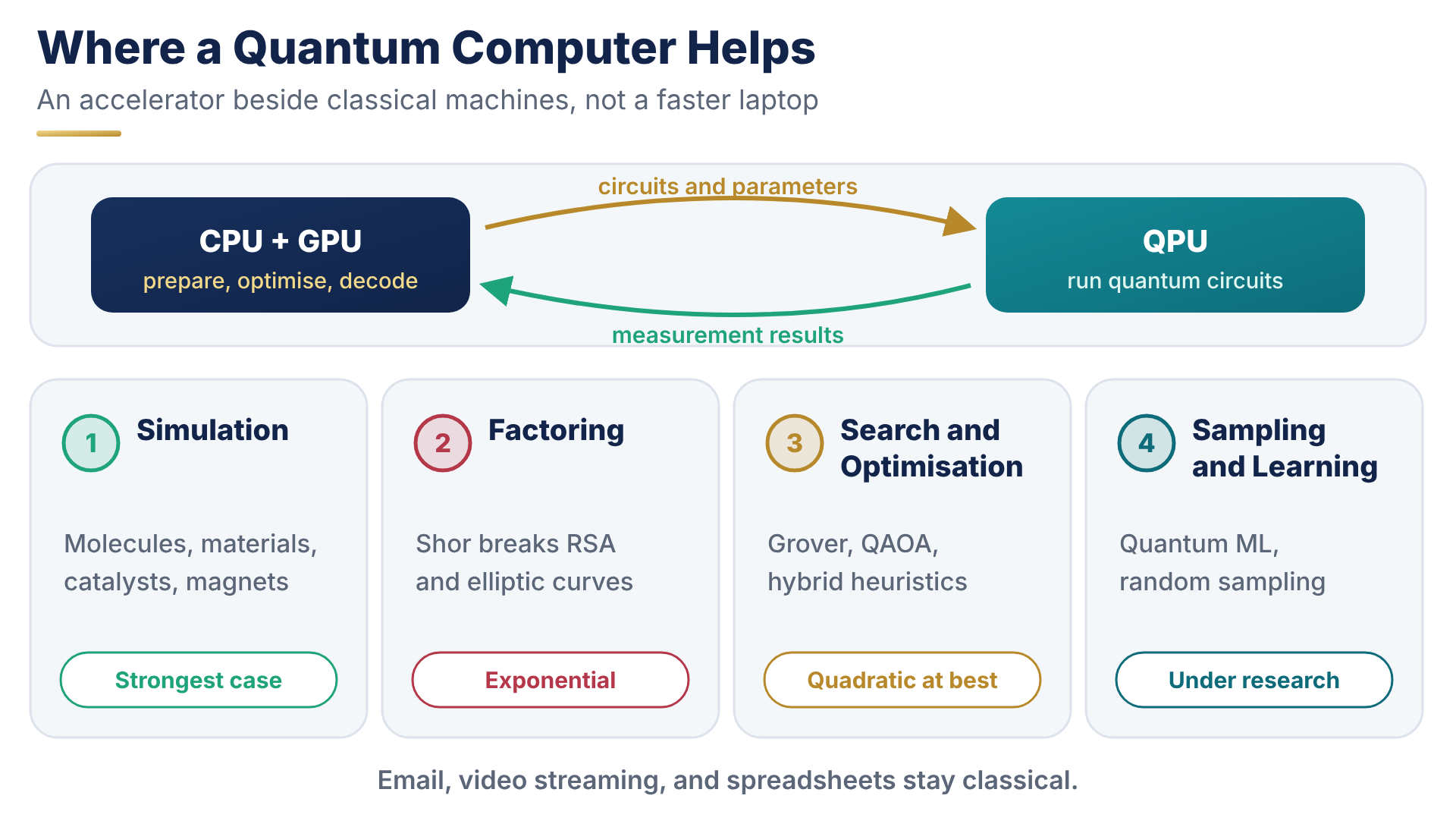
- Simulating nature. This was Richard Feynman’s original motivation: molecules and materials obey quantum mechanics, so a quantum machine is the natural tool to model them. In October 2025, Google ran its Quantum Echoes algorithm on Willow, a verifiable computation that ran 13,000 times faster than the best classical method on one of the world’s fastest supercomputers, and linked it to the kind of molecular structure data that NMR spectroscopy measures.
- Factoring and discrete logarithms. Shor’s algorithm (1994) solves these problems exponentially faster than any known classical method. That single result is why the security section below exists.
- Search and optimisation. Grover’s algorithm searches an unstructured list of N items in about √N steps, a quadratic rather than exponential gain. Hybrid heuristics such as QAOA target scheduling and routing problems, but a clear advantage at commercial scale has not yet been demonstrated.
- Sampling and machine learning. An active research field. Loading large classical datasets into quantum states is a bottleneck, so the strongest candidates are problems whose data is already quantum in nature.
Equally important is what a quantum computer will not do. It will not run an operating system, stream video, or make ordinary software faster. Most computing stays classical. The realistic picture, and the one IBM’s own roadmap now uses, is quantum processors working alongside high-performance computing, each doing what it does best.
Security Aspects
Almost every secure connection on the internet begins with public-key cryptography: RSA, elliptic-curve signatures, and Diffie–Hellman key exchange. Their security rests on factoring and discrete logarithms, exactly the problems Shor’s algorithm solves. Symmetric ciphers such as AES and hash functions such as SHA-2 face only Grover’s quadratic speed-up, so AES-256 and SHA-384 or larger remain comfortable.
How large a machine would break RSA-2048? The estimates keep falling. In 2012 the figure was about a billion physical qubits. In 2019, Craig Gidney and Martin Ekerå brought it down to 20 million noisy qubits running for eight hours. In May 2025, Gidney showed that fewer than one million noisy qubits running for under a week would be enough. No such machine exists yet, but the gap between what is needed and what is being built is closing from both directions.
The risk does not start on the day such a machine is switched on. An adversary can record encrypted traffic today and decrypt it later, a strategy known as harvest now, decrypt later. Michele Mosca’s rule makes the timing concrete: if the years your data must stay secret (x) plus the years you need to migrate (y) exceed the years until a cryptographically relevant quantum computer exists (z), then you are already exposed.
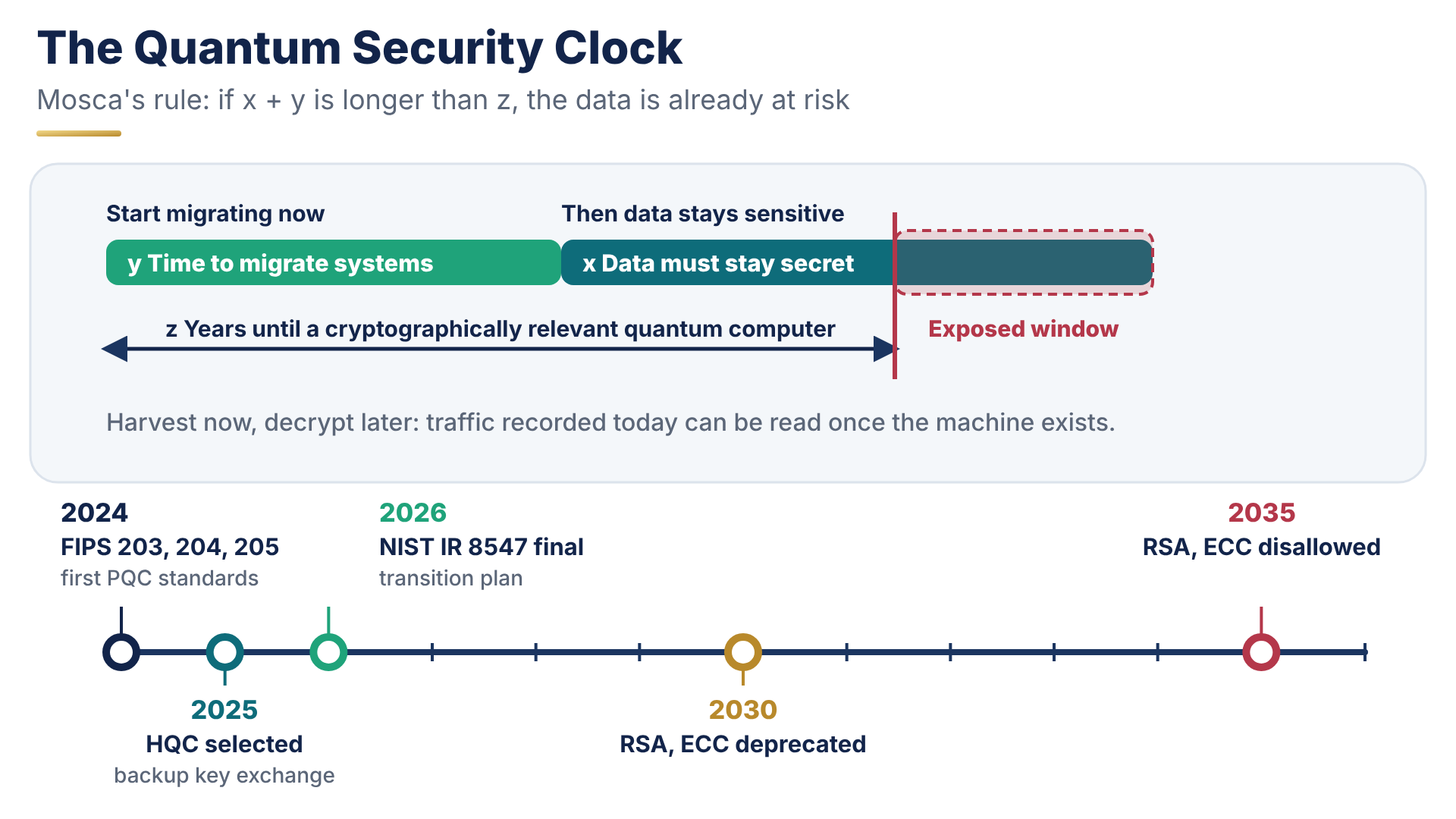
The replacement already exists. NIST published its first three post-quantum standards on 13 August 2024: FIPS 203 (ML-KEM) for key establishment, and FIPS 204 (ML-DSA) and FIPS 205 (SLH-DSA) for digital signatures. In March 2025 it selected HQC, a code-based algorithm, as a backup key-establishment scheme, and the FALCON-based FN-DSA is being prepared as FIPS 206. On 27 October 2026, NIST finalised IR 8547, its transition plan: quantum-vulnerable public-key algorithms are deprecated after 2030 and disallowed after 2035, now at every key size.
| Used Today | Purpose | Post-Quantum Replacement |
|---|---|---|
| RSA, ECDH | Key exchange | ML-KEM (FIPS 203); HQC as a backup |
| RSA, ECDSA, EdDSA | Signatures | ML-DSA (FIPS 204), SLH-DSA (FIPS 205), FN-DSA (FIPS 206, forthcoming) |
| AES | Bulk encryption | Keep; prefer AES-256 for long-lived data |
| SHA-2, SHA-3 | Hashing | Keep, with larger output sizes |
Applications in Industry
Early value is appearing where the underlying problem is hard for classical computers to model: chemistry, risk, and combinatorial planning. Most of today’s results are pilots and proofs of concept, but they are increasingly run on real data.
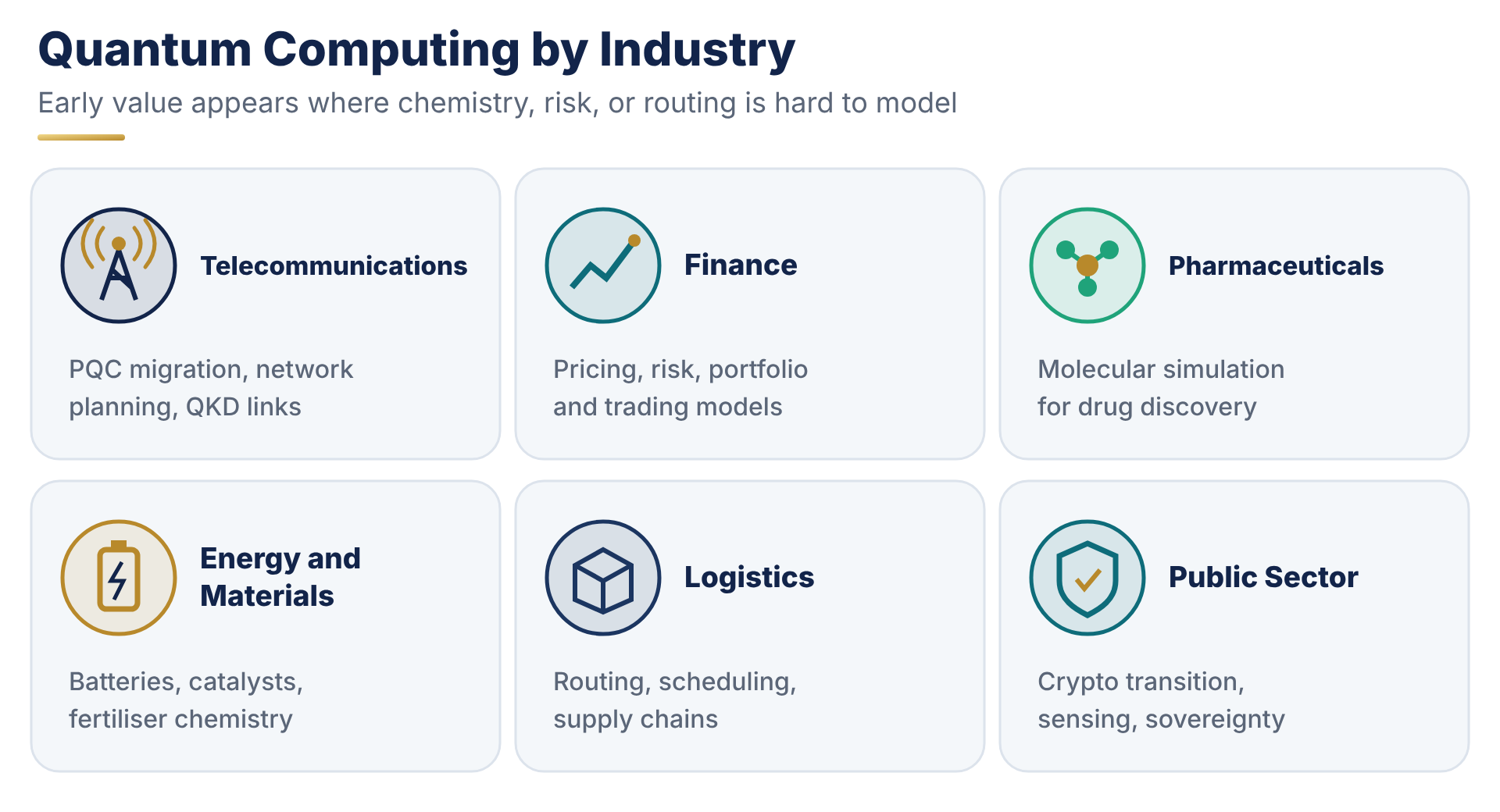
- Telecommunications. The most urgent quantum task for operators is defensive: the post-quantum migration described above. Further out lie network planning and spectrum optimisation, and the operator’s role in carrying quantum networks, the subject of Part 2.
- Finance. Pricing, risk, and portfolio models are natural candidates. In September 2025, HSBC and IBM reported that a hybrid quantum-classical method improved predictions of whether a corporate bond trade would be filled at a quoted price by up to 34%, using production-scale data and IBM Heron processors.
- Pharmaceuticals. Simulating how a candidate drug binds to its target, and calculating reaction energies more precisely than classical approximations allow.
- Energy and materials. Better battery electrolytes, catalysts for cleaner fertiliser production, and new materials for solar cells, all of which are quantum-mechanical problems at heart.
- Logistics and manufacturing. Routing, scheduling, and supply-chain planning, where hybrid algorithms are being tested against strong classical solvers.
- Public sector. Leading the cryptographic transition, protecting long-lived state secrets, and building national capability in a strategic technology.
References
- Google Quantum AI, “Our Quantum Echoes algorithm is a big step toward real-world applications for quantum computing,” October 2025.
- Quantinuum, “Helios: A 98-qubit trapped-ion quantum computer,” arXiv:2511.05465, November 2025; logical fidelity announcement, 19 October 2026.
- IBM and University of Chicago, quantum advantage on logical circuits, IBM Newsroom, 30 July 2026; IBM Quantum roadmap to Starling, June 2025.
- H. Manetsch et al., “A tweezer array with 6100 highly coherent atomic qubits,” Nature, 2025.
- C. Gidney, “How to factor 2048 bit RSA integers with less than a million noisy qubits,” arXiv:2505.15917, May 2025.
- NIST, FIPS 203, 204 and 205 (August 2024); HQC selection, NIST IR 8545 (March 2025); NIST IR 8547, Transition to Post-Quantum Cryptography Standards, final (October 2026).
- HSBC, “HSBC demonstrates world’s first-known quantum-enabled algorithmic trading with IBM,” 25 September 2025.