
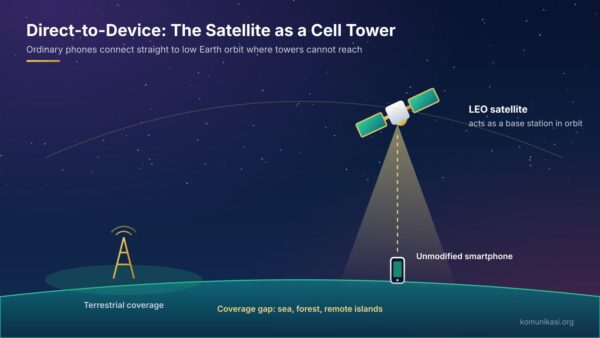
For most of the history of mobile networks, coverage was a matter of geography and economics. You built towers where people lived, where roads ran, and where the business case closed. Everywhere else, the phone simply showed no signal. That assumption is now being challenged from a few hundred kilometres up.
Direct-to-device satellite service, often called D2D or direct-to-cell, connects an ordinary smartphone straight to a satellite in low Earth orbit. No dish, no special handset, no separate subscription to a satellite phone company. The satellite behaves, as far as the phone is concerned, like a very tall and very fast-moving base station.
From Demo to Daily Service
What has changed over the past year is that D2D left the laboratory. T-Mobile in the United States launched its T-Satellite service with Starlink in the summer of 2025, starting with messaging. In September 2025, SpaceX agreed to buy EchoStar’s AWS-4 and H-block spectrum licences in a deal worth about 17 billion dollars, a clear signal that it wants to own dedicated mobile satellite spectrum rather than borrow it from terrestrial partners.
The competing approach comes from AST SpaceMobile, whose BlueBird satellites carry some of the largest commercial antenna arrays ever placed in orbit. The company received its FCC authorisation earlier this year, absorbed the loss of one satellite, and in early August began direct-to-cellular operations in Japan together with Rakuten Mobile. Its partners in the United States, including AT&T and Verizon, are preparing their own services on top of the same constellation.
Why This Matters Beyond the Headlines
The engineering is genuinely hard. A satellite moving at roughly seven and a half kilometres per second has to close a link budget with a handset antenna designed for a tower a few kilometres away, while managing Doppler shift and very short visibility windows. The fact that this now works with unmodified phones, standardised through the non-terrestrial network (NTN) work in 3GPP, is the real breakthrough.
The business model is equally interesting. D2D does not replace terrestrial networks; it fills their gaps. The most natural customers are not city dwellers but fishermen, plantation workers, hikers, and emergency responders. Early services focus on messaging, and broadband-class throughput depends on the next generation of satellites and on how spectrum is shared between operators and satellite providers.
An Archipelago Perspective
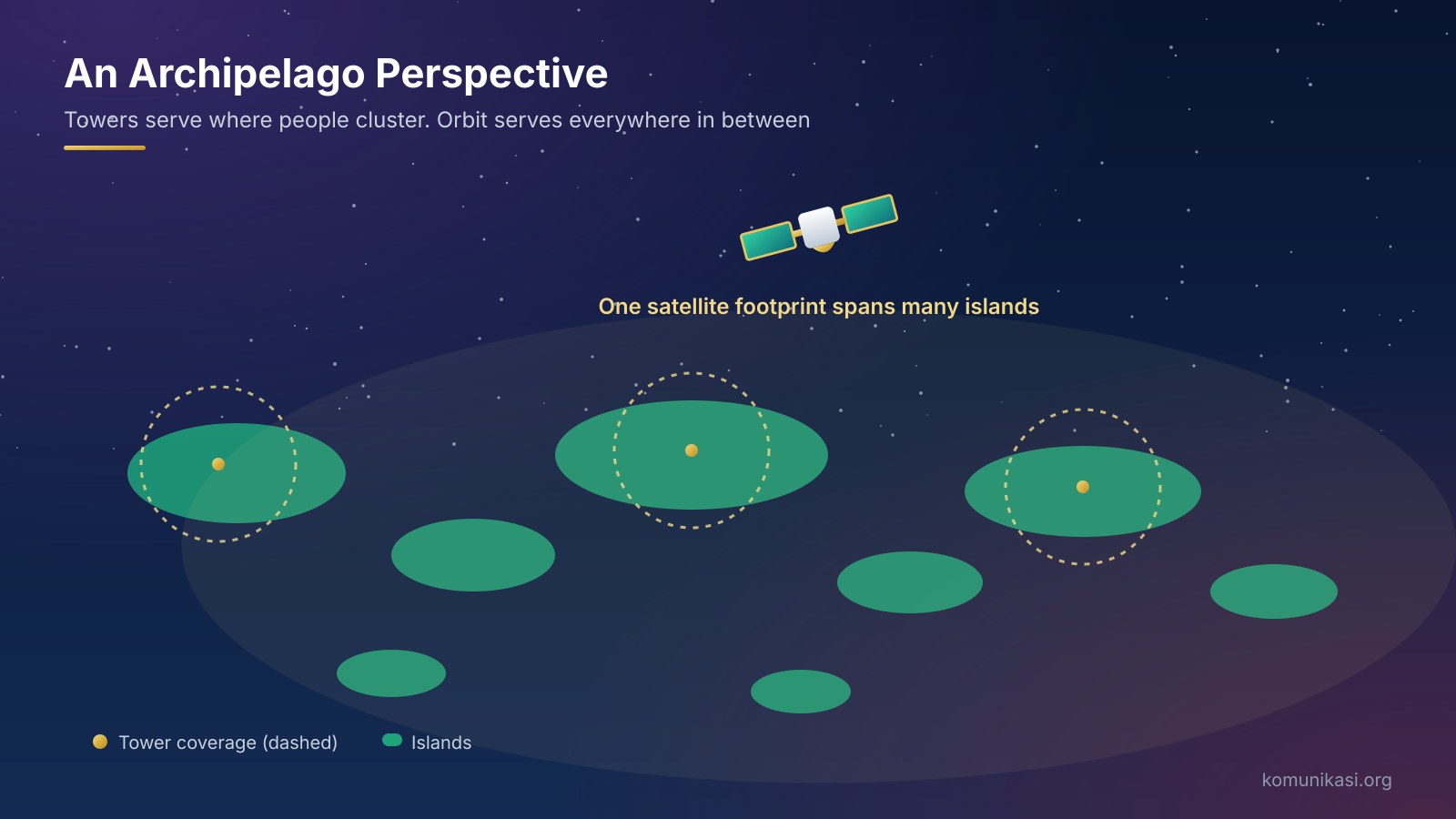
For Indonesia, with more than seventeen thousand islands and a long coastline, the implications are obvious. A meaningful share of our territory will never justify a fibre-fed tower. If D2D matures, the question shifts from “where should we build?” to “how do we integrate the sky into our national coverage strategy?” That includes spectrum policy, landing rights, lawful interception, and how revenue is shared between local operators and global constellations.
The industry has spent four decades extending the network outward from the city. D2D extends it downward from orbit. The two will meet somewhere in the middle, and the operators that plan for that meeting now will be in a much stronger position than those that treat satellites as someone else’s business.